La France insoumise program analysis, Digi Mart USA News: The La France insoumise (LFI) presented its presidential program on November 7, containing more than 1,000 measures. Party leader Jean-Luc Mélenchon has said he would apply “the program, the whole program” if elected.
Political scientist Rémi Lefebvre, a specialist in LFI, says the platform has tripled in size since 2017, when it contained fewer measures, and now totals 1,069. He argues the catalogue resembles a societal project more than a government roadmap and would be difficult to implement within a five-year term.
LFI has not yet published cost estimates for its proposals.
Lefebvre notes that LFI does not have a majority in the National Assembly and would need to negotiate compromises with other left-wing parties to govern. He also says that the Socialist Party and the Greens have programs of their own, and that the left-wing deputies share roughly 80 percent of the same positions in parliament.
The main differences, he says, concern foreign policy and Europe.
According to Lefebvre, the LFI program is not anticapitalist in the strict sense. He describes it as radical social democracy that accepts the market economy while proposing strong state regulation, higher public spending and redistribution.
He says it is less far-reaching than François Mitterrand’s 1981 program in terms of nationalizations.
Among the most left-leaning social and economic proposals are capping pay gaps within companies at a ratio of 1 to 20 and limiting inheritances to a maximum of 12 million euros. The proposed minimum wage would rise to 1,700 euros net per month, from 1,477 euros today.
The program also backs a “Zucman tax” of 2 percent on large fortunes, which the broader left supports. On pensions, LFI proposes abolishing the Macron pension reform and the retirement age of 64, while also referring to retirement at 60, a position Lefebvre says is unclear.
Ecology now forms the first chapter of the program. LFI calls for 100 percent renewable energy by 2060, ten years later than the target it set for 2050 in the previous presidential campaign, which would delay the definitive exit from nuclear power by a decade.
Lefebvre says LFI has dropped the option of leaving the European Union, which it previously called “plan B,” but advocates disobeying EU rules it considers obstructive and threatens to reduce France’s contribution to the bloc.
On the Israeli-Palestinian conflict, Lefebvre says the LFI program shows a strong focus on the issue, which shapes its wider foreign policy, including its approach to Ukraine. He says LFI has moved from supporting a two-state solution to considering an egalitarian binational state.
On Ukraine, he says Mélenchon does not condemn the Russian aggression and maintains that a diplomatic framework is needed for a ceasefire.
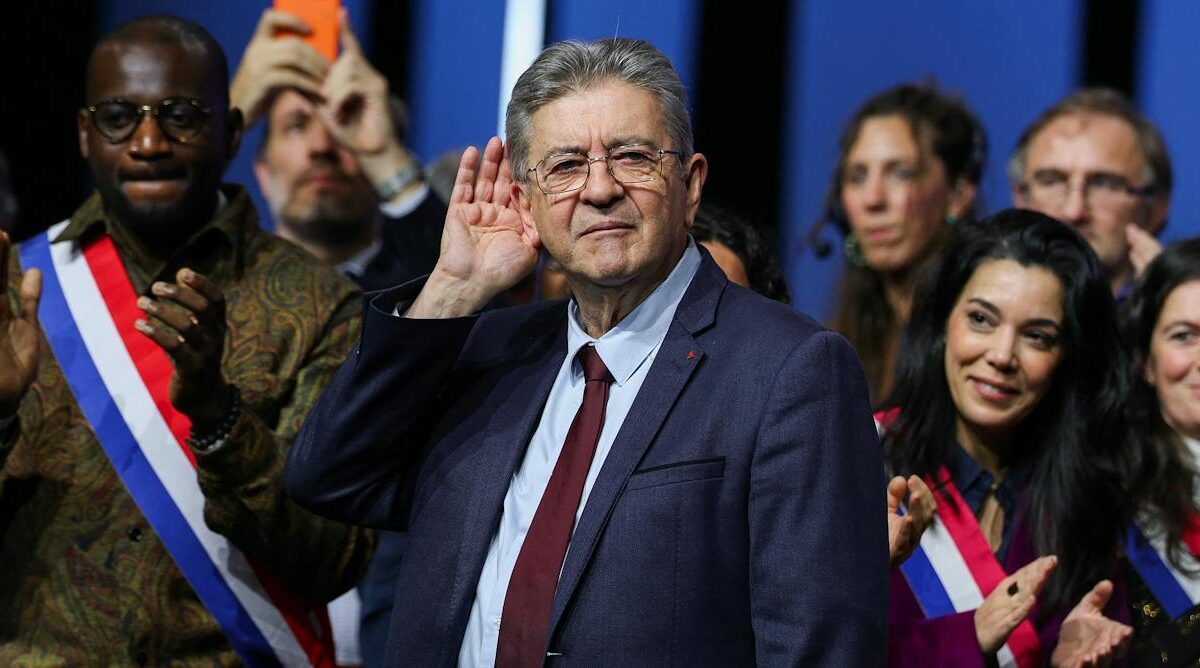
At a rally at Le Bourget on November 7, Mélenchon told journalists that uniting the left was “not my subject,” and Lefebvre says the party shows no strategy of opening toward other left-wing voters. Lefebvre notes that the sixth French Republic, a key LFI demand, has dropped from first to next-to-last place in the program.
He also says LFI’s internal decision-making is vertical, which he argues sits uneasily with its democratic goals. Lefebvre concludes that Mélenchon, currently leading in polls, will need moderate voters to win, and that his position against Marine Le Pen in a second round remains uncertain.