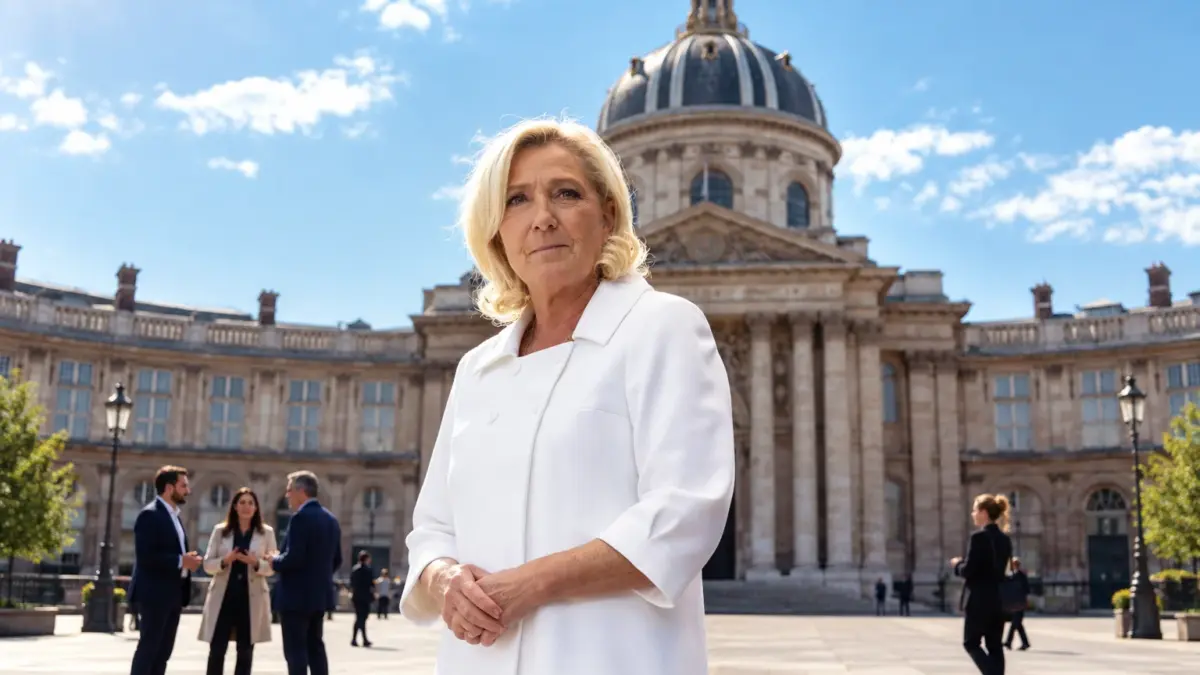
Marine Le Pen Zelensky Ukraine aid invitation, Digi Mart USA News: Volodymyr Zelensky has invited Marine Le Pen to see the reality of the war in Ukraine, while she argues that French financial aid should end. Their exchange raises a concrete question: what costs and risks should the French public weigh?
Le Pen, leader of the Rassemblement National, said on October 15, 2026 that she would travel to Ukraine “with pleasure” if Zelensky wanted to talk. She maintained, however, that France no longer has the means to continue its aid, so the openness to dialogue did not represent a change in her position.
Zelensky responded with an explicit invitation: “Yes, let her come, let her see our population.” He proposed that she speak directly with residents about their living conditions and their views of Vladimir Putin. His stated aim was: “I think she will change her position.”
Le Pen has not visited Kyiv since Russia’s full-scale invasion began in February 2022, and her lieutenants have answered the invitation on her behalf. At this stage, the exchange does not confirm that a trip will be organized or that her position has changed.
French support for Kyiv is not a single payment. It includes military equipment, training and various forms of financing.
The security cooperation agreement signed on February 16, 2024 structures the relationship over ten years and also covers industrial cooperation and the protection of critical infrastructure.
According to that text, French military aid was 1.7 billion euros in 2022 and 2.1 billion euros in 2023. For 2024, it announced up to an additional 3 billion euros.
That last figure was an announced ceiling, not proof that the full amount was spent.
European instruments are also part of the picture. The Ukraine Facility for 2024–2027, a joint financing mechanism, initially provided for 50 billion euros: 33 billion in loans and 17 billion in grants.
That amount concerns the European Union as a whole, not France alone.
These distinctions matter when assessing any promise of savings. A repayable loan, a grant and a delivery of equipment do not have the same budgetary effects.
Likewise, reducing a national aid program and changing a European mechanism involve different decision-making channels, so any general announcement should specify which expenditures it targets.
Financial aid does not serve only the military effort. According to the European review of payments made in 2024, the Ukraine Facility provided 16.5 billion euros to the Ukrainian budget that year.
These funds helped cover public salaries, pensions and essential services.
The effects of reduced support would therefore extend beyond Kyiv’s leaders. Retirees and users of public services are among those who benefit from this funding, and for them budget continuity addresses immediate needs.
For Ukrainian authorities, it also allows spending to be planned in a country at war.
On the French side, the National Rally’s argument emphasizes another priority: preserving resources for domestic needs. Its position appeals in particular to voters who consider foreign spending incompatible with France’s own difficulties.
However, an announced saving does not by itself guarantee a specific improvement in public services or purchasing power.
The debate therefore rests on two different time horizons. Le Pen stresses national financial constraints, while supporters of aid point to the security cost of a weakened Ukraine.
The Franco-Ukrainian agreement reflects the second view, treating Ukraine’s security as part of European security.
Zelensky is not an outside observer, since his country directly benefits from continued aid. He nonetheless argues for a reciprocal relationship.
In October he highlighted the interest for Kyiv’s partners in Ukrainian combat lessons, particularly on air defense systems and missiles, an argument that also benefits manufacturers adapting their equipment to battlefield experience.
This cooperation does not eliminate its cost to public finances. Conversely, acknowledging a French budget constraint is not enough to measure the consequences of a withdrawal.
To compare the two positions, it is necessary to distinguish the savings sought, the commitments involved and the expected effects on security.
The invitation therefore opens a concrete test without guaranteeing its outcome. In the coming weeks, the decisive elements will be a personal response from Marine Le Pen, any announced travel date, and a precise statement of which aid she would seek to halt.
These decisions, more than the exchange of statements, will show the political significance of this confrontation.