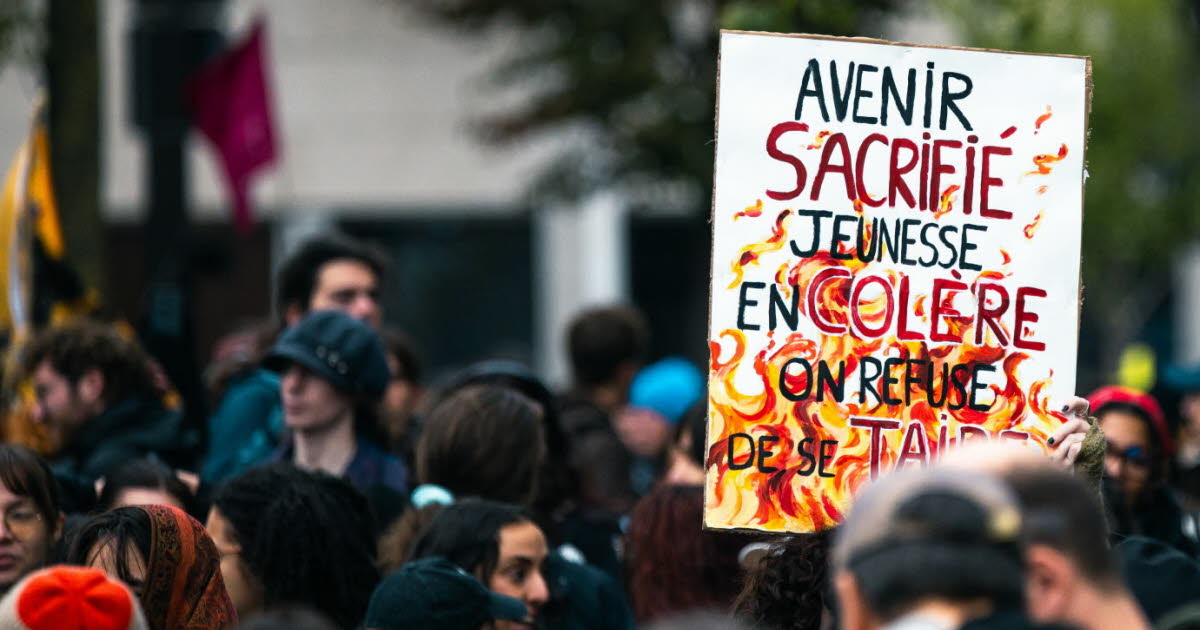
Printemps européen, USA News (France): Same ailments, same effects? A wind of revolt is blowing across parts of Europe, extending far beyond French borders. From Brussels to Lisbon and from Rome to Athens, slogans often blend together in street processions, accompanied by a shared anger among young demonstrators. Behind the image of a ‘European Spring,’ however, the reality proves more complex, as explained by Rosario Forlenza, professor of contemporary history and political anthropology at Luiss University in Rome.
Since October 17, the spotlight has been heavily focused on France, viewed from abroad as the champion of strikes and demonstrations. Aside from that single day of chaos, the mobilization degree of French high school students has made them highly visible elsewhere in Europe. In Italy, protesters have explicitly stated a desire to follow the French example. In Greece, youth have similarly looked to France for inspiration, with thousands of students and teachers taking to the streets. In Germany, young members of the ‘Gen Z regelt’ movement have organized rallies across dozens of cities in solidarity with France and other movements. The Italian academic notes that this represents a phenomenon of imitation rather than direct coordination originating from Paris.
The Role of Social Media and Divergent Grievances
Platforms like TikTok, WhatsApp, Instagram, Snapchat, and X have remained inseparable from protest gatherings over the past decade. Their role is frequently highlighted to explain how current movements spread rapidly. According to Rosario Forlenza, social networks allow mobilizations to expand quickly outside traditional political parties and labor unions without a recognized leader, creating collective excitement around pre-existing discontent, though they do not originate the grievances themselves.
Furthermore, the immediate triggers differ from one country to another: high school crises in France and Greece, housing costs and shortages in Spain and Portugal, and corruption in Albania. Nevertheless, the underlying context remains remarkably similar, marked by high living costs, deteriorating public services, and a loss of trust in traditional representative institutions.
A Generational Revolt and the Future of Protests
Across Europe, young people have increasingly skipped classes to voice shared demands concerning education quality, career guidance, and the costs of studying, transportation, and housing. The common denominator uniting them is future insecurity and the sentiment that current political and economic systems fail to provide sufficient opportunities or representation, compounded by anxiety over climate change and downward mobility compared to previous generations.
While describing a European generational revolt, Professor Forlenza refuses to reduce the current anger solely to a single age group, noting that the least privileged across all generations face similar difficulties, as seen in recent Spanish pension mobilizations and protests by truck drivers and farmers in southern Italy.
Instead of a singular pan-European movement, analysts point to distinct mobilizations born from a common crisis of expectations and a weakening social contract. As several European nations approach major electoral milestones—including legislative elections in Spain, a presidential election in France, and upcoming Italian parliamentary votes—analysts emphasize that the fundamental question is whether governments are prepared to alter policies generating such widespread insecurity and frustration.