Belgium media cordon sanitaire against far-right parties, Digi Mart USA News (France): The idea resurfaced after a racist attack in Trappes, in the Yvelines department, which killed Pengo Bossio Wangi. The town’s mayor, Ali Rabeh, called for rebuilding a “cordon sanitaire” around the far right in the National Assembly and in the media.
The question has heightened tensions in France, to the point that a petition to shut down the CNews channel could reach the floor of the chamber.
A petition calling for CNews to be closed has passed 600,000 signatures on the National Assembly website, well beyond the threshold required for a possible debate. The debate was settled in Belgium about thirty years ago with a media cordon sanitaire.
It consists of refusing to give free live airtime to representatives of parties considered liberticidal, explains Benjamin Biard, a researcher at the Centre de recherche et d’information socio-politiques (Crisp) in Brussels and a lecturer at the Catholic University of Louvain.
Asked where the notion originated in Belgium, Biard said it began as an agreement among the main democratic parties to refuse any alliance, electoral or post-election, with far-right parties. The mechanism first emerged in Flanders in the late 1980s and spread gradually to the French-speaking side from the early 1990s.
Today the cordon sanitaire goes beyond refusing to govern with the far right and, especially on the French-speaking side, includes broader measures, such as refusing to maintain sympathetic relations with or to debate far-right representatives.
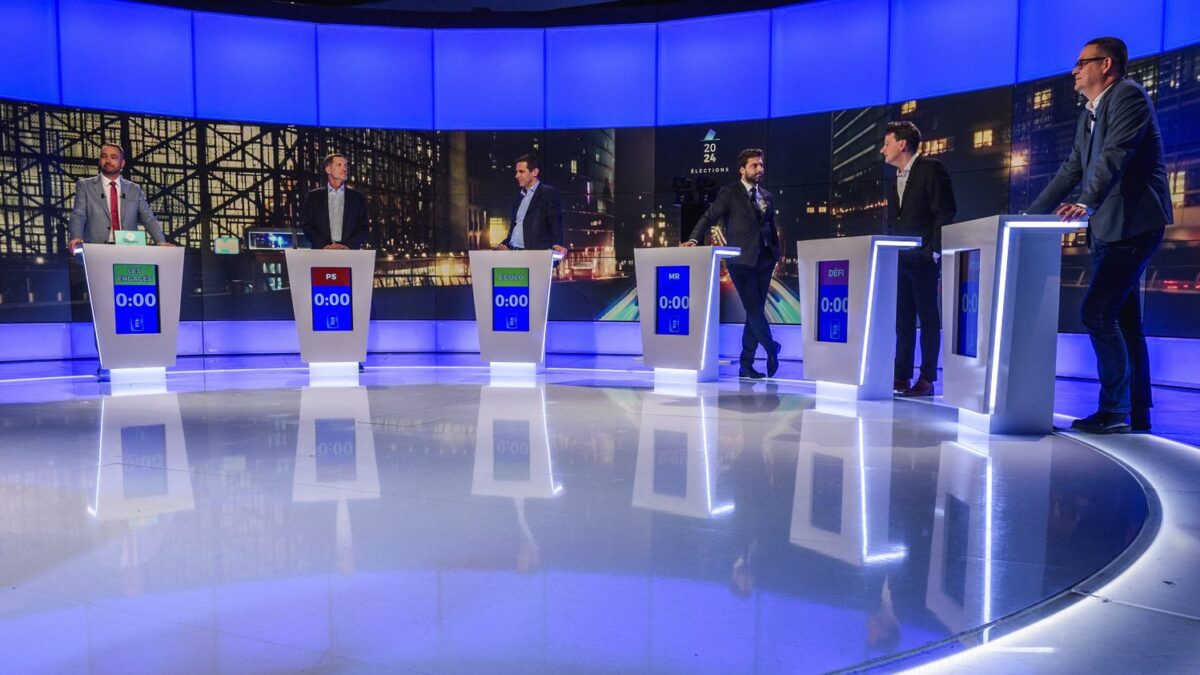
On the media side, the mechanism was added in December 1991 on the French-speaking side only, a few weeks after elections remembered as a “black Sunday” because of the strong gains of the far right, particularly in Flanders. The media cordon was initiated by RTBF, the French-speaking Belgian public broadcaster, and progressively extended to all audiovisual media.
Its aim is to refuse free live speaking time to representatives of liberticidal parties, historically the far right, given the risk of racist and xenophobic remarks spreading on air and the broader social responsibility of the media.
Biard said the practice is not strictly written into law. In 1994, the Belgian National Front of Daniel Féret sued RTBF for not inviting it to a debate of party presidents ahead of that year’s European elections, and the court ordered RTBF to host the party in debates under penalty of fines, one of the few legal victories for the far right.
The mechanism later gained legitimacy through recommendations from the Conseil supérieur de l’audiovisuel and the Conseil de déontologie journalistique. Since the early 2010s, the cordon has been a regulatory obligation according to the government of the French Community, the executive of the French-speaking region and Brussels.
Biard and researcher Léonie de Jonge have studied its effectiveness. Despite the influence of social media over the past two decades, they concluded that the media cordon remains important in reducing the circulation of certain ideas on live broadcasts.
It reduces the visibility of far-right parties and prevents a degree of normalization and legitimization, reinforcing the idea that these parties are not like others, although it is not the only factor explaining the far right’s marginality on that side of the country.
The mechanism is increasingly debated in French-speaking Belgium. Some want to extend the cordon to other political forces, notably the far left or radical left.
Others argue it is undemocratic because it denies political representatives or candidates free live airtime. Biard said he is regularly asked whether it is a form of censorship, including by left-leaning audiences, and he does not describe it as censorship.
The aim, he said, is to prevent far-right or liberticidal actors from exploiting democratic freedoms to undermine the foundations of democracy once they gain access to power.
Criticism comes mainly from the far right, although it is weak, and from parts of the democratic right such as the Mouvement réformateur (MR). In January 2025, RTBF broadcast Donald Trump’s inauguration speech with a delay of two or three minutes and analyzed it on television and radio panels to respect the cordon.
MR president Georges-Louis Bouchez criticized RTBF, including on CNews.
Some voices in France call for a similar media cordon, but Biard considers exporting the mechanism difficult. It emerged when the far right was electorally rising but still marginal.
Applying it where the far right is already institutionally established, highly visible and strong in polls, such as Marine Le Pen’s position in presidential polling today, could fail to achieve its goal and might even backfire by allowing the far right to portray itself as a victim and champion of free expression.