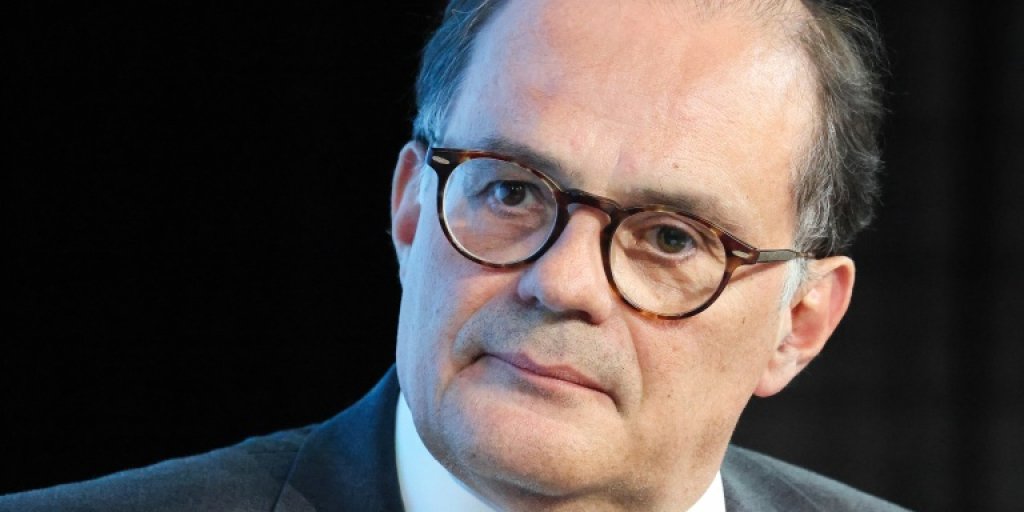
Bank of France governor forecasts slightly weaker French growth in 2026, Digi Mart USA News (France): France’s gross domestic product (GDP) growth in 2026 is not expected to reach the 0.4 percent previously anticipated by the Bank of France, but instead to come in “around 0.3 percent,” Governor Emmanuel Moulin warned on Tuesday.
“The estimate of 0.4 percent for the year 2026 was based on an assumption of positive growth in the third quarter. However, we had -0.1,” Moulin said in an interview on BFM Business.
“Naturally, mathematically, it will be very difficult to reach 0.4. And so we will rather be, I think, around 0.3 for the full year,” he added.
The Bank of France published its monthly business survey on Monday evening, in which it said it expects a moderate rise in French GDP in the fourth quarter, while stressing a very uncertain situation and a lack of visibility on the impact of social mobilizations.
Moulin described an “environment of uncertainty” across geopolitical, economic, political and social dimensions.
Like the national statistics agency Insee, the Bank of France had until now projected French growth of 0.4 percent for 2026. Moulin had said in early November that this forecast was “a little optimistic” and would be revised in mid-December.
The government still projects GDP growth of 0.5 percent, a target the High Council of Public Finances considers “difficult to achieve.”
Asked about the minimum wage (SMIC) increase effective December 1, announced Monday by Prime Minister Sébastien Lecornu, Moulin said that “boosts to the minimum wage” tend to “compress the wage scale,” and therefore do not allow purchasing power gains for people slightly above the minimum wage.
Moulin, who sits on the Governing Council of the European Central Bank (ECB), its main decision-making body, also said there would be “no change” in the institution’s monetary policy after the departure of its president, Christine Lagarde.
He said the two candidates, Dutch national Klaas Knot and Spaniard Pablo Hernandez de Cos, “are in line with Christine Lagarde’s continuity,” and that ECB monetary policy “is based on data and the state of inflation.”
Moulin nonetheless advocated that the chief economist post go to a French national: “we have very good candidates, especially very good female candidates for this position.” He noted that the ECB president decides appointments to the executive board, but that the post has never been held by a French person in the institution’s history.
The ECB could raise its key interest rates at its next meeting in mid-December to contain inflationary pressures.
“We are above our inflation target,” Moulin said, adding: “we have rather positive signals in terms of energy prices, but we will decide in December, when we meet.”