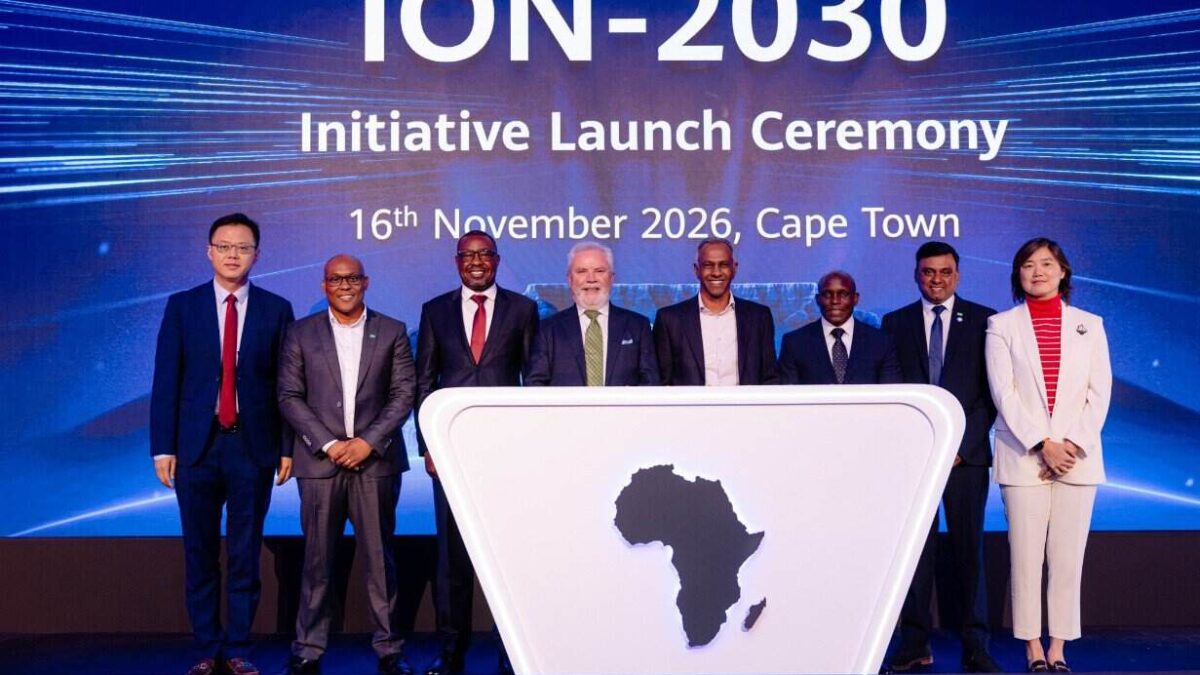
Borderless fibre Africa AI, Digimart Global (Cape Town, South Africa): Africa’s broadband leaders have called for a terrestrial fibre backbone that links African countries directly, warning that the continent’s AI ambitions could stall if networks go dark whenever a single cable is cut. The call was made at the WBBA Broadband Development Congress (BDC) Africa 2026 in Cape Town, which brought together more than 150 government officials and industry executives under the theme “Unlocking the Next Wave of Broadband Innovation with AI.”
The congress was hosted by the World Broadband Association (WBBA) and sponsored by Openserve and Huawei. It also saw the WBBA launch its ION-2030 initiative in Africa, a next-generation fixed network framework developed by the International Telecommunication Union (ITU).
Resilience and cross-border links
Yongqiang Yuan, Vice President, Optical Business Product Line at Huawei, said Africa records more than 100,000 fibre cuts a year and that every dollar invested in network resilience saves five dollars in losses. Submarine and terrestrial cables should back each other up, he said, with mesh backbone routes giving traffic another path after a cut.
Inland countries that depend on a single border link can lose all connectivity after one fibre cut. Amu Maja, Executive for Carrier and Global at Openserve, proposed an open access terrestrial backbone linking national networks from north to south and east to west.
Dr Jacob Munodawafa, CEO of the Southern Africa Telecommunications Association, added that future networks should detect faults and reroute traffic automatically.
Local AI and energy capacity
Ziaad Suleman, CEO of Cassava Technologies South Africa and Botswana, said predictive analytics can already spot early warning signs of an outage and shift traffic while crews repair the fault. He also argued that, with just 1% of the world’s data centre capacity, Africa’s AI models should be built for local languages and conditions.
According to Eskom Chairman Dr Mteto Nyati, South Africa hosts about 70% of the continent’s data centres and now has about 6 GW of surplus daytime capacity. China Telecom Global’s Athena Jun Xian said the company wants to work with African partners on submarine cables and landing stations.
National broadband plans
Washington Okoth, Secretary, ICT Infrastructure at Kenya’s State Department of ICT and Digital Economy, said the country’s third National Broadband Strategy, running from 2027 to 2032, will add 100,000 kilometres of fibre to the current 70,000, connect 6 million households and lift broadband coverage from 13% to 60%. In Tanzania, TTCL said its national backbone reaches about 125 of the country’s 139 districts and should cover all of them by December 2026.
More than 4 million African households were newly connected to fibre in the past year, according to the report. Affordability remains a key test, with Dr Sunil Piyarlall of Openserve saying that in many parts of Africa the immediate priority is still a dependable connection at a price people can afford.