Thales quantum technology, Digimart Global: French group Thales is working on quantum technologies that go beyond powerful computers, according to a Futura Sciences report. The research targets aerospace, defence, medicine and telecommunications, and the report says it is being developed in laboratories with the aim of eventually reaching everyday equipment.
Thales is reported to be mobilising around a hundred experts and working with the CNRS and the Albert-Fert laboratory. The main goal described is to integrate these technologies into equipment that can be used routinely.
Navigation without GPS
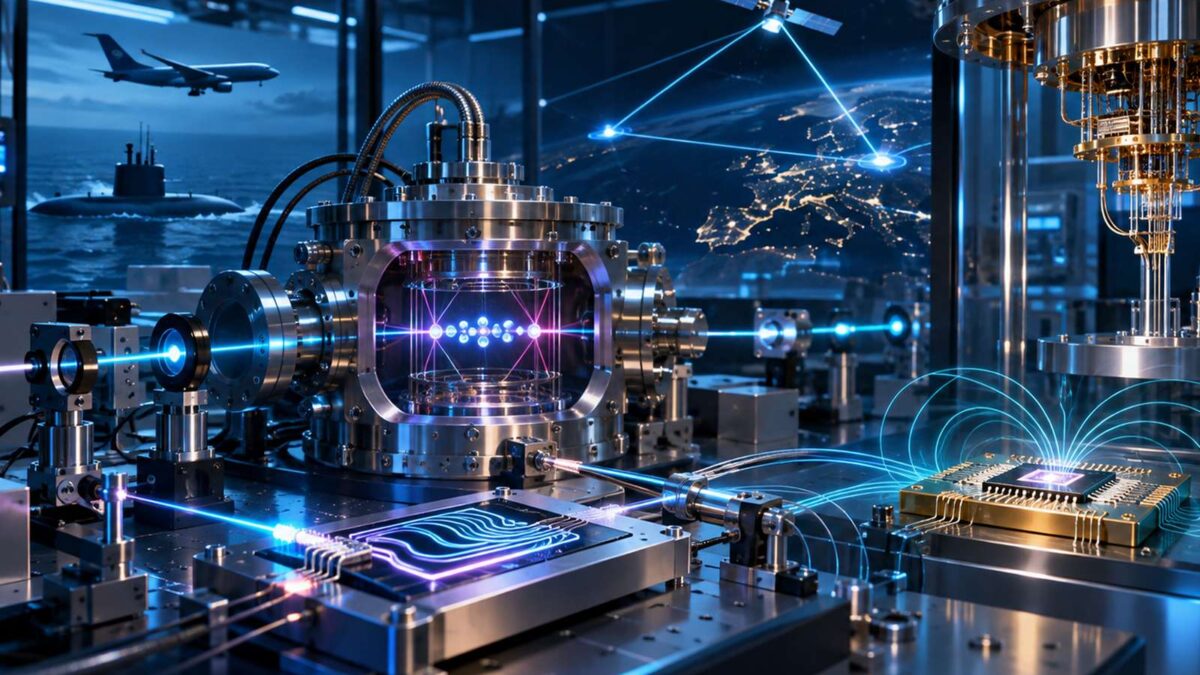
One area highlighted is a new generation of inertial navigation systems, which use the quantum properties of atoms to continuously measure acceleration and rotation. Current inertial systems can drift by several kilometres after several hours if no correction is applied.
According to the report, Thales researchers cool rubidium atoms close to absolute zero and use their wave-like behaviour to measure movement more precisely, aiming to reduce positioning errors to about one hundred metres.
The report says the benefits could be significant for submarines, which lack GPS at depth, as well as aircraft and military vehicles facing satellite signal jamming. It also states that a complete, compact and robust quantum navigation unit would require ten to fifteen more years of work.
Ultra-sensitive sensors
Another line of research concerns superconducting quantum interference filters, or SQIFs, which the report describes as devices that detect very faint changes in magnetic fields associated with electromagnetic waves. Albert-Fert laboratory researchers are said to be developing sensors that fit on a chip two centimetres square.
Possible uses mentioned include military maritime detection, radio telescopes, subsurface exploration and medical imaging with weaker magnetic fields than current MRI scans. The report notes that reliability and industrial production must still be improved, and large-scale deployment could take ten to twenty years.
Secure communications
The report also describes work on communication security. Quantum key distribution, or QKD, lets two parties create a secret key by exchanging information encoded in photon quantum states, and interception attempts can be detected.
Thales is also reported to be working on post-quantum cryptography, which uses new classical algorithms designed to resist quantum computer attacks and is more directly applicable to current systems.
The report concludes that moving from laboratory experiments to reliable, compact and affordable devices may take decades, a transition Thales is seeking to accelerate. The information comes from a single publisher article and has not been independently verified.