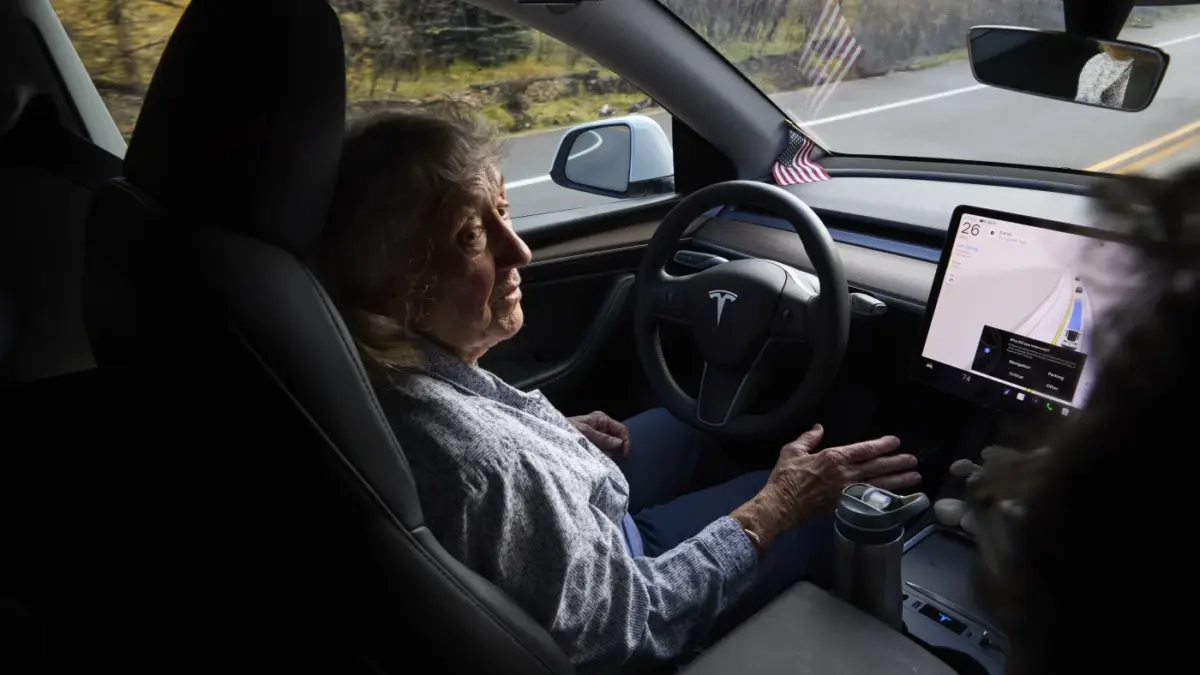
seniors Tesla self-driving, Digimart Global: Joan Spalding, 89, has driven the winding road to her home outside Denver for more than 50 years, but she now relies on her Tesla Model Y to do most of the driving. She tells the car where she wants to go and uses the touch-screen to start the trip, while the car handles steering, pedals and turns on narrow mountain roads near her home in Evergreen, Colorado.
Spalding was skeptical at first of Tesla’s Full Self-Driving (Supervised) system, a subscription service that drivers typically pay $99 per month to use. After a serious crash two years ago while trying to make a left turn, she said she realised her own abilities were not where she wanted them to be.
Her son Mike, who already drove a Tesla, suggested she get one as well.
Older drivers are a growing share of people on the road, and many families struggle with when a relative should stop driving. Some seniors are now using automated systems to keep driving for longer.
Tesla says FSD has more than 1.7 million active subscriptions, an increase of 67% from a year ago, but it has not said how many subscribers are seniors.
Tesla claims FSD is up to nine times safer than human driving. Bryan Reimer, a research scientist at MIT who studies how drivers interact with technology, said the company releases little data, so the claim cannot be independently verified.
He said the technology is impressive but is not a replacement for a human driver, and criticised Tesla for over-promising. The Insurance Institute for Highway Safety’s Alexandra Mueller said drivers can become complacent, and warned that older drivers with age-related impairments may not be able to take control in an emergency.
Tesla’s chief executive Elon Musk has promoted the idea that Tesla self-driving gives mobility to seniors. He has shared a video of 98-year-old Larry Dimmock, who said the system had not made a mistake in two or three months of use.
Dimmock said he feels safer with the system than with most drivers, and that he would not go out in the car otherwise.
For Spalding, the technology is about independence. She said it lets her remain in the home she and her late husband built more than 50 years ago, and that without it she would likely have to move somewhere she would not need to drive.
Safety concerns remain, but for these drivers the system has become a way to stay mobile.