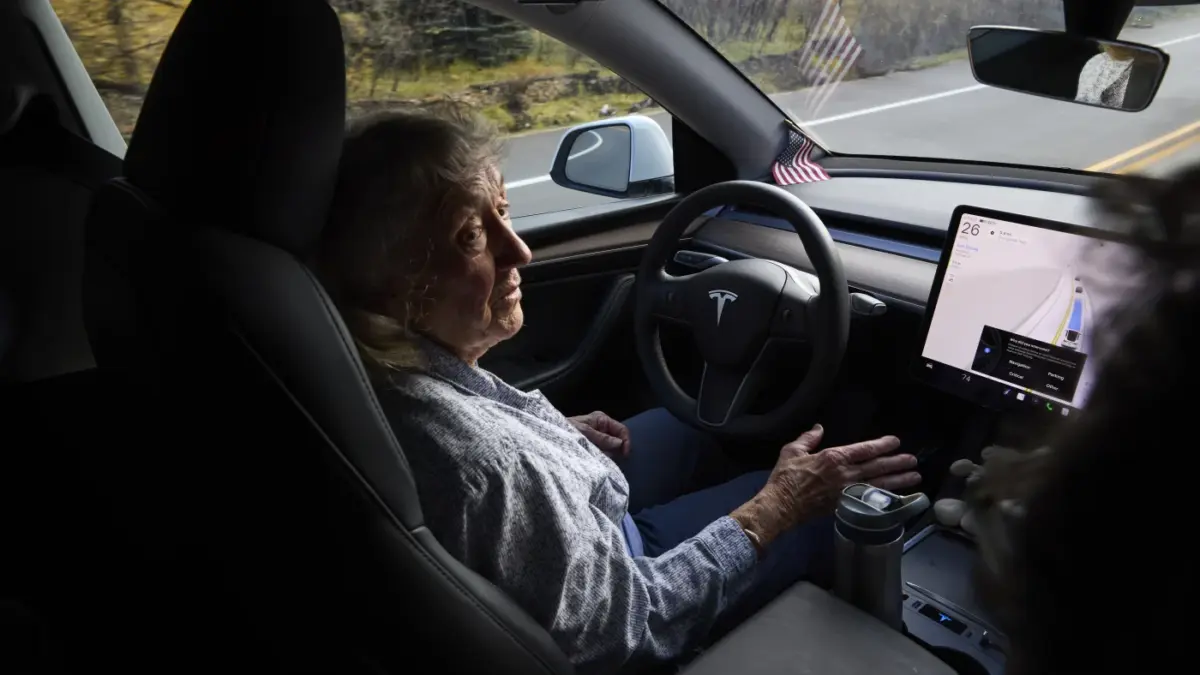
senior drivers Tesla, Digimart Global (Evergreen, Colorado): Joan Spalding, 89, has driven the winding road to her home outside Denver for more than 50 years, but she now relies largely on her Tesla Model Y to navigate it. She tells the car where she wants to go and uses the touch-screen to start the drive, while the vehicle handles steering and pedals.
The system is Tesla’s Full Self-Driving (Supervised), often called FSD, a subscription service that drivers pay for, usually $99 per month. Spalding said she was skeptical at first but now believes the system drives more safely than she would herself.
Her experience reflects a broader trend. NPR reports that more older drivers are on the road than ever, and that seniors are using Tesla’s automated systems to stay behind the wheel longer.
Tesla says FSD has more than 1.7 million active subscriptions, an increase of 67% from a year ago, but the company has not said how many subscribers are seniors.
Spalding began driving the Tesla after a series of minor fender benders and a serious crash two years ago while attempting a left turn. Her son Mike, who already drove a Tesla, suggested she get one as well.
She said the car gives her mobility and freedom she would otherwise lack, allowing her to keep living independently in the home she and her late husband built.
Safety experts raise concerns
Bryan Reimer, a research scientist at MIT who studies how drivers interact with technology, said he would not drive with the system or recommend it to loved ones, citing safety gaps that make him uncomfortable. He said Tesla has continually over-promised and under-delivered, and that the name Full Self-Driving feels more capable than the system is.
Alexandra Mueller, a senior research scientist at the Insurance Institute for Highway Safety, said drivers can become complacent when the system performs well repeatedly. She also warned that older drivers may not be ready or able to take control in an emergency, particularly if age-related impairments are present.
Tesla claims that FSD is up to nine times safer than human driving. Reimer said the company releases little data about the system, so those claims cannot be independently verified.
Official communications refer to the product as FSD (Supervised), and drivers are expected to pay attention at all times.
Elon Musk promotes the practice
Tesla CEO Elon Musk has encouraged the use of the technology by seniors, posting on social media platform X that “Tesla self-driving gives mobility to seniors.” He has also shared a video featuring 98-year-old Larry Dimmock, who said the system has made no driving errors in the two or three months he has used it. Dimmock said he feels safer with the system than with anyone driving him.
NPR notes that it is unclear how many senior drivers use FSD to remain on the road longer, and that Tesla has not said whether it tracks this information.