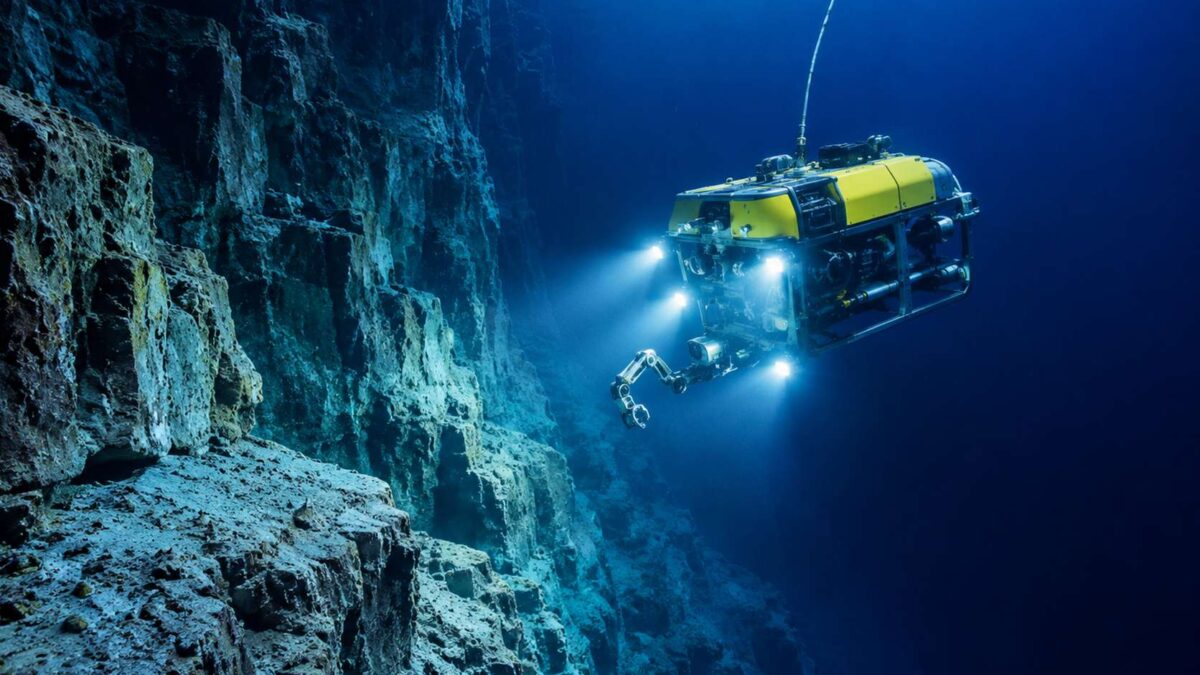
Mariana Trench volcanic deposits, Digimart Global (Mariana Trench, Pacific Ocean): A remotely operated underwater robot exploring the Mariana Trench has found traces of explosive volcanic eruptions at depths of more than 6,000 meters below the Pacific surface, according to a study published in the journal Frontiers in Earth Science by a team that includes researcher Robert Stern.
The Mariana Trench, whose deepest point, Challenger Deep, lies at about 10,900 meters, sits where the Pacific plate dives beneath the Philippine Sea plate in a subduction zone. In late 2024, an international team deployed the teleoperated robot Jason/Medea to collect rock samples from the trench walls and help explain the geological structure of this boundary.
Because of crushing pressure at these depths, the robot was pushed to its operating limit of 6,500 meters and explored the northern wall of the trench along a segment about 300 kilometers long. This wall marks the edge of the overriding Philippine Sea plate.
Near 6,000 meters, the researchers found that the seafloor was made of volcanic rock. Closer examination identified pyroclastic deposits, material produced by explosive eruptions.
The team says these are the deepest such deposits ever found.
The finding is unexpected. In this part of an overriding plate, the mantle is usually too cold to melt and produce magma, even with fluids released by the descending plate.
Such activity would normally require special tectonic conditions, such as strong extension that allows hotter mantle material to rise.
Explosive eruptions are also considered unlikely at this pressure, which exceeds 600 bars, because it limits the expansion of dissolved gases. Stern said the team is still studying the phenomenon.
The researchers suggest the deposits may be linked to an eruption style controlled by supercritical fluids, and say the location, close to the trench axis, calls existing models into question.