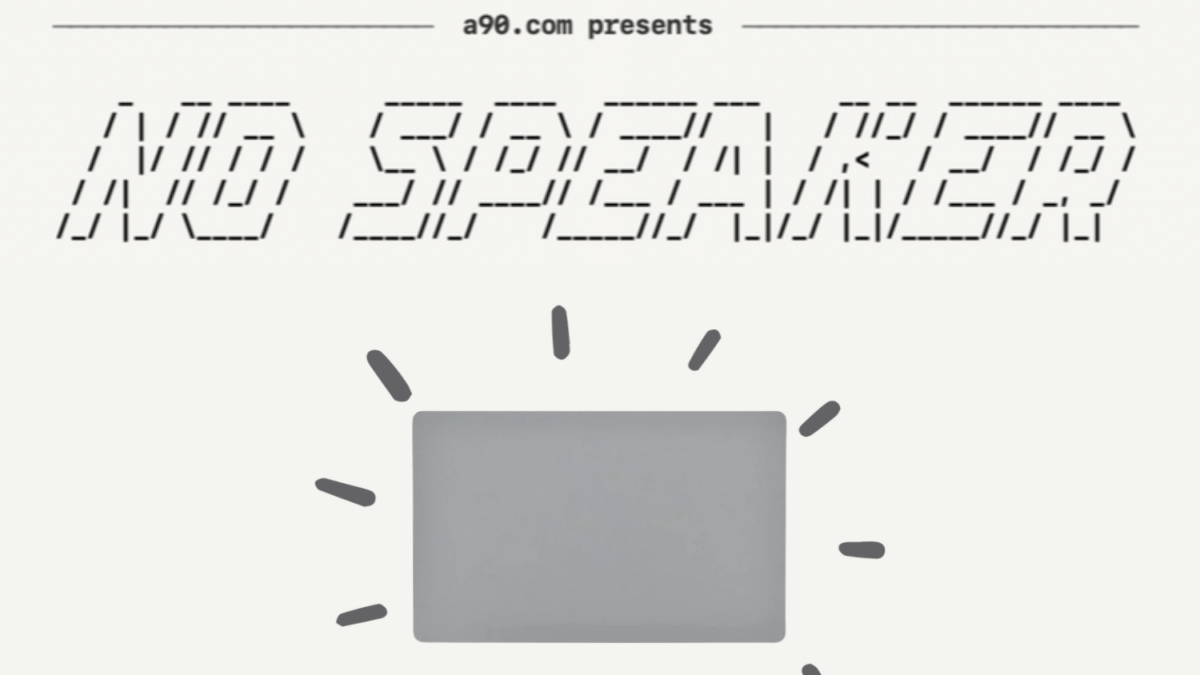
MacBook haptic motor voice, Digimart Global: A MacBook’s trackpad does not actually click. It only feels that way because a haptic motor beneath the glass taps the user’s finger.
A new open-source tool called nospeaker uses that motor to make the trackpad talk, according to a publisher report from Notebookcheck.
The project was developed by Cody Collier, who posts as os6 on GitHub. It runs from the command line and reads out text using a macOS voice through the trackpad.
It can also play a rising tone sweep. However, the tool cannot play music, YouTube videos or other audio files.
The approach depends on how quickly the motor can move. According to the project repository, nospeaker drives the motor up to 4,000 times a second, which vibrates the glass fast enough to produce audible sound.
The app first generates speech using macOS’s built-in voices, then analyzes that audio every 10 milliseconds for two formants, loudness and pitch. These are played back as two tones on the motor, and hissy sounds are converted into short bursts of high tones.
The result is robotic but surprisingly loud. Collier measured the output as strong from roughly 100 Hz to 4 kHz, with a few dead spots, and clearest around 1 kHz.
In a brief test by Notebookcheck on a MacBook, the sound was loud enough to work as a makeshift speaker. The developer suggests muting the Mac and placing it on a table to reduce noise.
Compatibility and limits
Apple’s public haptics API offers only three fixed taps, so nospeaker uses the private MultitouchSupport framework instead. Because this framework is not public, a macOS update could break the tool.
Collier also says the app never drives the motor past its normal maximum strength.
According to the report, any Mac with a Force Touch trackpad should work. That covers MacBooks from 2015 onward and the Magic Trackpad 2 or later.
The tool requires macOS 12 on Apple Silicon or macOS 13 on Intel. Collier has tested it only on an M5 Max MacBook Pro, while Notebookcheck also tried it on an M5 MacBook Pro.
The project is free under the MIT license.