
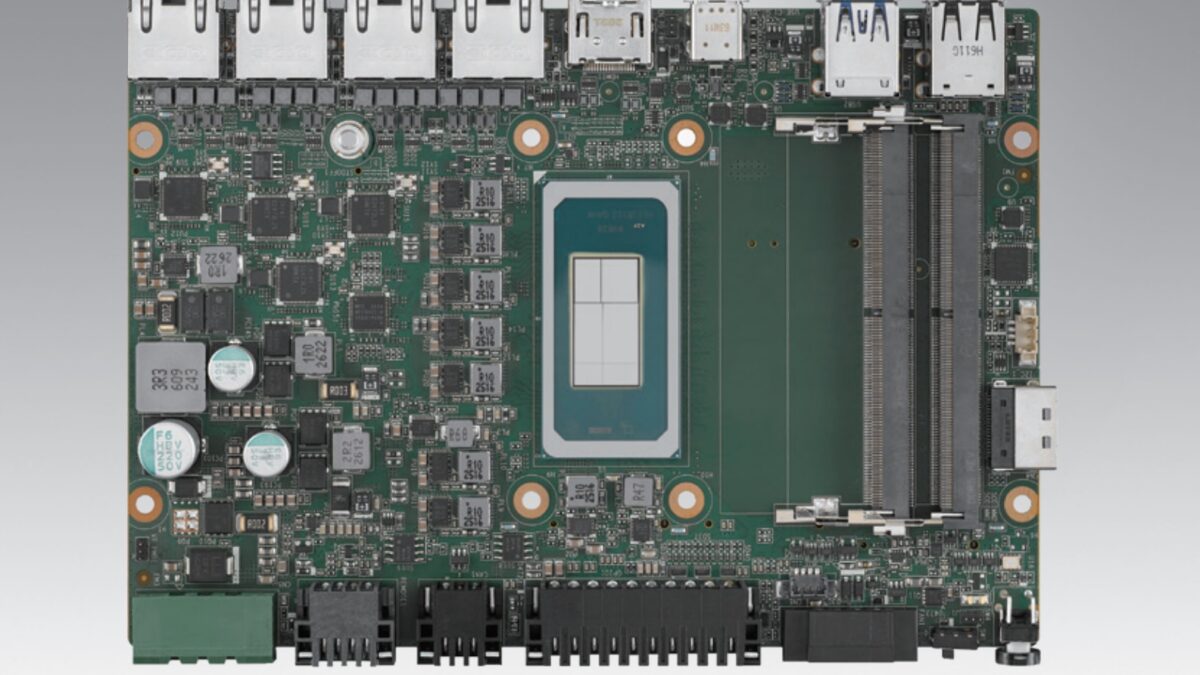
Intel Nova Lake-H, Digimart Global: Industrial computer maker Advantech has leaked preliminary specifications for Intel’s upcoming Nova Lake-H mobile processors. The details appear in a specification sheet for its ASR-A505 single-board computer, a 4-inch board designed for autonomous mobile robots.
The sheet lists a 16-core chip with a 2.0 GHz P-core base clock, a maximum boost frequency of 4.8 GHz and 18 MB of last-level cache. Its TDP may be configurable between 15 W and 25 W.
The chip is described as part of Intel’s Core Ultra Series 4 family, also known by the Nova Lake-H codename.
The core configuration is unusual. Advantech lists eight performance cores, four efficiency cores and four low-power efficiency cores (8P+4E+4LE).
Earlier leaks pointed to a 4P+8E+4LPE layout for the 16-core model, reportedly identified as the Core Ultra 9 4970H. Because Advantech’s document is preliminary, the difference may be a typo with the P-core and E-core counts swapped.
The document also states support for DDR5 memory at up to 8000 MT/s across two CSODIMM slots, with a maximum capacity of 128 GB. The integrated graphics configuration is not finalized: the execution-unit count is listed as “TBD,” although the Arc graphics are listed at up to 2.3 GHz.
Separately, a 28-core Intel Nova Lake-S desktop processor has appeared in the OpenBenchmarking database with a listed frequency of 5.2 GHz. The chip is identified only as “Intel 0000” and was tested on Intel’s NVL-S UDIMM 1DPC CRB Fab2 reference motherboard with 32 GB of memory, running Ubuntu 26.04 with an Intel-specific Linux 7.2.3 kernel.
The entry, submitted on November 5, 2026, contains no performance results.
A possible 28-core layout of eight performance cores, 16 efficiency cores and four low-power efficiency cores (8P+16E+4LPE) is suggested, though the benchmark listing does not break down the core types. Intel has not officially announced the specifications of its Nova Lake processors, and the company’s next-generation processors are expected to be unveiled at CES 2027 in early January 2027.