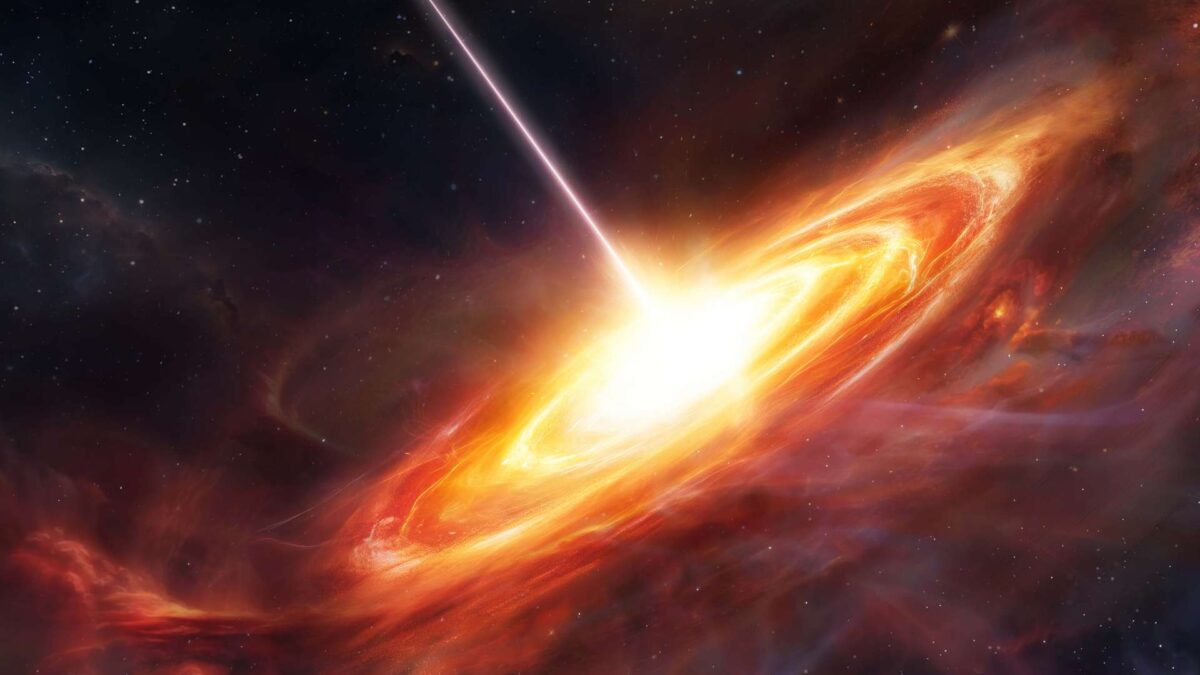
Euclid quasar discovery, Digimart Global: Astronomers say the Euclid and James Webb space telescopes have identified the most distant quasar known to date. According to a report in Futura Sciences, the object, catalogued as J1504+6252 and nicknamed Dún Aonghasa, is seen as it appeared about 630 million years after the Big Bang.
Quasars are extremely bright cores of active galaxies, powered by supermassive black holes that can reach billions of times the mass of the Sun. The source reports that the quasar was spotted among millions of objects in data collected by Euclid over roughly 18 months.
Its distance and observation time were determined by measuring its redshift with James Webb, which gave a value of z = 8.13.
The source says the object appears to contain about 360 million solar masses, according to researchers writing in the journal Astronomy & Astrophysics. That is far larger than the roughly 4 million solar masses attributed to the black hole at the centre of the Milky Way.
The mass is the central puzzle. The source states that the object seems too massive to have formed through the usual scenario based on the standard cosmological model, particularly because its rate of matter accretion appears low.
Mergers of giant black holes from massive stars do not appear sufficient to explain it.
The article notes that the discovery currently favours a scenario in which a supermassive black hole forms through direct gravitational collapse of a vast mass of matter. The source adds that finding more distant, early quasars of this kind could strengthen the case for very massive black hole seeds present soon after the Big Bang, including the primordial black holes proposed by Stephen Hawking.
Further Euclid observations could help distinguish between these scenarios, although the source says the current discovery does not settle the question.