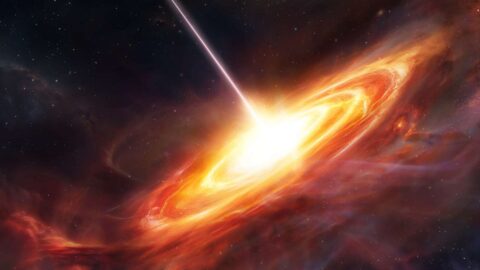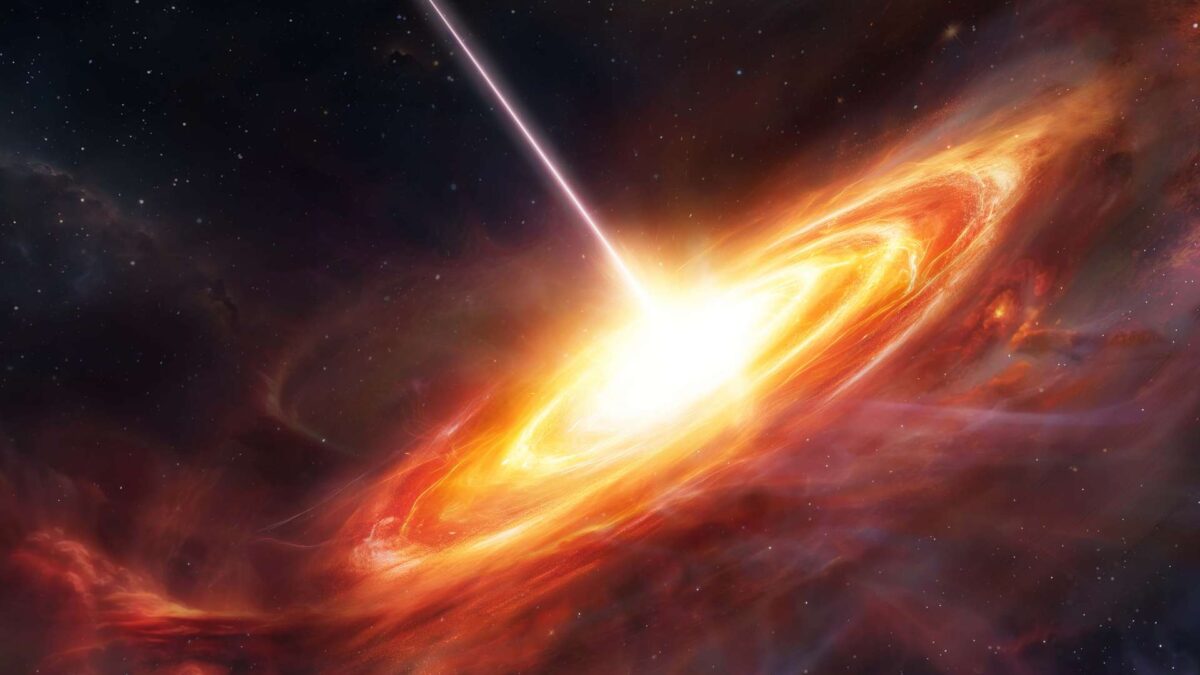
Euclid James Webb quasar, Digimart Global: Astronomers say the Euclid and James Webb space telescopes have identified the most distant quasar known to date, according to a publisher report on Futura Sciences. The object, officially designated J1504+6252, is seen as it appeared about 630 million years after the Big Bang, roughly 40 million years earlier than the previous record holder.
The quasar was first spotted by Euclid among millions of objects in a dataset collected over about 18 months. The James Webb Space Telescope was then used to measure its redshift of z = 8.13, which allowed researchers to determine its distance and the age at which it is being observed.
Scientists have nicknamed it Dún Aonghasa, after a prehistoric fort on Inis Mór off Ireland’s Atlantic coast.
A quasar is an extremely bright core of an active galaxy powered by a rotating supermassive black hole. According to the report, the research team estimates that Dún Aonghasa contains about 360 million solar masses, compared with a little over 4 million for the supermassive black hole at the centre of the Milky Way.
The findings were described in an article published in Astronomy & Astrophysics.
The size of the object creates a puzzle for cosmologists. Under the usual scenario derived from the standard cosmological model, a black hole this massive would not have had enough time to form, particularly given its apparently low rate of matter accretion.
The report suggests the discovery currently favours direct gravitational collapse of a vast cloud of matter as a formation pathway.
The report notes that this conclusion could change if more distant, early quasars like Dún Aonghasa are found, which might imply that very massive black hole seeds existed soon after the Big Bang, possibly including the primordial black holes proposed by Stephen Hawking. Future Euclid observations could help distinguish between these scenarios, although the current discovery does not settle the question.