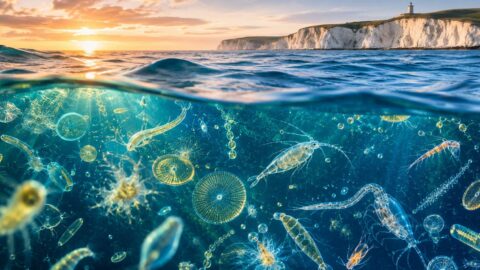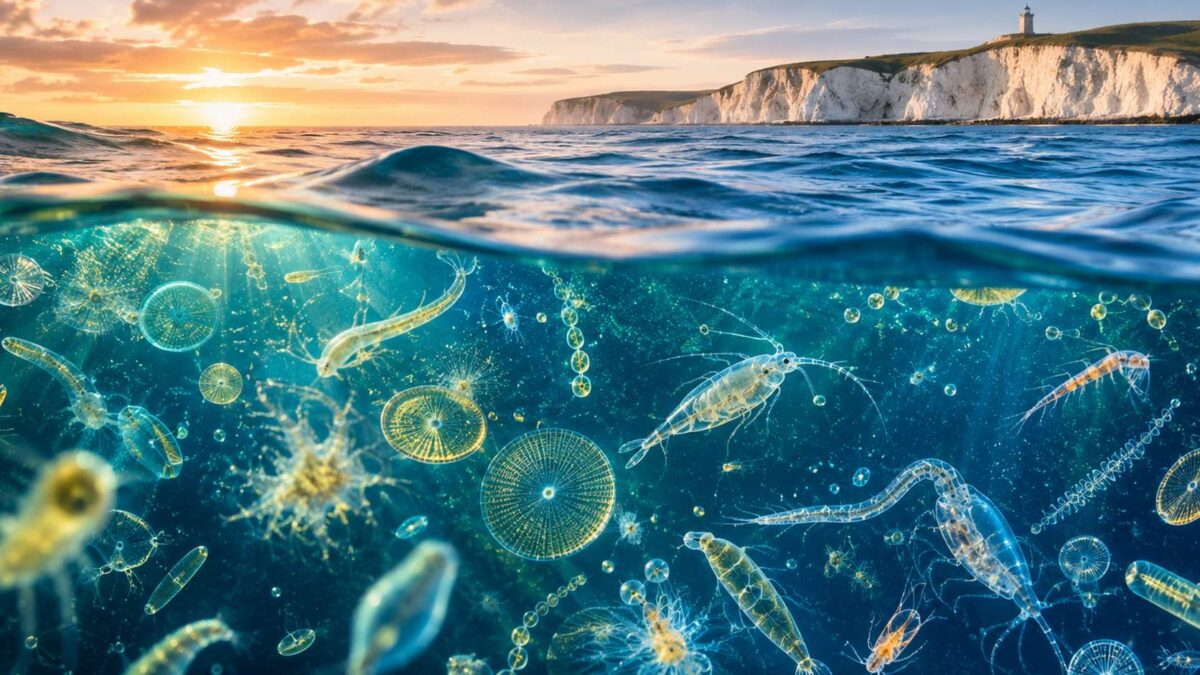
English Channel plankton shift, Digimart Global (English Channel): The English Channel may look much as it did decades ago, but a new study suggests its food chain has been quietly reorganising over the past 35 years. Researchers at the Plymouth Marine Laboratory compared long-term microscopic analyses with environmental DNA, which includes traces of cells, faecal matter and remains of organisms.
Winners and losers in the food chain
According to the study as reported by Futura Sciences, many crustacean groups, including copepods, which are a basic food source for many marine animals, have declined markedly. At the same time, some groups are thriving unusually well.
Larvae of seabed-dwelling animals, such as polychaete worms, bryozoans and echinoderms like sea urchins and starfish, have become more abundant. These larvae belong to meroplankton, organisms that spend only part of their life cycle as plankton before metamorphosing.
Warming waters and changing plankton
The article links these shifts to rising water temperatures, which can affect nutrient availability and water stratification, the layering of water by density. Futura Sciences cites the Normandy climate panel as reporting that sea temperatures in the Channel rose by 1 °C between 2004 and 2019. Météo France data cited in the report indicate that the Channel experienced 55 days of abnormal heat in 2025, compared with an average of 2 days a year between 1961 and 1990. As some nutrients decline, larger phytoplankton particles are reported to give way to smaller cells, which favours organisms that feed on very small particles.
Possible wider effects
Changes at the base of the food chain can cascade upward. Zooplankton supports larger marine species, so shifts in its diversity may affect certain fish species more than others, with knock-on effects for marine mammals and for the seafood available to people.
The article also notes that plankton helps regulate atmospheric carbon dioxide, and that changes in phytoplankton could alter its capacity to store carbon, potentially adding to warming. The article notes that these changes are not yet fully visible at the surface, and that their wider impacts are expected to become clearer in coming years.