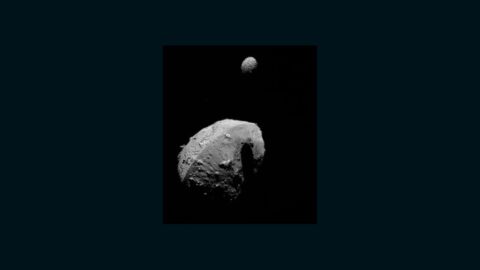
Dimorphos asteroid crater, Digimart Global: The first images of the asteroid Dimorphos, which Nasa deliberately crashed into to test whether Earth could defend itself against a dangerous rock, have been released by the European Space Agency (ESA). The pictures show a stadium-sized crater on the damaged asteroid.
The collision took place in December 2022, when Nasa’s Dart spacecraft was sent into Dimorphos to test whether it was possible to push a rock off course should one ever head towards Earth. Dart hit the asteroid at about 14,000 mph (22,000 km/h).
What the Hera mission has found
The ESA later dispatched a spacecraft called Hera to assess the damage. According to the agency, Dart successfully altered the orbit of Dimorphos as it circled the larger asteroid Didymos.
Dimorphos now has one face flattened by a stadium-sized crater and is tumbling chaotically, and hundreds of previously unknown boulders surround the pair.
Before the impact, Dimorphos took around 11 hours and 55 minutes to orbit Didymos. That orbital period has since shortened by around 33 minutes.
Hera’s principal investigator, Patrick Michel, said scientists had debated whether the asteroid had sustained a crater, changed shape or stayed the same, and that the answer was all three at once.
Why the findings matter for planetary defence
The images were unveiled at the Natural History Museum in Berlin. Hera mission manager Ian Carnelli said that an asteroid impact 66 million years ago changed the course of life on Earth, and that humanity is now validating how to prevent such an event from happening again.
He added that combining the Dart and Hera missions moves asteroid deflection towards becoming a reliable tool for protecting the planet.
The Hera investigation is still under way. The spacecraft is scheduled to approach about 13 km from the asteroids in December and return progressively higher-resolution images.
In January 2027, Hera is due to deploy two shoebox-sized CubeSats, miniature satellites, that will venture even closer. The ESA also credited valuable contributions from international partners, including Japan’s JAXA.