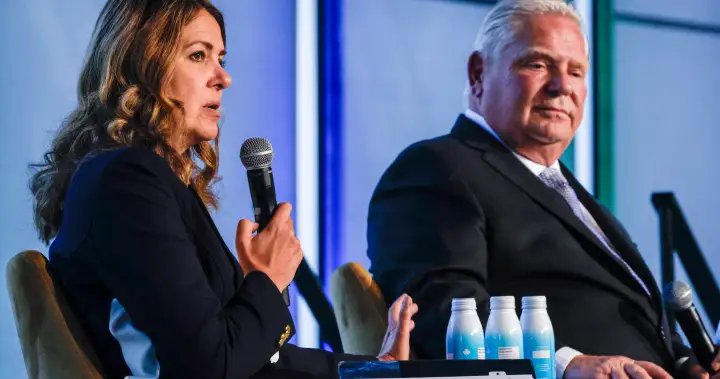
Interprovincial trade barriers, Digimart Global (Toronto, Ontario): Ontario Premier Doug Ford and Alberta Premier Danielle Smith say internal trade barriers remain across Canada despite moves to open up free trade between provinces. The two spoke Monday at a fireside chat held by the Toronto Region Board of Trade, according to the publisher’s report.
Bureaucracy and regulation slow progress
Smith said problems persist within the bureaucracy behind everyday matters such as selling alcohol to the Liquor Control Board of Ontario. She said that while premiers can agree to open free trade, many layers of legislation, regulation and agency directives still act as individual barriers, and that these are not easy to rewrite.
As an example, Smith said the College of Physicians and Surgeons of Alberta had limited out-of-province doctors to treating 12 patients in Alberta. She said the province wanted to use doctors from anywhere in Canada for virtual appointments, but the college, which is run by an independent board, created a barrier.
That rule was eliminated in April, Smith said. She also admitted Alberta needs to further reduce the number of trade exemptions.
Ontario says it has removed all exemptions
Ford said Ontario is the only province, and the largest, that has eliminated every trade exemption, and he argued that doctors, nurses and skilled trade workers who are qualified in Alberta should be equally welcome in Ontario. He said Ontario has signed 10 memorandums of understanding with other provinces and territories, but that Quebec still maintains many exemptions.
He also said the trade barriers cost Canada’s economy $200 billion, a figure he gave in the remarks reported by the publisher.
Alcohol sales and energy corridor
Smith said more than 1,000 different types of Ontario alcohol are sold in Alberta, while the LCBO stocks only 53 Alberta alcohol products. Ford pointed to Ontario’s changes allowing grocery stores and some 8,000 convenience stores to sell wine, beer and spirits, while noting the LCBO still controls purchasing and selling of spirits.
Both premiers also support expanding energy trade within the country, including a proposed pipeline carrying crude oil from Alberta to refineries in southern Ontario, which they have dubbed the Northern Shield Energy Corridor. Ontario and Alberta signed a memorandum of understanding in 2025 to open up trade, months after U.S.
President Donald Trump launched a trade war with Canada.