The electric PV5 provides the foundation, the rugged WKNDR previews an adventurous interpretation, and a newly introduced camping kit brings overnight practicality closer to everyday ownership.
These developments are connected, but they are not interchangeable. Kia’s American website still identifies the WKNDR as a concept unavailable for purchase.
For readers in the United States, that distinction matters more than any dramatic photograph of a lifted van parked beside a remote mountain trail.
What the Kia Camper Van Actually Is
The name “2026 Kia camper van” does not describe one clearly defined American production model. Instead, it covers a growing collection of ideas and products built around Kia’s PV5 electric vehicle architecture.
The production van, an accessory camping package, and the WKNDR show vehicle serve different purposes. Understanding those differences makes the news considerably more useful.
Someone interested in a compact electric vehicle for occasional overnight trips has different needs from a traveler expecting an equipped motorhome. Kia’s emerging camper direction offers possibilities, but its various configurations should not be treated as identical vehicles.
The WKNDR Started the Conversation
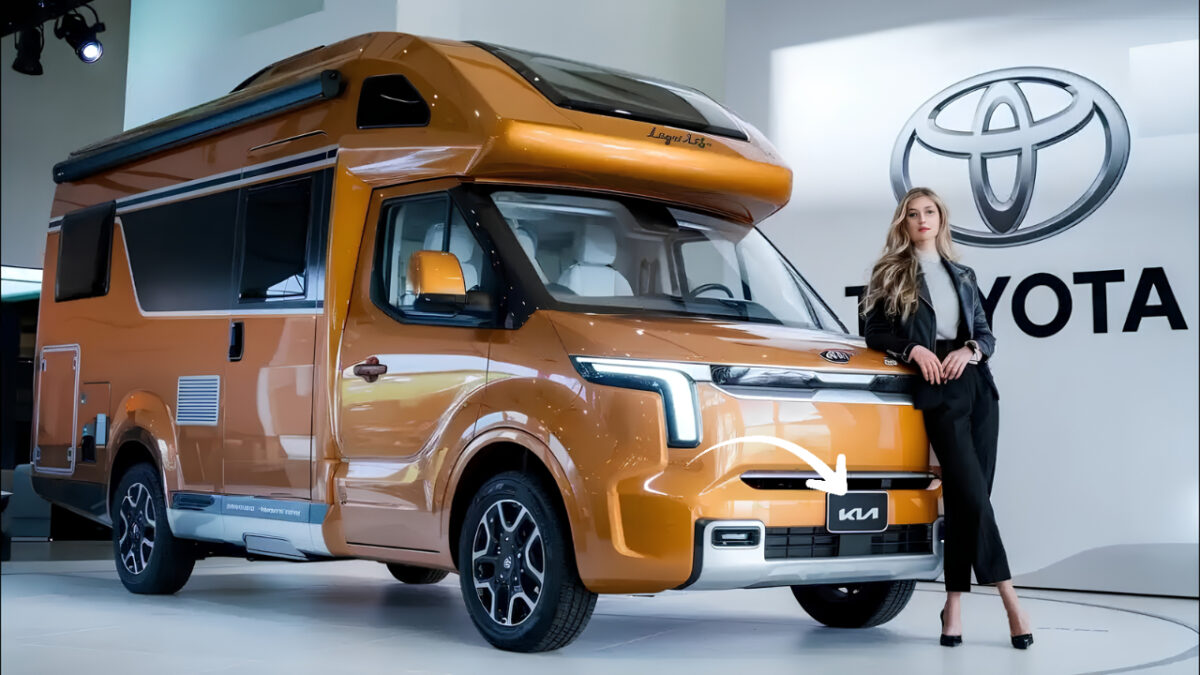
Revealed at the 2024 SEMA showcase, the PV5 WKNDR introduced Kia’s vision of an electric escape vehicle. Its lifted stance, off-road tires, and adaptable interior gave the practical van a more adventurous personality.
Kia also highlighted an exterior storage arrangement called Gear Head, designed to shelter equipment outside while the vehicle is stationary.
That approach addresses an issue familiar to anyone who has camped in a small vehicle: outdoor gear quickly competes with living space. Moving equipment outside can free the cabin for relaxing, organizing belongings, or settling down after a long day outdoors.
Modular Design Is the Main Attraction
Beneath the camper conversation sits Kia’s dedicated E-GMP.S architecture. The company describes this platform as the basis for different body configurations, including Passenger, Cargo, and Chassis Cab versions of the PV5.
Its broader lineup also identifies a Light Camper direction. The important idea is flexibility rather than one fixed interior. A vehicle developed around multiple uses gives designers and conversion specialists room to explore different layouts.
For prospective campers, that could mean choosing between a relatively simple sleeping arrangement and a more specialized recreational conversion, depending on what eventually reaches their particular market.
A Camping Kit Makes the Idea More Practical
One tangible development arrived in February 2026, when reporting detailed an officially branded PV5 camping kit developed by California company Vanlab.
Unlike the elaborate WKNDR, this package uses a removable, flat-pack approach intended for the PV5 Passenger. The arrangement works with the folding rear seats to create a double bed while retaining seating for five when traveling.
Its appeal lies in that everyday versatility. A van does not necessarily need to become a permanent miniature apartment to support a satisfying weekend away. For some households, preserving normal passenger use could be the more attractive compromise.
American Involvement Does Not Mean American Availability
The Vanlab connection gives this story an American angle, but it should not be mistaken for confirmation of a United States vehicle launch. Reporting on the kit explained that it was introduced through Kia’s accessories operation in South Korea, while the United States had not been confirmed as a PV5 market.
That geographical distinction is easy to miss when headlines emphasize a California developer. An American company can help create a product intended initially for customers elsewhere. For domestic shoppers, a camper accessory announcement and an American dealership launch remain two entirely separate pieces of news.
Adventure Features Need Careful Interpretation
The WKNDR’s equipment explains much of its appeal. Coverage of the concept describes a pop-up camper attachment, solar panels, a winch-equipped front bumper, and an onboard air compressor.
The compressor was presented as useful for adjusting tire pressure or inflating an air mattress. Those features create a persuasive picture of a self-contained weekend vehicle, but they belong to the concept’s presentation.
They should not automatically be attributed to a standard PV5 or a removable camping kit. The difference between an imaginative show vehicle and a finalized customer specification remains central to understanding Kia’s camper plans.
What Matters for Travelers in the USA
For American readers, the immediate question is not whether the camper looks appealing. It is whether Kia will establish a confirmed domestic offering with clearly defined equipment and availability.
The official American WKNDR page provides no purchase option and explicitly labels the vehicle unavailable. Until a production announcement changes that position, descriptions of a ready-to-order American WKNDR would overstate the evidence.
The useful story is the development path: a modular electric van, recreational experimentation, and accessories that demonstrate how the underlying vehicle can support camping without necessarily becoming a dedicated full-time recreational vehicle.
An Emerging Camper Story, Not a Finished American Launch
Kia’s camper developments deserve attention because they connect an actual electric van platform with increasingly concrete recreational applications.
The global PV5 program includes a Light Camper direction, while the Vanlab package shows how a simpler conversion can work alongside ordinary passenger use.
Neither development turns the WKNDR into a confirmed American production model. For now, the clearest reading of the 2026 news is also the most grounded: Kia’s electric camping ambitions are progressing, but United States buyers still need an official market announcement before treating those ambitions as a vehicle they can order locally.