
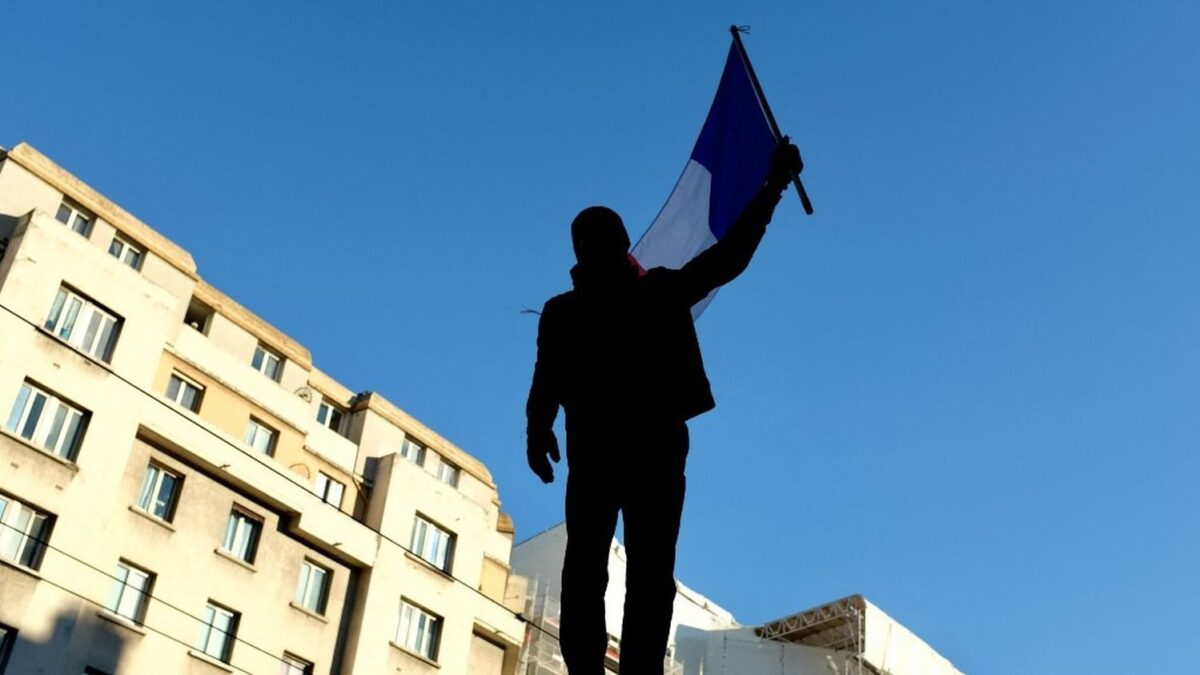
French administrative house arrest orders against protesters, Digi Mart USA News (France): Did authorities unlawfully prevent activists from demonstrating on October 24 and 31? Lawyers, unions and associations say the Interior Ministry has used individual administrative orders to place people under house arrest, based on anti-terrorism legal tools.
“Nothing justifies suspecting them, terrorism is a convenient excuse. The ministry is misusing anti-terrorism legislation,” Nathalie Tehio, president of the Ligue des droits de l’homme (LDH), told franceinfo.
Numerous organizations, including the LDH, the Syndicat de la magistrature and the Syndicat des avocats de France, denounced at a press conference on Wednesday what they called an “authoritarian shift” in power. They said the state of law was being diverted to silence “any dissenting voice” before a new day of social protest on Thursday.
These defenders of civil liberties have referred the matter to the Conseil d’Etat, notably over orders preventing protesters from reaching a gathering point.
Most of these orders, in force from Friday evening to Sunday evening, rely on the “Mesures individuelles de contrôle administratif et de surveillance” (Micas) framework. Stemming from the 2015–2017 state of emergency, these measures were transferred into ordinary law through the Silt law of October 30, 2017.
They include a perimeter restriction, often the size of a commune, daily reporting at a police station, or a ban on entering certain areas.
At least sixty cases over the weekend of October 31: A smaller share of these enforceable decisions takes only the form of a ban on entering areas, under a March 2026 law on the organization of the 2030 Olympic Games. In both cases, these legal provisions may only be applied to “prevent the commission of acts of terrorism.”
Interior Minister Laurent Nuñez told the National Assembly’s inquiry commission on the October 17 violence on Tuesday that about twenty bans on entering areas had been issued, “notably on the 24th” of October. “We also took a number of individual administrative control and surveillance measures, motivated by the risk of insurrection.
The calls were explicit for October 31, for Halloween night.”
Aïnoha Pascual, a lawyer for several activists, and other lawyers estimate that at least sixty people were subject to Micas for the weekend of October 31. According to her, no evidence exists to justify “their link to a terrorist entity.” Although they are engaged in causes such as ecology, antifascism or support for Palestine, most have clean criminal records.
Some were prosecuted for “ordinary offenses,” Pascual noted.
“We denounce these anti-terrorism tools, which are now used not against terrorism but against political opponents,” lawyer Arié Alimi told France 3 Bourgogne Franche-Comté. In the past, Micas, which may be imposed for a maximum of three months and renewed, have already drawn criticism.
Originally they were used against “jihadist returnees from Syrian prisons” or “radicalized people with psychiatric disorders,” recalled Serge Slama, a professor of public law at Université Grenoble Alpes.
Then, during the 2024 Paris Olympic and Paralympic Games, Micas multiplied, “with a broader scope and many minors concerned,” without a genuine terrorist risk being established, Slama continued. That summer, the Interior Ministry issued 547 Micas, of which 178 were challenged in administrative court and 52 were annulled or suspended.
Regarding the orders issued in recent days, Slama again said that “the conditions are not met.” “The Penal Code contains a precise definition of terrorism. It means seeking to provoke terror, to terrorize the population,” the jurist noted.
“They attribute to him the diversion of a procession”: David*, an activist from the Vienne department, was served a Micas by gendarmes the day before October 31. According to the order seen by franceinfo, he is accused of being “close to the local far-left and radical ecology movement,” of having attended a July 2024 Soulèvements de la Terre demonstration that ended in a blockade, and of having taken part, “with his tractor,” in an undeclared mobilization in Poitiers on October 24, ultimately leading the procession.
The ministry also justifies its decision by a broader context: calls for “insurrectionary actions” for October 31, the attack in the Yvelines on October 23, and the “numerous clashes and scenes of chaos” that marked October 17.
On France Inter on Wednesday morning, a pro-Palestinian activist without a criminal record, who was also targeted by a Micas for the weekend of October 31, said she had “never been in police custody, never made the slightest tag on a public road.” She denounced an unfair procedure in which “they are trying to gag political activists.” She had also testified on Sunday to ICI Belfort-Montbéliard.
“Being an activist does not make me a terrorist. Having the right to demonstrate taken away is very brutal.”
These orders also targeted trade unionists. On Instagram, Solidaires 63 reported that one of its members was served a Micas on October 30, notably because he was seen near a high school “as part of the student movement during which projectiles were thrown.” “They also attribute to him the diversion of a procession of 250 people from the route declared during the October 17 demonstration, when it was a collective decision,” the movement asserted.
Speaking to AFP, lawyer Raphaël Kempf said that “dams have broken since the Interior Ministry began labeling the actions of October 17 as terrorist.” According to his colleague Mathilde Lanté, Micas also often rely on “notes blanches,” intelligence documents that do not reveal their sources.
“Notes blanches were used extensively during the 2015–2017 state of emergency,” Slama explained. “Their principle is not objectionable, but the Interior Ministry has grown accustomed to using them abundantly.
Normally, interpretations of these notes should not be used by the administrative court if there is an appeal. Except that the judge, especially when examining urgently, may end up relying on them.”
Deadlines complicated appeals: In principle, activists can contest ministry orders by filing an urgent appeal with the administrative court. But in practice over the October 31 weekend, lawyers complained of notifications sent late by the ministry, sometimes the evening before the demonstration.
A Micas must be notified to the person concerned at least 48 hours before taking effect, a period extended to 72 hours for a ban on entering areas alone, unless there is “duly justified urgency,” according to the Code de la sécurité intérieure.
“This deprives applicants of the possibility of effective recourse, since if you have the possibility of referring the matter to a judge within 48 hours, you still need to receive notification of the measure within a sufficient time,” lawyer Vincent Brengarth told RTL.
“There is an administrative tactic to prevent the exercise of appeal rights. Yet Article 13 of the European Convention on Human Rights also requires this right to an effective remedy.” Nathalie Tehio, LDH president, told franceinfo.
The pro-Palestinian activist interviewed by France Inter said her urgent appeal “was not even examined.” “When it reached the administrative court judge, my Micas had already been lifted, since it was only for two days,” she said. David’s appeal was suspended by the Poitiers administrative court “at 6 p.m.
on Saturday,” too late to allow him to attend the demonstration, his lawyer said. In Clermont-Ferrand, the court rejected another activist’s appeal in time, as lawyer Nicolas Hervieu denounced on X.
The same occurred for Gérard, an environmental activist from Lot, interviewed by France 3 Occitanie.
Lawyers have announced their intention to challenge these decisions on the merits. Administrative judges will therefore have to rule on the legality of these orders within fifteen days.
Separately, it is also possible to bring the matter before the European Court of Human Rights. In May 2024, the court found France in violation over the house arrest of an environmental activist in 2015 during COP21 in Paris, according to the specialized outlet Le Club des juristes.
But nine years after the events, this important ruling received “no media attention,” Slama lamented.
A Marseille teacher who was subject to a Micas on October 30 and 31 told franceinfo that these measures had made him reconsider. He said he would keep protesting.
“I think the government will not succeed in really halting the social movement with bans like these.”
The Interior Ministry, asked for the precise number of these orders since the start of the social protest and to respond to recent criticism, did not respond.
* The first name has been changed.











