
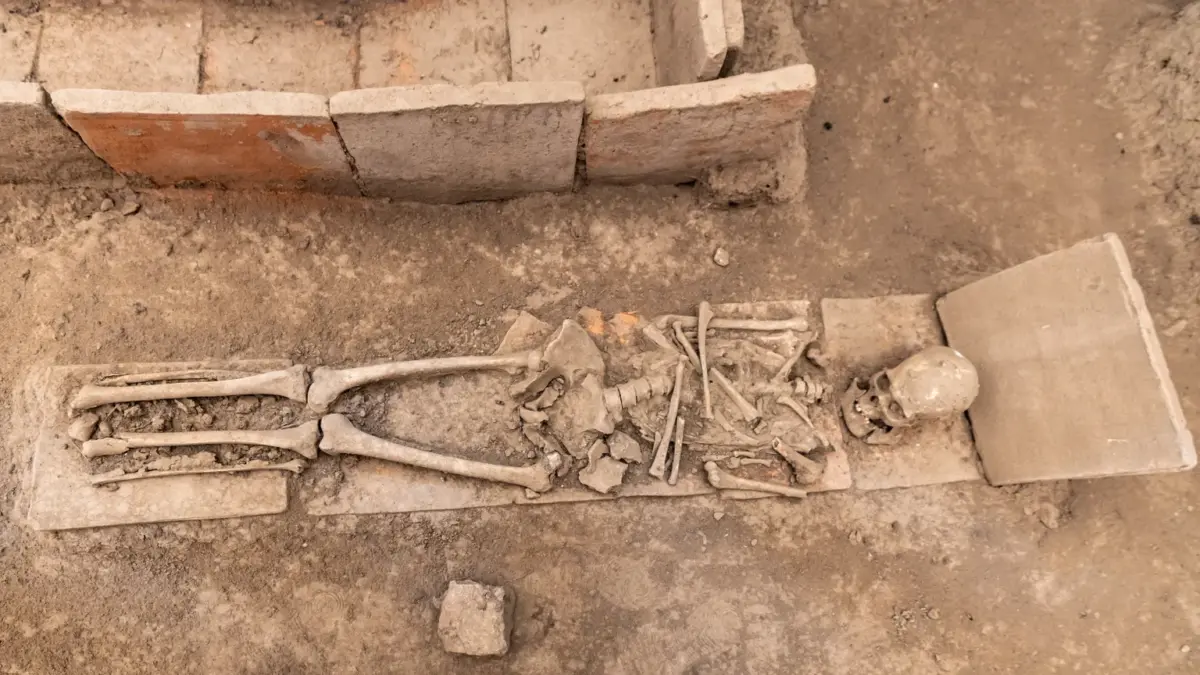
INAH possible prehispanic ossuary discovered during Mexico-Querétaro train construction in Mexico City, Digi Mart USA News (Buenavista station area, Mexico City): The National Institute of Anthropology and History (INAH) announced the discovery of a possible ossuary during construction work for the Mexico-Querétaro Passenger Train, near the Buenavista terminal in Mexico City. The find includes human remains, ceramic pieces and various objects that could provide information about the funerary practices of communities that inhabited the area several centuries ago.
The discovery was made on September 17, 2026, during earthwork for the laying of the railway track. The first skeletal remains were identified through archaeological rescue work coordinated by archaeologist Víctor Francisco Heredia Guillén, under INAH supervision.
According to specialists, the deposit may correspond to the Late Postclassic period, between 1200 and 1519 AD, or to the period of contact with the Spanish, from 1519 to 1535 AD.
What was found during Mexico-Querétaro train works?
After excavating approximately 1.40 meters deep, archaeologists located skulls, jaws, fragments of hips, femurs, ribs and teeth. Deeper down, they identified a funerary deposit without anatomical relationship between the bones, a characteristic that points to the possible existence of an ossuary.
So far, specialists have counted nine skeletons. Two of them show cranial modifications, in addition to five jaws and large bones, including radii, tibiae and iliac bones.
The condition of some remains will allow studies to determine age, sex and other characteristics of the individuals. These analyses will be carried out by the Physical Anthropology Laboratory (LAF).
Researchers also found archaeological materials associated with the Azteca III period, dated between 1350 and 1520 AD. For specialists, the combination of human remains and ceramic objects could offer information about the final years of the prehispanic period and the early colonial era.
The deposit was located in what was formerly the calpulli of Nonoalco, one of the 19 prehispanic neighborhoods of the Tlatelolco islet. Another notable element is its proximity to the Church of San Miguel Nonoalco, built during the 16th century and used as a visiting chapel by Franciscan friars of the Convent of Santiago Tlatelolco.
After documenting and recording the materials at the discovery site, specialists transferred the pieces to the laboratories of the archaeological project in Tula de Allende and Tepeji del Río de Ocampo, Hidalgo. There they will undergo cleaning, restoration and analysis to determine their dating and characteristics.
Claudia Curiel de Icaza, Secretary of Culture of the Government of Mexico, said the discovery will deepen knowledge of the ancient communities that inhabited the territory where Mexico City now stands.
Ultimately, INAH’s research results will shed more light on funerary practices, customs and historical changes experienced by the populations of Nonoalco and Tlatelolco.











