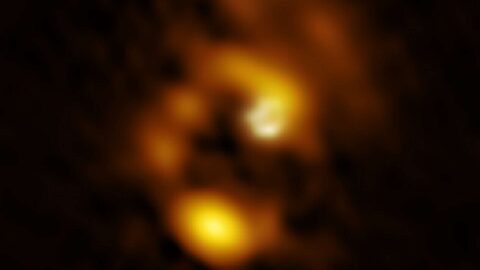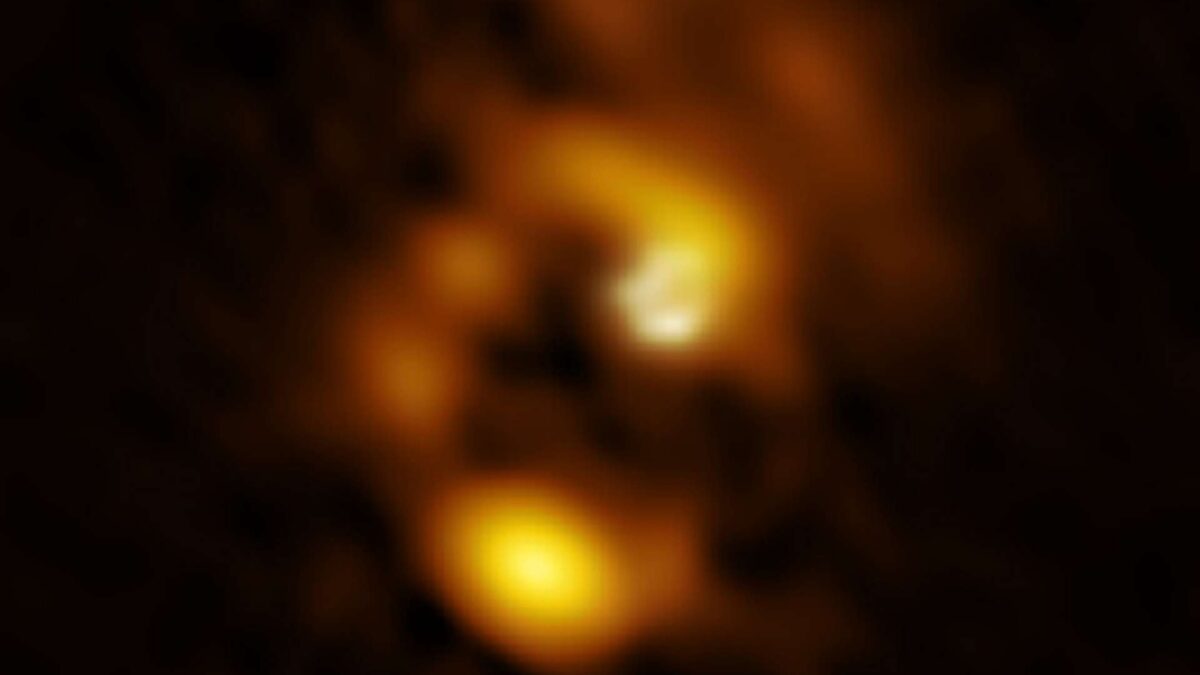
Mira Ceti, Digimart Global (Constellation Cetus, about 330 light-years from Earth): Known since 1662 as a “wonderful” star, Mira Ceti has once again surprised astronomers. Observations from the Atacama Large Millimeter/submillimeter Array (ALMA), a radio telescope complex in Chile, show a vast loop of material ejected far from the star.
According to the report by Futura Sciences, the loop extends up to 10 astronomical units from the star’s surface, a distance comparable to the gap between the Sun and Saturn. Mira Ceti is a red giant, a stage in the life of a star near the end of its life, which sheds its outer layers into space.
Astronomers had long believed that such mass loss came from continuous and moderate stellar winds, in which light pressure pushes dust grains away from the star’s surface. The scale of the ejected structure now challenges that view.
Researchers from Chalmers University of Technology in Sweden, publishing in the journal Astronomy & Astrophysics, argue that a more powerful mechanism is at work, probably linked to the star’s magnetic field. According to that research, magnetic outbursts may account for most of the mass the star loses, with repeated appearance and disappearance of hot spots like the one observed by ALMA.
Mira Ceti was the first pulsating variable star recognised by astronomers, with a brightness cycle of about 333 days that was long unexplained. Modern observations, the report notes, confirm that the name “the wonderful” is more justified than ever.