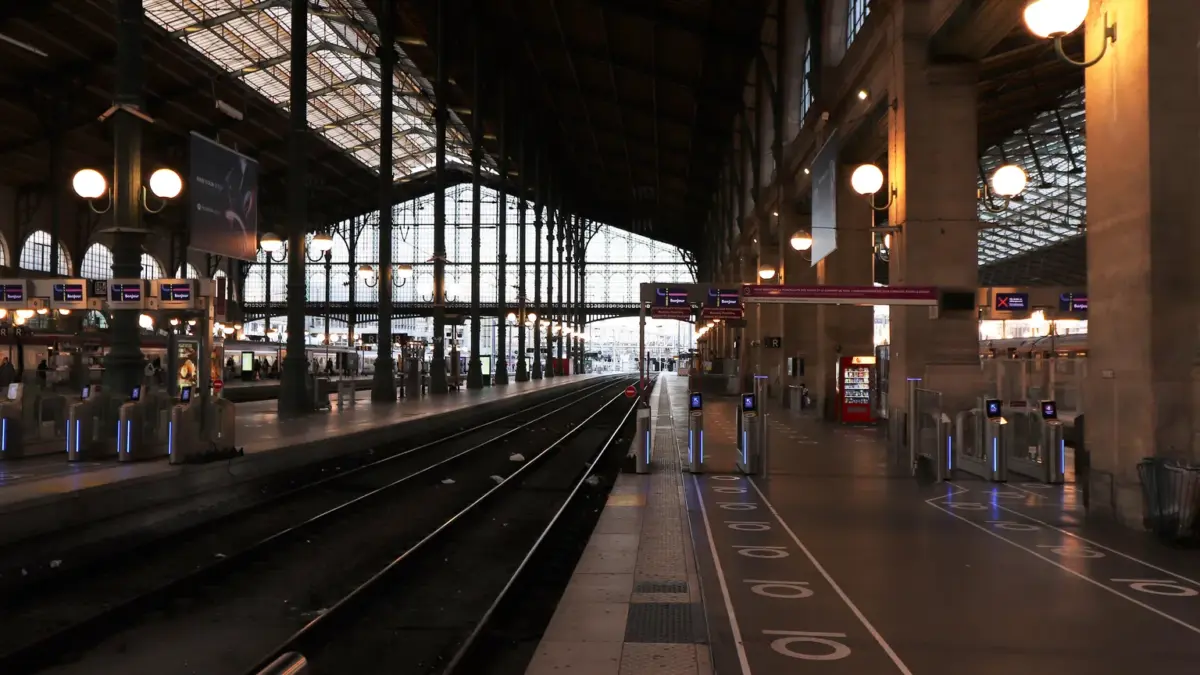
SNCF strike November 5 train disruptions France, Digi Mart USA News (France): Rail traffic will be “disrupted” to “heavily disrupted” on Thursday on regional lines, as well as on certain RER and Ile-de-France train lines, due to a cross-sector social movement, according to SNCF, which made the announcement Wednesday evening. Traffic on the major intercity routes will be better preserved, with one in ten TGV high-speed trains cancelled.
In the Ile-de-France region around Paris, service will be affected on RER lines B, C, D and E, as well as on train lines J, L, H, N, R and U. Trams, buses and cable cars, along with RER line A and lines K, P and V, will operate normally, according to SNCF Voyageurs Ile-de-France and Ile-de-France Mobilités (IDFM).
Daily commuters will be affected across all regional networks. In Auvergne-Rhône-Alpes, Brittany, Occitanie, certain routes in the Provence-Alpes-Côte d’Azur region and in the Hauts-de-France region, regional TER train services will be “heavily disrupted” on Thursday, and that disruption will continue into Friday morning, particularly in Hauts-de-France, SNCF said on its regional websites.
Elsewhere, traffic will be at least “disrupted” until Friday morning, including in Bourgogne-Franche-Comté. SNCF advises passengers to check train schedules and connections before travelling.
Ile-de-France Mobilités said detailed line-by-line traffic forecasts are available on mobility websites and apps.
The four representative unions at the national rail company, CGT, Unsa ferroviaire, Sud Rail and CFDT, have called a unified 24-hour strike on November 5, joining the national call of the major confederations to defend wages and employment. Although they obtained a bonus and increased allowances from SNCF management on Tuesday, their demands center on catching up with inflation for all SNCF salaries in 2026.
More broadly, rail unions denounce a “regressive budget” that they say will “worsen poverty, cut into Social Security, freeze civil servant salaries and drain resources for the ecological transition.”