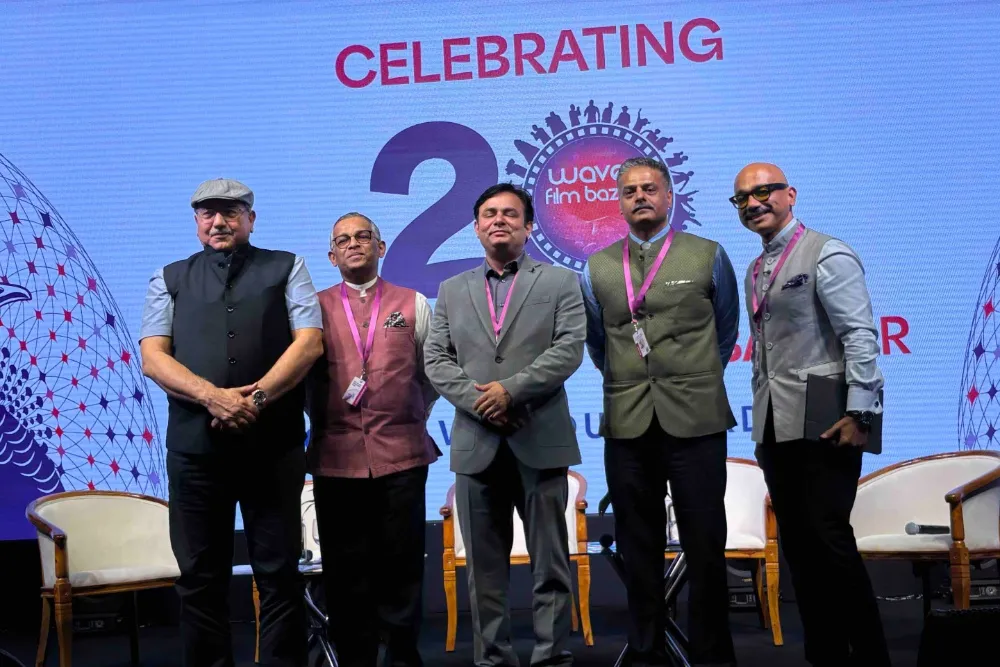
India AI workforce, Digimart Global (Goa, India): India plans to bring at least 10 million people into its AI workforce through the National AI Talent Mission, recently launched by Prime Minister Narendra Modi. The target was described by Lt.
Col. Vikram Singh Bhati, director of the National Council for Vocational Education and Training (NCVET), during a panel at WAVES Film Bazaar.
The session, titled “AI and the Future of Creative Skills: Transforming India’s Media & Entertainment Workforce,” was held alongside the 57th International Film Festival of India (IFFI) in Goa. It was moderated by voice-over artist and actor Vijay Vikram Singh and included Amit Meena of the Ministry of Skill Development and Entrepreneurship, K.
Satish Nambudiripad of the Centre for Creative Economy and Public Policy at the National Institute of Technology Calicut, and Biren Ghose, founder and CEO of Astra Studios.
Government Skilling Push
Bhati said the effort began with the ministry launching a scheme called SOAR (Skilling for AI Readiness) to prepare workers for AI. He also urged companies to take part, saying the industry should start absorbing people through an apprenticeship model to help both existing workers and new entrants adapt.
Changing Creative Work
Meena said AI is changing the production chain from conceptualization to release, adding that it is “democratizing the whole process.” He stressed the need to reskill existing workers as those changes take hold.
Nambudiripad warned that AI tools tend to homogenize output, and that India’s folklore, regional languages and cultural nuances could be flattened if training does not account for the country’s diversity. He called for technical institutions, film schools and industry to work together, and for skilling to reach tier-two and tier-three cities.
Ghose said creative skills are shifting from execution to imagination, and from software proficiency to technology orchestration. He also called for creative technology skills to be recognized in sectors beyond film and gaming.