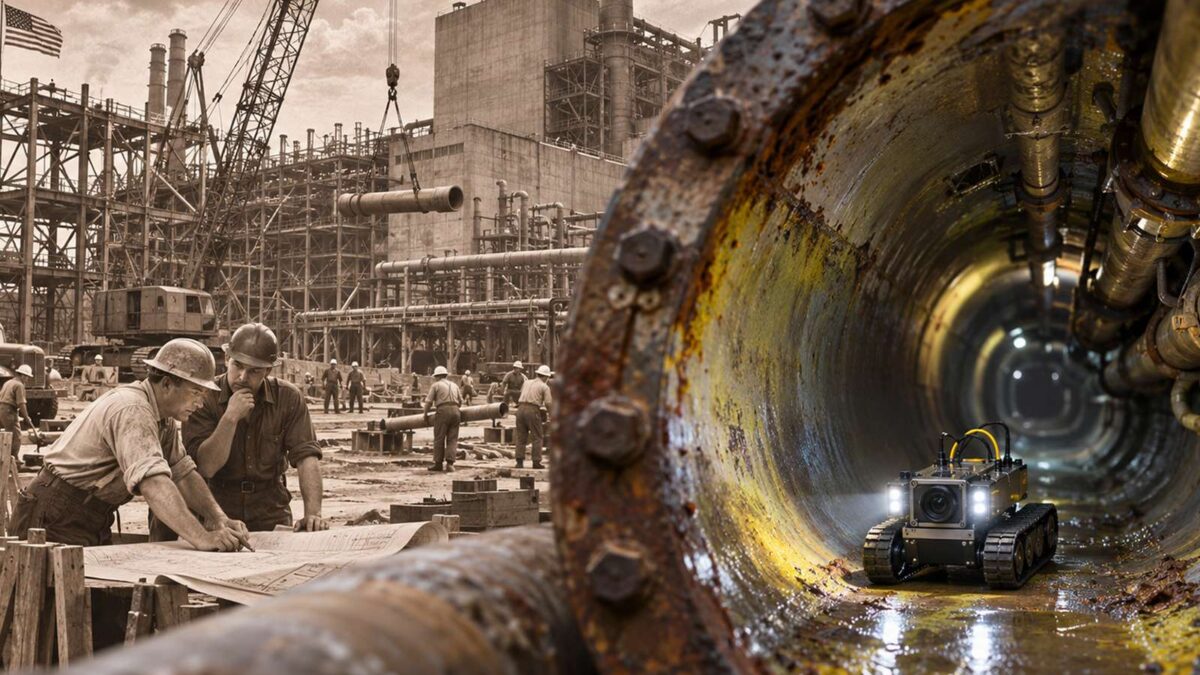
Hanford nuclear site robot, Digimart Global (Washington State, United States): The Hanford nuclear complex, built by the United States in 1943 on the banks of the Columbia River as part of the Manhattan Project, still holds large quantities of radioactive waste. Its first reactor was the world’s first built to produce plutonium on an industrial scale, and although plutonium production has stopped, the site remains a major nuclear cleanup project.
Radioactive waste from decades of production is stored in underground tanks linked by a network of pipes. These aging pipes must be inspected for signs of corrosion or cracks.
The double-walled pipes are buried, can extend several hundred meters or more, and include many right-angle bends. Some measure only 5.1 centimeters in diameter, and digging them up would be costly and complex, without necessarily revealing internal corrosion.
Standard inspection cameras can typically advance only about three meters, while ultrasonic probes are often too bulky to pass the bends. To address this, engineers at Sandia National Laboratories developed a robot called SPIINE, which was presented in the journal Robotics.
SPIINE measures just 15.2 centimeters long and has a flexible chassis, six deformable wheels, a high-resolution camera and adjustable LED lighting. It is operated with a simple video game controller and can conform to pipe walls, negotiate 90-degree turns and change direction at junctions.
A key challenge is the cable that supplies power and carries data. Friction increases at each bend, making progress difficult.
The researchers therefore proposed linking several motorized modules along the cable to distribute the pulling force.
Still being tested for real-world conditions
Initial laboratory tests were described as successful, but SPIINE has not yet been proven under actual conditions at Hanford. Engineers are working on a self-cleaning system for the camera, a recovery mechanism in case of failure, and miniaturized ultrasonic sensors able to measure wall thickness.
In the long term, the small robot could help support one of the largest nuclear cleanup projects in the United States while limiting workers’ exposure to radioactive waste risks.