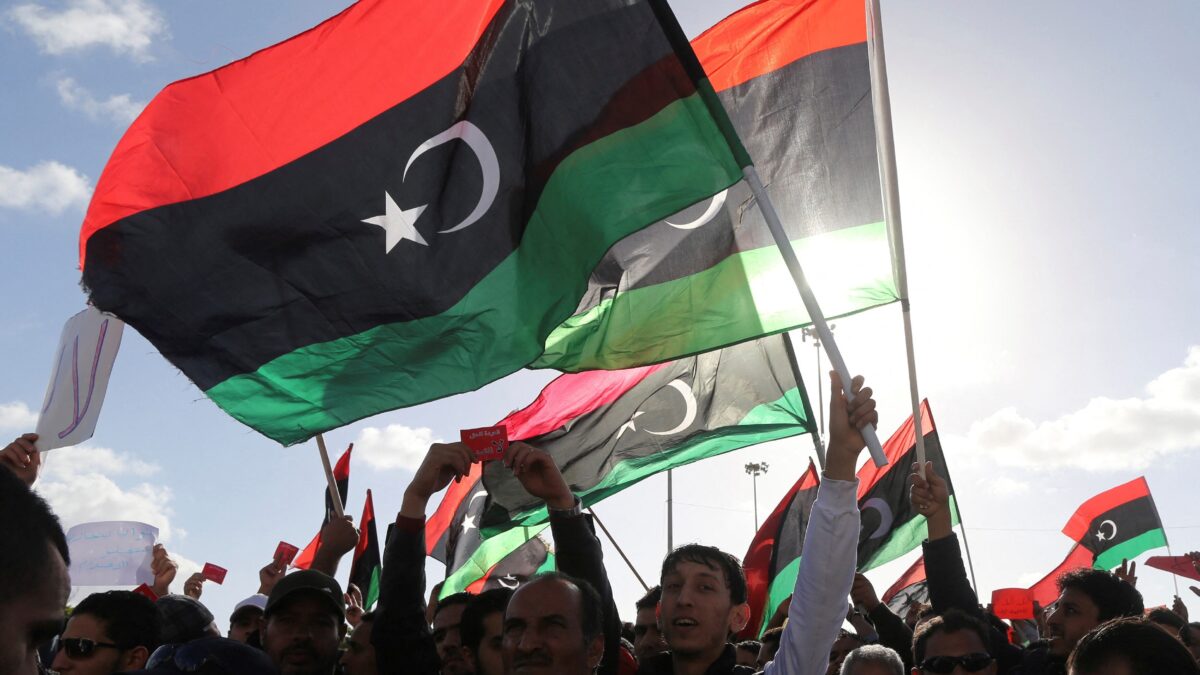
Libya conflict, Digimart Global (Libya): Ukraine’s sinking of a Russian naval vessel at the Benghazi naval base in eastern Libya on Sunday showed how a long-paralysed conflict in the North African country, involving a number of regional powers, risks triggering fresh outbreaks of instability.
The Libya conflict has its roots in the 2011 Nato-backed uprising that ended Muammar Gaddafi’s 42-year rule. An attempted democratic transition was derailed as groups of fighters built local power bases around rival political factions and seized economic assets.
Fighting in the capital, Tripoli, followed an election in 2014, after which most new parliament members moved east, recognised Khalifa Haftar as military chief and set up a parallel administration there.
How the Divide Deepened
A UN-backed political agreement was meant to reunify the warring east and west, but eastern factions rejected the deal. In 2019, Haftar’s Libyan National Army (LNA) attacked Tripoli.
Backed by the United Arab Emirates, Russia and Egypt, the assault was staved off by western factions supported by Turkey, leading to a 2020 truce that stopped major warfare.
A later UN-backed effort installed an interim Government of National Unity and planned elections for 2021, but the vote was cancelled amid disputes over the rules and candidate eligibility. With no agreement among rival factions on a way forward, the conflict has remained paralysed and the country divided.
Tripoli lacks sway over much of Libya’s territory, and foreign powers remain dug in on the ground.
The Foreign Powers Involved
According to the publisher’s account, Russia was an early supporter of Haftar. A UN panel of experts reported in 2019 that Russia’s Wagner company had up to 1,200 mercenaries in Libya, and in 2020 the US said Moscow sent warplanes; Russia denied sending troops or jets.
After the 2020 ceasefire, the US military’s National Geospatial-Intelligence Agency said Russia continued to expand facilities at six LNA-controlled airbases and had docked warships at LNA-controlled naval bases. Analysts say this presence helps Russia project influence deeper into Africa, and the government in Tripoli has called for Russia to leave.
Two Libyan security officials said in March that Ukrainians were operating out of western Libya, providing training to forces affiliated with the Tripoli government while also carrying out operations against Russian targets. The Government of National Unity has not denied a Ukrainian presence in western Libya but says it will not permit Libyan territory to be used as a launchpad for attacks.
Turkey sent troops, drones and armoured vehicles in 2019 at the request of the internationally recognised government to help fight off Haftar’s attack, and retains a military presence in western Libya with Tripoli’s support, including an airbase at al-Watiya and a naval base in Misrata. The UAE’s backing for Haftar dates to 2014, when it saw him as a bulwark against factions linked to the Muslim Brotherhood.
UN experts said the UAE supplied drones, air defences and armoured vehicles to Haftar; the UAE has denied these allegations and has since built ties with Libyan Prime Minister Abdul Hamid Dbeibeh.
Oil, Migration and the Path Ahead
Libya is a major oil exporter, with output of up to 1.3 million barrels a day, and revenue has long been the biggest prize for the main factions, leading to repeated production and export shutdowns. Most oil fields and terminals are in areas controlled by the LNA in the east, but under international agreements all revenue must go through the central bank in Tripoli.
Groups have closed oil terminals or halted work at fields as a tactic to pressure the Tripoli government.
US Libya envoy Massad Boulos is promoting an initiative intended to unify Libya’s state institutions and pave the way for elections. Details have not been announced, although Boulos has said the sides agreed on a comprehensive and clear framework for unification.
Analysts say the push would be based on the Haftar family, which dominates in the east, and the Dbeibah family, which dominates in the west, agreeing to share power. One proposal would keep Dbeibah as prime minister in a new government with Saddam Haftar heading a presidential council, a formula that may worry Libyans who fear the main power brokers will not allow real change.
For European countries, Libya’s role as a departure point for migrants crossing the Mediterranean is also important.