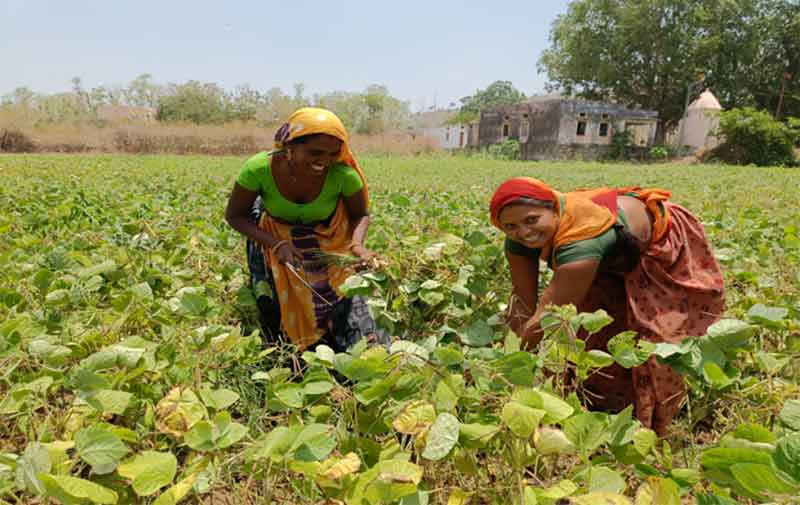
Vaagdhara, USA News (Dungarpur and Banswara districts, Rajasthan): In the tribal heartland of southern Rajasthan, stories of development rarely begin with a gleaming building. More often they begin with the green bed of a nutrition garden, a stamp on a government paper, or a bag of indigenous seeds. Here, Vaagdhara’s faith rests on a simple idea: change is never imposed from outside; it grows from within the community. Village-level groups are its pivot, places where women and farmers identify their own questions and go looking for their own answers.
Among the stories that have flourished in the shade of these groups is that of Saju Devi and her husband Dhanji Meena, whose home is in Dhanela gram panchayat, just five kilometres from the block headquarters of Aspur in Dungarpur district. This family of two sons and two daughters once struggled to balance a month’s needs. Dhanji farmed, and went from village to village selling seasonal vegetables such as tomatoes, okra, bottle gourd, chillies, aubergines, ridge gourd and sponge gourd, but the income barely covered the household’s basic requirements.
Agricultural Struggles and Early Livelihoods
The family owns five bighas of land, four of them level and one uneven. The uneven plot could be cultivated only in the kharif season, and its yield went no further than fodder for the animals and grain for the household. The level fields gave a kharif crop, but by the time rabi arrived the water ran out, and wheat and gram could be sown on only a small patch. Two bullocks, two buffaloes and eight goats did not bring in enough to change their circumstances.
In 2020, Saju Devi joined the ‘Saksham Samuh’ formed by Vaagdhara. As she attended its meetings regularly, she began to see how far dependence on the market could be reduced by relying on local and limited resources. She established a nutrition garden on a small plot near her home, where beds of tomatoes, okra, bottle gourd, spinach and fenugreek began to flourish. The family’s meals became richer in nutrition and their health improved, and by selling the surplus she began earning between one and two hundred rupees a day in season.
Solar Energy and Government Schemes
The real turning point came in 2024. Shailendra Giri Goswami, a Vaagdhara facilitator, told her about the Pradhan Mantri KUSUM solar energy scheme, under which the central and state governments provide farmers with solar-powered irrigation pumps. With her husband’s support and the help of agriculture officer Rekha Meena, she applied online, and in November 2024 a solar pump stood beside her field. When the water came, the rabi fields came alive too, and wheat, gram, mustard, peas and green vegetables began to grow. The horticulture department also provided forty mango saplings to open a path to steady earnings.
Saju Devi shared this light with her village by telling Sunil, Kaluram and Bhemji Meena about the scheme and helping them apply. Meanwhile, elderly villagers faced other challenges, such as Alku Ben of Chhoti Padal village, whose old-age pension stopped in 2022 due to an age discrepancy on her Aadhaar card showing her as 49 instead of 66. In November 2024, during a Gram Swaraj group meeting held by community facilitator Prakash, member Manji Bhai raised the issue. The group visited Alku Ben, identified the error, and worked through the tehsil office and Bhogoro ka Kheda panchayat to correct her birth records. In May 2025, her pension was sanctioned, and arrears totaling ₹31,000 reached her account.
Reviving Traditional Farming in Bhun ki Ghati
In Bhun ki Ghati, located in Ghatol development block thirty-two kilometres from Banswara district headquarters, Hakru Bhai faced similar economic constraints on four bighas of land. After 2014, he used chemical fertilizers because organic produce fetched no fair market price, often forcing him to migrate to Gujarat for seasonal labor. In 2018, his wife Itri Ben joined the village’s first Saksham group, and by 2021 Hakru Bhai joined the Krishi evam Adivasi Swaraj Sangathan.
Trained by experts in seed production, conservation, and market knowledge, Hakru Bhai improved his produce quality and quantity. The shift back to traditional farming ended his seasonal migration, boosted his income, allowed him to educate his children, and enabled him to grow flowers earning an additional one thousand to fifteen hundred rupees a day during social occasions. His journey highlights how community organization and collective self-reliance continue to reshape rural lives across southern Rajasthan.