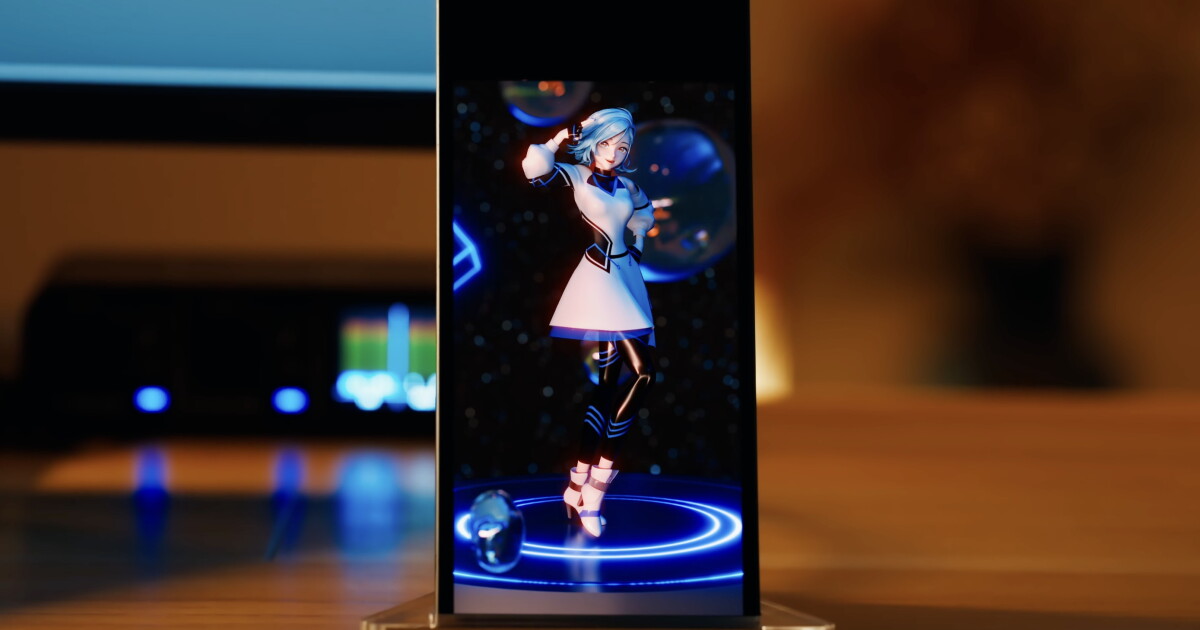
Sony ELF-MN1 glasses-free 3D desktop display, Digi Mart USA News: Sony has introduced the ELF-MN1, a 6-inch desktop display that brings its glasses-free spatial 3D technology to everyday users. Previously, Sony’s Spatial Reality Display monitors have mostly been used by designers, engineers and medical professionals, with price tags to match.
The ELF-MN1 is designed for personal content such as anime characters, avatars and digital figures rather than CAD models. Sony says it can make these characters appear to stand in front of the viewer without a headset or special glasses, and the device connects to a smartphone or PC with a single cable.
The display pairs an LCD with a micro-optical lens layer and a high-speed sensor that tracks the viewer’s pupils. As the viewer moves their head, the screen renders a separate image for each eye in real time, giving characters depth.
Sony has added an infrared sensor to its third-generation eye tracker to help maintain tracking in dim rooms.
The 6-inch panel has a resolution of 1,080 x 2,160 pixels, or 403 ppi, which Sony describes as the sharpest Spatial Reality Display it has made so far. It is rated at 470 nits with a 1,350:1 contrast ratio, and Sony says a two-viewpoint system helps reduce blurring and ghosting.
The 3D effect works best from 30 to 80 cm (12 to 31.5 inches) away, and it is intended for one viewer at a time.
The display weighs 300 g (10.5 oz), or 350 g (12.3 oz) with its acrylic stand. It includes 1-W stereo speakers and a microphone for voice-interactive apps.
It connects over USB-C to recent iPhone, Pixel, Galaxy and Xperia phones, or to a Windows 11 PC with an RTX 2070 Super-class GPU. With a sufficiently powerful power adapter, it can also charge a connected phone while in use.
The ELF-MN1 is scheduled to launch in Japan on December 11 with an estimated street price of around ¥54,000, roughly US$340. Sony has not said whether it will be sold in other markets. For comparison, the 27-inch ELF-SR2 sells for around ¥550,000 in Japan.
At launch, content is available through several compatible apps, including Gugenka’s HoloModel digital figure service, Deskrium, Animates and Fenestra. Sony also provides a Unity SDK with OpenXR support for developers building apps for Windows, Android and iOS, and says it plans to work with XR and spatial content creators on new material.