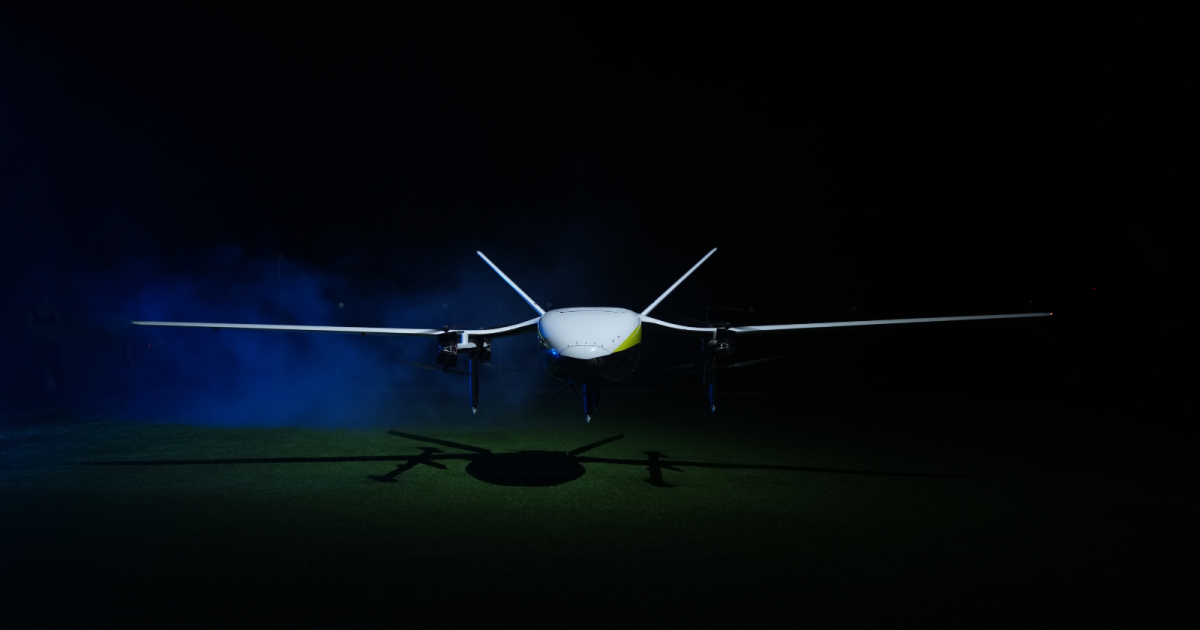
Skyways Skyreach cargo drone, Digi Mart USA News: Texas startup Skyways says its new Skyreach drone can carry urgently needed parts to offshore platforms or troops in contested areas without a crewed helicopter, and that it can do so for roughly a tenth of the cost while flying more than 1,300 miles (2,092 km).
Skyreach is a hybrid vertical takeoff and landing aircraft with eight electric motors that lift it off the ground like a multicopter, and a two-stroke heavy-fuel engine that takes over for cruise flight. The engine burns jet fuel, the same fuel used by airports and armed forces, and a generator keeps the batteries charged in flight, so the batteries do not need to be plugged in or swapped between missions.
The drone has a 22-foot (6.7 m) wingspan and a 7-cubic-foot (198-liter) cargo bay that loads from the top and opens at the bottom, allowing it to airdrop a package or lower one on a tether without landing. Skyways says it can operate in winds of up to 40 knots and temperatures from -5 to 120 °F (-21 to 49 °C), and with the lightest load it can remain airborne for more than 18 hours.
The company does not publish a price or specify which helicopter its one-tenth cost figure refers to. Skyways CEO Charles Acknin told Tectonic that Skyreach currently costs about US$300 an hour to run, and that the company wants to reduce that to $100 with greater autonomy.
The 1,300-mile figure depends heavily on payload. According to the company’s spec sheet, it assumes just 10 lb (4.5 kg) of cargo on a one-way trip.
With 50 lb (23 kg) on board, the range drops to about 780 miles (1,255 km), and with 80 lb (36 kg) it falls to around 280 miles (450 km). Those figures also assume a steady 70-knot (130 km/h or 81 mph) cruise with no wind and 45 minutes of fuel held in reserve.
Skyways describes them as design figures that may change while Skyreach is still in flight testing.
The trade-off is driven by weight. Skyreach has a maximum takeoff weight of 360 lb (163 kg) and can carry about 100 lb (45 kg) of fuel and cargo combined, so each additional pound of payload reduces the fuel available for the flight.
Skyreach will replace the smaller V2, which Skyways says has already performed operational work at sea. In 2025 the V2 made cargo runs to RWE’s Arkona wind farm in the Baltic Sea, and Skyways has since signed a logistics partnership with DSV.
Skyways and Shell also announced that the FAA has cleared a V2 to fly beyond visual line of sight from Gibson, Louisiana, to an offshore platform in the Gulf of Mexico to inspect a pipeline and simulate a cargo drop. The FAA describes this as a first-of-its-kind authorization, and the flight has not yet taken place.
The military is also a target market. Skyreach is the production version of the aircraft behind a $37-million US Air Force contract awarded through AFWERX in June 2025 to move toward full-rate production.
Skyways says the V2 has flown missions for the Marine Corps, Navy and Air Force.
Skyways says it has started production in Austin, Texas, and will begin flying Skyreach with defense and commercial customers in December. Acknin said the company’s ambition is to deploy a network of more than 1,000 autonomous aircraft for defense and commercial customers within five years.