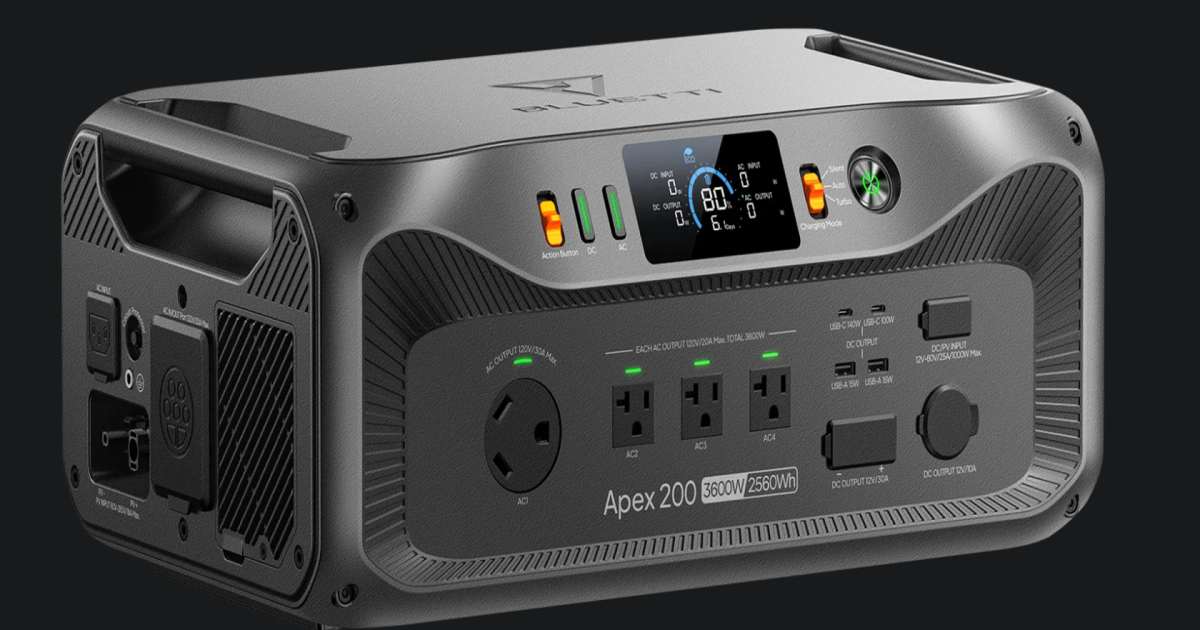
Bluetti Apex 200 expandable portable power station, Digi Mart USA News: A reviewer writing for New Atlas says that watching a kettle drain home energy shows how power-hungry household appliances can be. Monitoring solar generation, battery storage and electricity use reveals a common problem: the “morning gap” between a battery running low and solar panels producing enough power to take over.
That gap is hardest in winter, when days are shorter, the sun sits lower and households keep consuming electricity. Bluetti’s new Apex 200 is an expandable portable power station designed to grow with energy needs, though the reviewer notes that adding battery capacity does not automatically add electricity.
The Apex 200 starts with 2.56 kWh of lithium iron phosphate storage and a 3.2-kW AC output. Bluetti says additional battery modules can expand capacity to 33.28 kWh, with compatible parallel configurations offering greater output and storage.
The company targets camping, RV use and emergency home backup, with solar charging, app-based monitoring and individually controllable AC outlets.
In testing by Popular Mechanics, the Apex 200 powered a refrigerator for 27 hours, although results depend on the appliance and how hard it works. The introductory US$1,099 price runs through November 18, after which the advertised regular price is higher.
The reviewer argues that expandable storage is most useful when solar generation can refill it. Battery capacity, measured in kilowatt-hours, determines how much energy can be stored, while output power, measured in kilowatts, determines how much can be delivered at once.
A kettle may briefly demand 2.4 kW, but a three-minute boil uses only about 0.12 kWh.
Independent reviewers have noted that the US Apex 200 lacks the 240-V split-phase capability of Bluetti’s larger Apex 300, which may limit certain whole-home installations. At 59.3 lb (27 kg), the unit is portable but not light, making it more suited to vehicles, beach properties or occasional-use settings than to powering a whole house through a winter morning.
The reviewer’s advice is to measure consumption, identify essential loads, calculate the energy needed to bridge the gap until the next charging opportunity, and assess how reliably solar generation can replenish storage during the least productive months. The key, the reviewer concludes, is matching storage to generation and consumption rather than buying the biggest battery available.