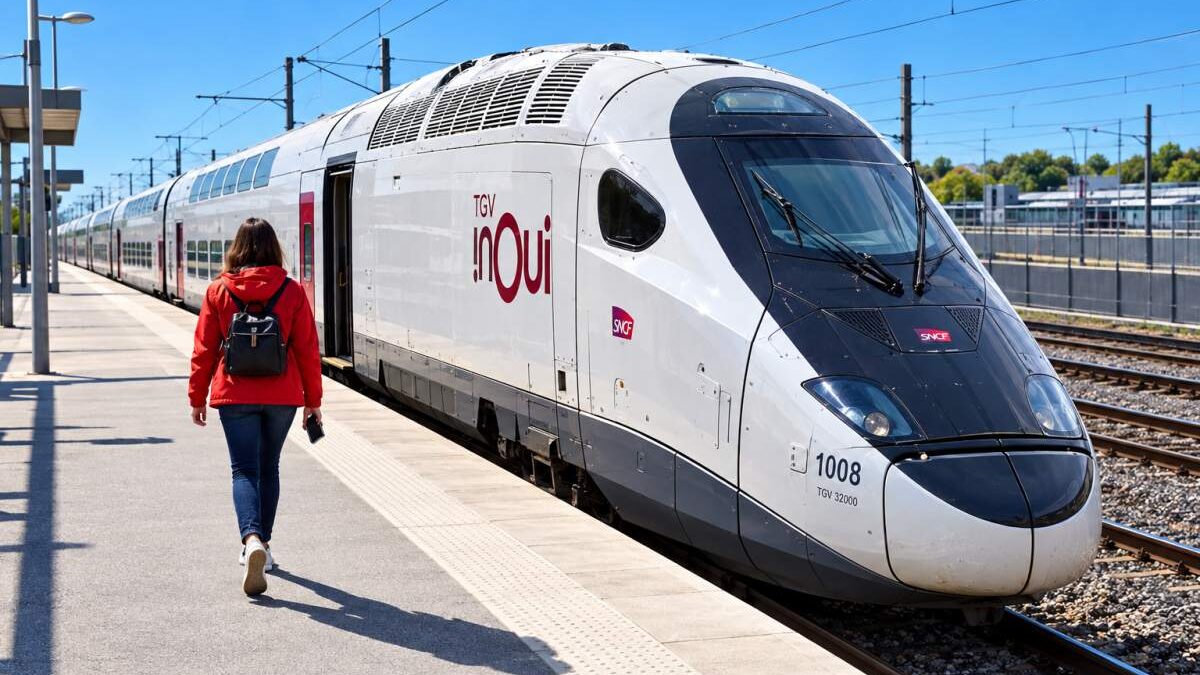
TGV M onboard Wi-Fi and 5G streaming on the Paris-Marseille route, Digi Mart USA News (France): The TGV M has carried passengers between Paris and Marseille since Monday, November 9, on a trip of 3 hours and 9 minutes. Alstom promises a “Wi-Fi architecture compliant with the latest 5G standard,” designed to support video streaming on board.
For travelers, the stakes are measured in gigabytes. Watching a series for the entire trip uses about 3 GB in standard quality and up to 21 GB in 4K on a mobile plan.
That 21 GB exceeds the average monthly data consumption of a French person. If the new train’s Wi-Fi delivers on its promise, those gigabytes stay off the mobile plan.
Free Wi-Fi on TGV INOUI trains has existed since late 2016. Its principle has not changed: rooftop equipment captures the 4G signal from operators along the track and redistributes it inside the cars as a Wi-Fi network, “regardless of your operator,” according to SNCF.
Passengers select the network SNCF_WIFI_INOUI and accept the terms on the wifi.sncf portal. On OUIGO, Wi-Fi is a paid option and video is restricted.
The problem is not the Wi-Fi itself but what sits behind it. Three limits add up: bandwidth is shared and quality remains lower than a home connection; every tunnel and coverage gap interrupts the link, just as with a phone’s mobile data; and the connection depends on the mobile network along the track.
The new trainset addresses the first and third limits from the inside, since it cannot change the trackside antennas. In September 2022, Alstom described a “Wi-Fi architecture compliant with the latest 5G standard,” and its then-CEO promised windows with “small holes that cannot be seen and that prevent the Faraday effect.”
SNCF itself qualifies its promise: the quality of internet access depends on the mobile networks available along the line. Better Wi-Fi does not mean a perfect connection for the entire journey, and a ticket marked “TGV INOUI” does not guarantee a new trainset.
Thirteen new trains are expected by the end of the year, with one daily round trip starting Monday, a second route, and Nice at the end of November.
Against coverage gaps, the only remedy is to stop relying solely on ground antennas. SNCF launched a consultation in July 2025 to prepare a tender for equipping its trains with a hybrid access system: mobile network when available, low-Earth-orbit satellite when it fails, with automatic switching invisible to passengers.
Two candidates are reportedly expected: Starlink, with more than 7,000 satellites and already equipping Scottish trains, and Eutelsat with its OneWeb constellation, backed by the French state.
In its communication on the TGV M, SNCF says a satellite solution is being tested. No contract award has been announced to date, and the timeline mentioned from the outset spoke of two to three years before large-scale deployment.
Airlines are ahead: Air France already offers satellite Wi-Fi to its passengers, and mobile operators are eyeing satellite frequencies to cover phones without network coverage. In the meantime, travelers should plan a trip as if the connection could drop.
The real concern for passengers is not the technology but the data bill. A series in standard quality consumes about 1 GB per hour, 3 GB in HD and 7 GB in 4K.
Over the three hours of a Paris-Marseille trip, the total ranges from 3 to 21 GB. For reference, the average French person uses 18.4 GB per month, so a single 4K trip on a phone’s 5G connection weighs more than an entire month of ordinary use.
These orders of magnitude depend on trip length, chosen quality and plan size. A single one-way journey can consume a large share of a monthly allowance when the train’s Wi-Fi does not hold up.
Exceeding a plan’s limit is costly: out-of-bundle data can cost up to 50 euros per gigabyte with some operators, and the operator’s app usage tracking and out-of-bundle blocking remain the main safeguards. Four habits help avoid surprises, whether or not the train is new.
When a train’s Wi-Fi is overloaded, the phone falls back to the operator’s network, and this is where plans differ greatly. Unlimited-data plans or plans of 200 GB and more absorb an HD trip without concern; a 20 GB plan can lose nearly half its monthly allowance.
Wi-Fi calling has the reverse problem: on board, calls pass through the train network when the operator offers it, and some smaller operators exclude it.
5G coverage along high-speed lines varies by operator, and the TGV M changes nothing here: its windows let the signal pass through but do not create it. For frequent travelers, the choice of plan matters as much as the choice of train, and the most generous data plans are no longer always the most expensive.
The TGV M’s connected comfort will arrive as trains are delivered: 160 trains have been ordered, including 30 for Eurostar, at roughly one train per month through 2032. Paris-Marseille comes first, then Nice at the end of November, and 12 to 13 round trips per day in early 2027.
On other routes, Wi-Fi will remain the 2016 version, shared and fragile, until satellite service or new trains arrive. A ticket does not guarantee the equipment: a new trainset can still be replaced by an older one on the day of departure.
There is one piece of good news independent of any timeline: the TGV M ticket costs no more than a standard TGV INOUI ticket. “The TGV M changes nothing about prices,” the SNCF chairman has repeated.
The gigabytes saved, however, have a very concrete cost on the end-of-month phone bill.