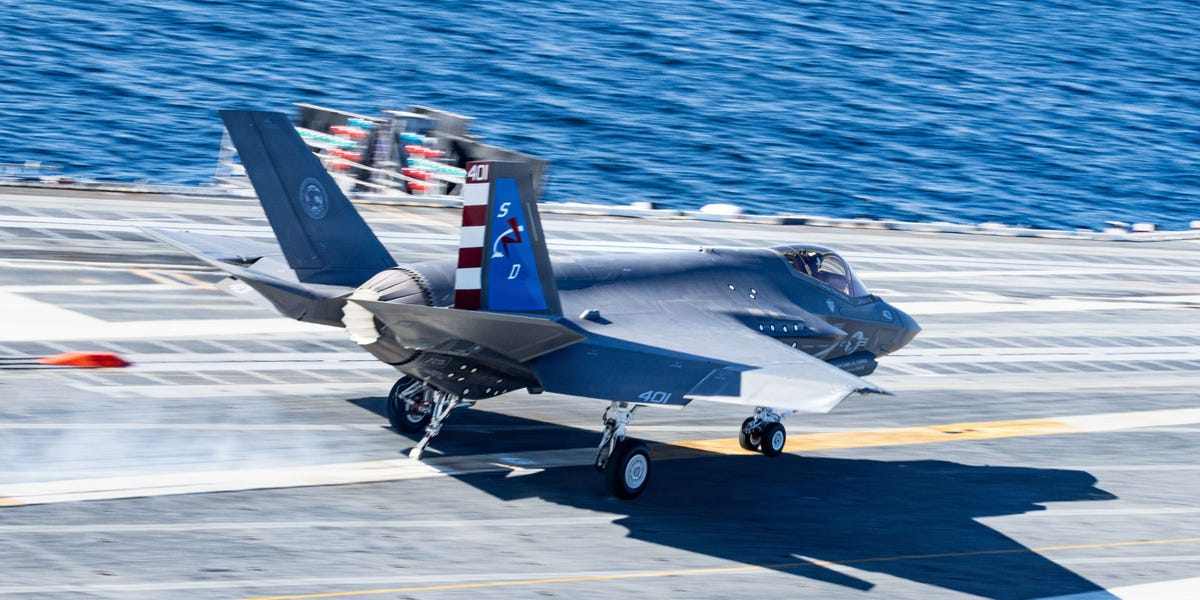
Pentagon F-35 parts inventory tracking GAO report, Digi Mart USA News: The U.S. Department of Defense is struggling to keep track of F-35 stealth fighter parts, according to a new government watchdog report.
The F-35 Lightning II Joint Strike Fighter program, the most expensive weapon system program in history, has faced consistent challenges with spare parts, rising acquisition and sustainment costs, and readiness issues.
On Monday, the Government Accountability Office, a congressional watchdog agency, said that as of March 2026, the F-35 Joint Program Office still did not know the status of more than 1 million F-35 parts worth over $85 million that the GAO had flagged in 2023. The failure stemmed from an inability to maintain parts records at contractor-managed facilities.
The report said the program office could not determine whether more recently reported losses included any of those previously identified parts.
The GAO found several pervasive problems that make it difficult for the Joint Program Office to account for F-35 parts. The central issue, according to the agency, is the Enterprise Logistics Management System, or ELMS.
The system has not been reliable because it pulls in data from a mix of sources and is not updated to reflect real-time changes and statuses. The GAO said the core problem is the inability to connect directly to prime contractor systems.
The Pentagon also lacks complete records for some parts. As of March 2026, the GAO found, the program had not entered into its official system roughly 17,000 parts, with a total value of about $1.3 billion, that were undergoing maintenance or repair.
Officials told the GAO the value could be as high as $2.5 billion when accounting for other costs such as transportation and overhead.
“The data are not reliable for asset accountability or financial reporting,” the GAO report said of information in the ELMS. “Timely and accurate data on F-35 parts are also important to ensure that the F-35 program is positioned to meet the needs of the warfighter.”
The Pentagon owns roughly 26 million F-35 parts worth an estimated $31 billion, spread across more than 700 government- and contractor-managed facilities. Government-managed facilities hold about 70% of the parts, while contractors store the remaining 30%, which complicates the inventory process.
Since 2020, the F-35 Joint Program Office has spent at least $17 million conducting physical inventories of parts at contractor- and government-managed facilities, but the GAO found these efforts have not adequately resolved the issues.
“Until the interfaces with contractors’ systems are established and effective validation procedures to ensure data quality are implemented, DoD will not have accurate information about where its F-35 parts are located, what their value is, and how many there are,” the report said. The Department of Defense concurred with the GAO’s recommendations.
A Joint Program Office spokesperson told Business Insider that the department is implementing specific actions to monitor and analyze loss trends.
“The JPO is actively developing program-specific procedures and tailored training for Accountable Property Officers (APOs), alongside a detailed plan to define and structure the APO program,” the spokesperson said.
The GAO regularly assesses aspects of the F-35 program. Earlier this year, the watchdog reported that the mission-capable rate for the aircraft, meaning the share of time it is available to perform one mission, fell from 67% to 44% between fiscal years 2021 and 2025.
The full mission-capable rate, or the percentage of time the F-35 can perform all of its missions, declined from 38% to 25% over the same period. The GAO identified a lack of spare parts, alongside maintenance issues, as causes of the decline in readiness.
The F-35 is built for a broad set of missions, including air-to-air combat, ground attack, surveillance and electronic warfare. The U.S.
military operates three versions: the F-35A, built for conventional runways; the F-35B, which can take off from shorter runways and land vertically; and the F-35C, designed for aircraft carrier operations.
The Department of Defense launched a $13.7 billion readiness plan last year aimed at improving aircraft availability by the end of the decade. That investment could end up costing more than expected, the latest GAO report warned, because unreliable inventory records could make it difficult to determine which parts the program needs and in what quantities.