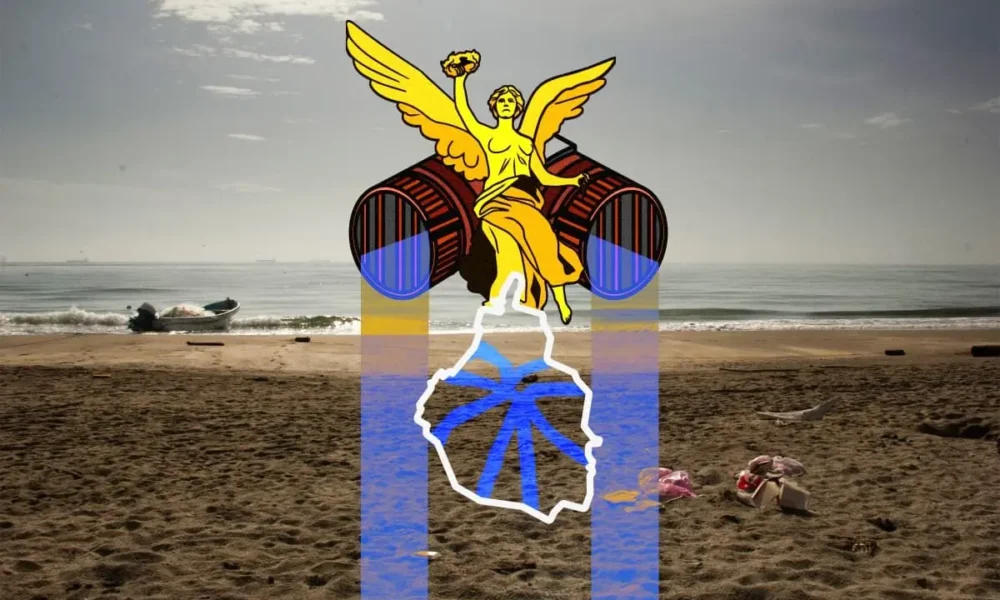
Mexico City wastewater pollution of the Gulf of Mexico via the Pánuco River basin, Digi Mart USA News (Mexico): Lacking its own coastline, Mexico City discharges part of its wastewater into the Gulf of Mexico through 500 kilometers of drainage that reaches the Pánuco River basin. This basin, however, was left out of the priorities for meeting the 30×30 environmental goal, according to the publisher’s report.
Microfibers such as polyester, plastic waste, batteries, oils, dog feces and even human remains are among the materials biologist Ahjaima has found in rivers in the State of Mexico and in the drainage network connecting that state with Mexico City. Ahjaima, a graduate of the Metropolitan Autonomous University (UAM), has spent more than 15 years researching contamination in Ecatepec and eastern Mexico City.
The mixture of waste forms leachate, a toxic liquid produced when water passes through debris and carries chemicals, organic matter, metals and bacteria. “They are highly toxic, they seep into the subsoil and underground rivers,” she said.
The deep drainage system of Mexico City carries part of the wastewater of the Metropolitan Zone of the Valley of Mexico to Hidalgo, where it joins the Tula River and continues through the Moctezuma and Pánuco rivers until it reaches the Gulf of Mexico. The report notes this basin was excluded from the 30×30 target, which seeks to protect at least 30% of land and marine surfaces by 2030.
In 2024, treatment plants processed an average of 31,716 liters of wastewater per second, of which 19,029 came from Mexico City. This flow equals 1.64 million cubic meters per day, enough to fill about 658 Olympic swimming pools like the Francisco Márquez pool.
The water continues along the El Salto River, on the border between the State of Mexico and Hidalgo.
Treatment plants remove much of the organic matter but do not completely eliminate heavy metals, microplastics and other chemicals. A 2019 study titled Measurement of illicit drugs in wastewater: a pilot study in Mexico identified metabolites of cocaine, marijuana and other drugs, including benzoylecgonine, THC-COOH and methamphetamine.
A 2023 investigation led by Juan C. Durán-Álvarez analyzed wastewater from Mexico City and the Mezquital Valley in Hidalgo over 30 months.
The study identified drug residues including famotidine, indomethacin, dexamethasone, azithromycin and ivermectin.
In the Mezquital Valley, another study published in 2018 analyzed 218 organic pollutants in wastewater, springs and groundwater. It detected 65 of the 118 pharmaceutical compounds evaluated, three of seven reproductive hormones analyzed, and benzoylecgonine, a cocaine metabolite.
Meanwhile, Ahjaima collects at least five types of plastic during eight-hour workdays and inspects ravines up to 20 meters high covered in waste. In this work she has learned to distinguish seven types of household plastics and recognize the synthetic microfibers that enter the drainage system.
“Almost everything is polyester, one wash and you lose who knows how many grams of microplastic,” she said, referring to fibers shed by synthetic garments during laundering.
Although chemical analysis of these flows requires specialized resources, Ahjaima describes what she observes in the water: “It is evident that it is completely rotten and poisoned in every color and flavor.”
In pre-Hispanic times, the lakes of Texcoco, Mexico, Xochimilco, Chalco, Xaltocan and Zumpango were connected by canals that allowed canoes to travel between chinampas and cities. After floods affected Mexico-Tenochtitlan, Moctezuma I commissioned Nezahualcóyotl to build a dike at Texcoco in 1449.
After the conquest, floods drove the construction of an artificial outlet for the basin. In 1607, Enrico Martínez began the drainage toward Huehuetoca through the Nochistongo tunnel.
At the end of the 19th century the Gran Canal del Desagüe, 47.5 kilometers long, was built, carrying water from San Lázaro to Zumpango and the Tequixquiac tunnel, with an outlet to the Tula River. Porfirio Díaz inaugurated the work on March 17, 1900.
During the 20th century, the Second Tequixquiac Tunnel, the Deep Drainage System and the Central Emissary Tunnel, as well as the Eastern Emissary Tunnel, expanded the capacity to drain Valley of Mexico waters toward the Tula River basin.
For communities near the river, wastewater became part of the landscape and daily life. René Romero Rivera, who grew up near the Tula River and the Viejo Requena canal in Hidalgo, recalls that his play areas were plots irrigated with sewage.
“The water was there, but you couldn’t interact with it,” he recalled. At home they warned him it could harm him and asked him to stay away.
If someone fell into a sewage ditch, he explained, they could suffer skin problems.
“It was part of the normal landscape, in quotes, that I happened to know: the sewage river and a sewage canal, the Viejo Requena canal,” he said.
“We are standing at the mouth of the majestic Pánuco River, one of the largest in Mexico. You can see how it reaches the sea and impacts the Gulf.
This river originates in the upper parts of Mexico City,” explained José Jaime Salinas Carús, a biologist dedicated to environmental education and wildlife conservation in Tamaulipas.
From the Tampico seafront, where a beach more than 100 meters long borders the Pánuco River, Salinas Carús described the water’s course. “That water falls to Tula, Hidalgo, where it is used for agriculture and vegetables.
Then it flows through the Moctezuma, Tancochín and other rivers until merging into the Pánuco River. From the mouth to Mexico City there are 500 kilometers of route.”
To interpret the relationship between basin pollution and the sea, Melanie Kolb, a researcher at the UNAM Institute of Geography specializing in environmental governance and water management, explained that “the Pánuco River represents an extreme case of concentrations and mixtures of pollutants.”
In March 2021, a sample taken at the breakwaters of Miramar Beach in Ciudad Madero recorded 295 MPN (Most Probable Number) of fecal coliforms. The state sanitary risk map attributed the result to the flow of contaminated water from the Pánuco River into the sea during the rainy season.
Contamination is also documented in agricultural areas of the Mezquital Valley. A study published in 2017 in the journal Water Research compared communities exposed to irrigation with wastewater with others using well water.
Among children under five, the prevalence of diarrhea in the week before the survey was 10% in exposed communities and 5% in unexposed ones. The research, titled Health risks from exposure to untreated wastewater used for irrigation in the Mezquital Valley, Mexico: A 25-year update, examined health risks associated with this exposure.
About eight kilometers from the mouth lies the Laguna del Carpintero, within urban Tampico. There, a crocodile catches a dead fish beside a discharge outlet.
The lagoon covers 157 hectares, of which 77 are water body. The rest comprises land with sports facilities, recreational spaces and cultural venues.
On its shores, iguanas move through vegetation. Mangroves occupy part of this perimeter and have lost surface area over the last two decades.
“As we lose the mangrove, we are losing that natural barrier and letting all those pollutants reach the sea directly,” said Gustavo González Hempel, a lawyer who has participated in its defense since 2007.
Pointing below us, he identified two discharge points: “Here we have a sewage discharge. Further on, another discharge where you can see grease and oils.”
“The lagoon connects with the Pánuco River through the Canal de la Cortadura, about eight kilometers from the Gulf of Mexico. The main tributary of the Laguna del Carpintero is the Pánuco River, which connects through the Cortadura canal; with tidal exchange and river current, brackish and fresh water enter the lagoon,” González Hempel explained.
The mangrove plays a role in this water exchange and in the habitat of various species. “It acts as a filter for brackish waters, and its roots are, colloquially speaking, a kind of nursery for fauna and various organisms reproducing there,” he said.
In December 2022, Mexico adopted Target 3 of the Kunming-Montreal Global Biodiversity Framework, which calls for conserving at least 30% of terrestrial, marine-coastal and inland water areas by 2030.
In October 2025, SEMARNAT reported that 14.65% of the country’s land area and 23.78% of its marine area held some protection category. To reach 30%, it calculated that 30.8 million hectares of land and 19.6 million hectares of marine and coastal areas would need to be incorporated.
CONABIO’s proposal for Priority Sites for Biodiversity Conservation identified terrestrial, marine and inland water areas relevant for conservation, including the Pánuco River, Melanie Kolb explained.
The river is recognized as a priority site for biodiversity, although it was left outside the intervention areas of MEx30x30. In June 2024, SEMARNAT and the Mexican Institute of Water Technology (IMTA) prepared a Technical Justification Study to declare the area of influence of the Endhó Dam in Hidalgo an Ecological Restoration Zone.
The document gathers diagnoses on water quality and the presence of heavy metals in soils and crops. The proposed zone covers the area of influence of the Endhó Dam but leaves out the Moctezuma and Pánuco rivers, which receive waters from the Valley of Mexico.
When the publisher requested information from IMTA about both basins through public transparency channels, its Water Quality and Ecology Coordination responded that it had not conducted studies on those water bodies or on the effects of wastewater discharges on them.
Given this situation, Melanie Kolb stated that “the available information, even if imperfect or deficient, is more than sufficient to act immediately.”
Industries hold discharge concessions linked to the Pánuco River corridor. CONAGUA records identify 79 permits with an authorized annual volume of 32 million cubic meters, equivalent to more than 12,000 Olympic pools.
The permits correspond to 65 holders distributed across Hidalgo, San Luis Potosí, Veracruz, Tamaulipas and the State of Mexico. Most are for urban public use, but there are also authorizations for industrial and service activities.
In Pueblo Viejo, Veracruz, PEMEX’s Francisco I. Madero Refinery holds an authorization to discharge more than 10 million cubic meters annually into the river.
That volume represents nearly one-third of the total authorized in the records analyzed. The permit is valid until December 14, 2027.
For the remaining records, which include permits in Tamaulipas, the State of Mexico and Hidalgo, their exact location and type of user are unknown, as CONAGUA responded that “this information is not available in existing records.”
In Tampico, residents link changes in the Pánuco River to declining species in the region. José Jaime Salinas Carús, who participates in protection efforts for the lora sea turtle and in crocodile research in the Garrapatas estuary in Altamira, recalled that the name Tampico means “place of water dogs,” referring to otters, which, he says, “are now rarely seen.”
“Many native species have disappeared or been displaced. Animals have protected themselves by moving to cleaner basins such as the Tamesí-Champayán,” he explained.
The lower Pánuco basin brings together wetlands, mangroves, salt marshes and lagoons, with freshwater and marine environments. At least 85 species have been documented in these ecosystems, including oysters, snails, shrimp and prawns.
The region concentrates agricultural, industrial, fishing, port and navigation activities.
The transformation has also reached the coast. Salinas Carús described changes in sand accumulation and loss associated with the jetties built during the Porfiriato era.
On the northern side, the structure has allowed the beach to gain ground on the sea by altering sediment transport.
Luis Humberto Salinas Ramírez, a musician and businessman, has known Tampico’s coasts and lagoons since childhood. For 14 years he ran a floating business on the Laguna del Carpintero and identifies the pollution sources reaching the area.
“It comes contaminated with phosphate, potassium, fertilizers, all the vinasse coming from the sugar mills […] but there are many heavy metals that end up in the sea,” he said.
As he spoke, a child rode across the lagoon in a boat with his father and grandfather.
Sediment research documents the presence of pollutants at the river mouth and along the Tamaulipas coast. The thesis by Mayumy Amparo Cabrera Ramírez analyzed 111 oceanographic stations off Tamaulipas and Veracruz and documented the transport of material from the Pánuco River onto the continental shelf.
A study published in 2018 examined four seabed sediment cores off Tamaulipas. In three, it found increasing concentrations of vanadium, chromium, zinc, copper, lead, zirconium and barium toward the surface layers.
Barium profiles recorded increases of between 30% and 137% after the opening of oil facilities.
The researchers linked these changes to growing oil activity in the Gulf of Mexico. In deep Gulf waters, a study published in PNAS in 2026 analyzed more than a decade of fauna records and documented population declines after the 2010 Deepwater Horizon spill.
Between 2011 and the 2015 to 2023 sampling period, fish abundance fell 63.5%, macrocrustaceans fell 62%, and small cephalopods fell 59.7%. For the analysis, researchers examined more than 2,000 samples and conducted acoustic measurements.
In addition, on the Tampico coast, another study published in 2023 by Itzamna Z. Flores-Ocampo and John S.
Armstrong-Altrin of the UNAM Institute of Marine Sciences and Limnology analyzed microplastics in beach sediments. The researchers found an estimated average of 13,392 particles per kilogram of sediment.
All were fibers, and polyester was the most abundant polymer.
The study identifies the Pánuco River as a pathway transporting microplastics from the mainland to the sea.
Melanie Kolb uses the ridge-to-reef approach to study the connection between what happens inland and its effects on coastal and marine ecosystems. Her conclusion is that pollution reaches the sea through rivers and sediment transport.
Both deforestation and construction remove vegetation cover and favor the transport of particles into waterways. Untreated wastewater adds drugs, chemicals and pathogens.
“A problem generated in one system, such as urban areas, industrial developments or agricultural activities, is transferred to another system, in this case the Pánuco River and then the coastal and marine zone,” Kolb explained. She calls this transfer of impacts between systems trans-systemic impacts.
To restore rivers, the researcher stated that “the fundamental principle in river restoration is to stop polluting them at the source.” By interrupting polluting discharges, she explained, “the ecosystem begins its gradual recovery.”
Kolb proposes complementing laboratory chemical analysis with participatory monitoring and citizen science. Using simple protocols, communities can assess river conditions using bioindicators such as aquatic insects.
“Simple sampling with hand nets, the presence or absence of insect families allows water quality to be classified into three basic categories (good, fair, poor),” she explained. “Conventional laboratory chemical analyses carried out by CONAGUA are costly and impossible to deploy along the entire length of a river.”
The Mexican government has taken on international commitments to reduce pollution threatening biodiversity and to conserve inland waters by 2030. Kolb stated that “Mexico has the technical data needed to execute this goal, but the lack of personnel, operational capacity and political priority within agencies such as CONANP has prevented this information from being translated into effective reserves and management measures.”
Target 7 of the Kunming-Montreal Global Biodiversity Framework calls for reducing pollution risks to levels that do not harm biodiversity. Target 3 includes conservation of inland waters.
For the Pánuco River, meeting these commitments requires that conservation also consider the quality of water leaving the Valley of Mexico through the basin and reaching the Gulf of Mexico.
This content is published by La Verdad Juárez with express authorization from Causa Natura Media. The reporting was produced with support from the Earth Journalism Network of Internews.