La Bola Negra film homage to Federico García Lorca and queer legacy, Digi Mart USA News: Directed by Javier Ambrossi and Javier Calvo, known as “Los Javis,” La Bola Negra (The Black Ball) is Spain’s major hope for next year’s Oscars. The film reimagines the unfinished 1936 work of the same name by Spanish poet and playwright Federico García Lorca (1898-1936), based on the only four existing pages.
The original text would have been Lorca’s first play with a gay protagonist. The film is co-written by Los Javis with queer playwright Alberto Conejero, author of the original play La Piedra Oscura (The Dark Stone, 2013), on which the film is also partly based.
The film’s title refers to Lorca’s original story, in which Carlos, a young gay man, tries and fails to join a private club due to rumors about his sexuality. The selection committee votes in secret using white and black balls.
The black ones represent rejection, hence the term “blackballed,” and implicitly social exclusion.
Los Javis first became known for three major streaming series: the comedy Paquita Salas (Netflix, 2020), a tragicomic story about a has-been talent agent; Veneno (HBO Max, 2020), based on the life of a trans sex worker who became a national celebrity in 1990s Spain; and the religious musical drama La Mesías (MUBI, 2023). La Bola Negra is only their second feature, after La llamada (Holy Camp, 2017), a musical about a lesbian romance.
The new film represents a significant leap in scale, production values and global reach.
La Bola Negra won best direction for Los Javis at Cannes and also won audience awards at San Sebastián, Toronto and London, drawing full houses on the festival circuit. It has also become a social media phenomenon and has been acquired by Netflix.
Lorca, considered Spain’s most influential 20th-century poet and playwright, was executed by firing squad in 1936, at the start of the Spanish civil war, because of his politics and sexuality.
In the film, Lorca’s unfinished text grows and expands into the 21st century, pausing at three moments in Spain’s history: the Second Republic in 1932, the civil war in 1937, and contemporary Spain in 2017, telling three gay stories. In the second story, based on Conejero’s play, Lorca’s real-life lover Rafael Rodríguez Rapún (Miguel Bernardeau) is a Republican prisoner of war.
He develops a fleeting platonic infatuation for his Nationalist guard, Sebastián, played by singer-songwriter Guitarricadelafuente in his first acting role.
Their connection becomes part of a complex chain of relationships and revelations that carries the story, and queer history, forward, supported by a score by Raül Refree and cinematography by Gris Jordana. Lorca’s legacy runs through the film, explicitly through his unfinished play, his homoerotic sketches and a small cameo by Alberto Cortés, and more implicitly through the Spanish settings and the depiction of motherhood, a subject he examined extensively in his work.
Lola Dueñas gives a notable supporting performance as Teresa, a troubled single mother. Penélope Cruz plays a glamorous cabaret singer with one of the film’s most memorable lines, while Glenn Close plays an American Lorca scholar entirely in Spanish.
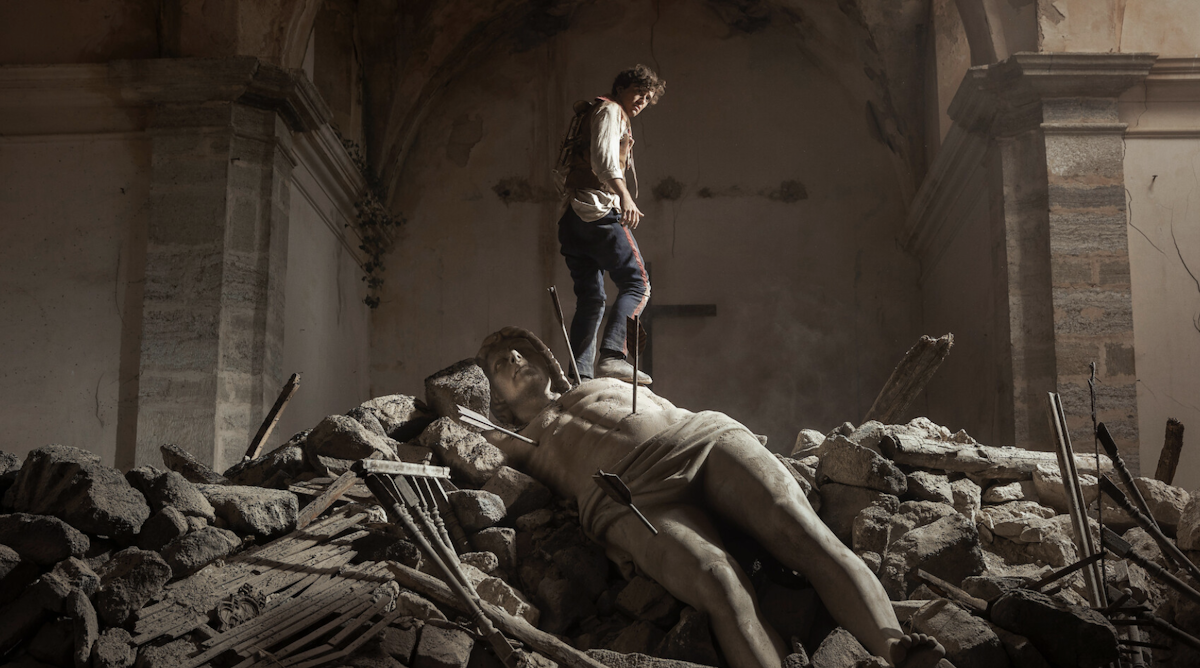
The film is filled with queer imagery across time, from a war-torn statue of the persecuted Saint Sebastian, who has become a contemporary queer icon, to hypermasculine sailor figures recalling Rainer Werner Fassbinder’s homoerotic film Querelle, and the gay dating app Grindr. Shot on 35mm film, La Bola Negra combines moments of drama and intimacy in relatively small spaces that contrast with landscapes of epic proportions.
The film’s queer gaze embraces both ideals of masculinity and body diversity. Alongside the characters played by Bernardeau and Guitarricadelafuente, the protagonist of the final section is Alberto, a larger-bodied gay man played by Carlos González, who is known for queer roles in streaming hits such as Veneno and Mariliendre (Fag Hag, 2025).
Queer people have long been excluded from official histories, ignored, silenced or presented in ways that obscure their sexuality. La Bola Negra makes that history visible while celebrating the role queer people have played in shaping culture: Lorca as a playwright, Sebastián as a musician, and Alberto as a queer historian.
That reclamation resonates in today’s Spain, a country often associated with LGBTQ+ progress. Spain was the third country in the world to legalize same-sex marriage, in 2005, and currently ranks first in Europe on the 2026 Rainbow Map for legal rights and protections, yet the political climate feels increasingly uncertain.
Francoist and fascist nostalgia is finding new audiences through social media, and the possibility of a conservative and far-right coalition hangs over Spain’s general election on November 29.
Lorca’s remains are believed to lie in an unmarked mass grave in his native province of Granada. His unfinished manuscript survives as a symbol of queer legacy and inheritance.
In the film, its pages become a baton passed across generations, and an emblem of reparation for queer shame, represented by the black ball of the title.
By bringing Lorca’s story back to life through a predominantly queer cast and a production heavy with queer iconography, Los Javis make La Bola Negra part of the very legacy the film seeks to reclaim.