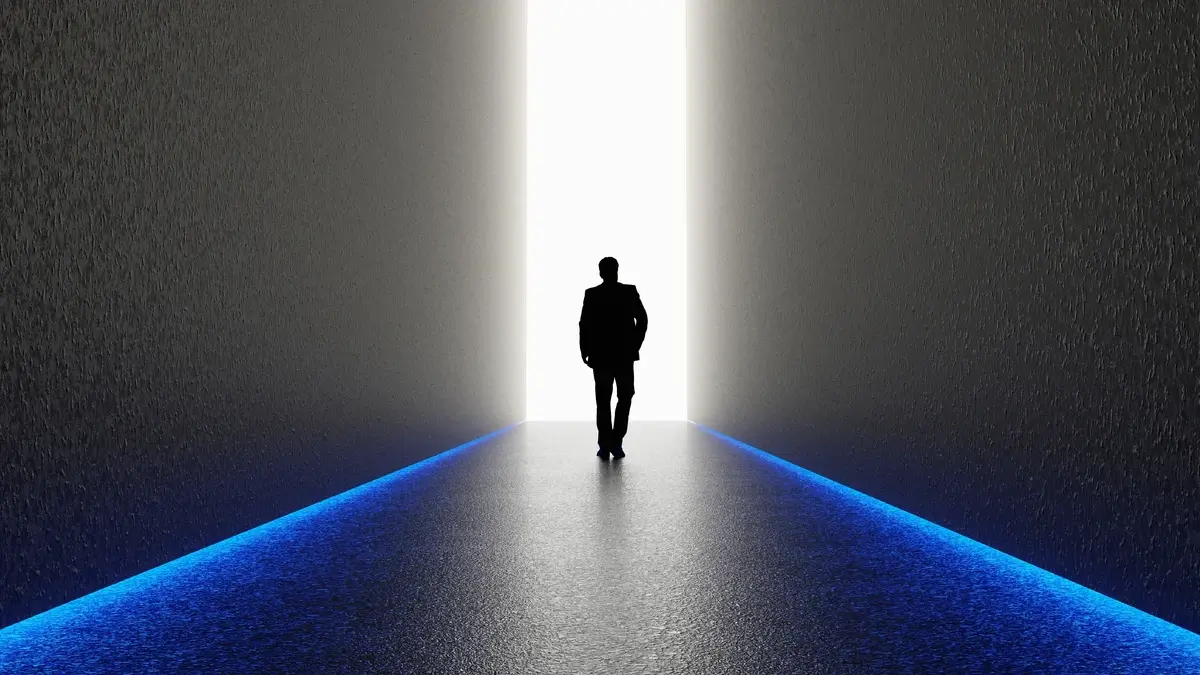
Near-death experience drawings reveal four recurring spatial forms, Digi Mart USA News: The famous tunnel does exist in the memories of people who have come close to death, but it is only one setting among others. Researchers asked 50 people to draw their near-death experience, and four architectural forms recur with a troubling regularity.
The color of each scene also appears to be dictated by its shape.
A blinding light, the sensation of floating above one’s body, a dark corridor: for centuries, near-death experiences (NDEs) have been described in the same words, for lack of better ones. France Lerner, a neurophenomenology researcher at the University of Haifa, chose the pencil instead.
With her team, she had 50 people draw the spaces they had passed through, in a study published October 15 in the journal Frontiers in Psychology. Participants described 112 scenes, 108 of which fall into four geometric families.
The phenomenon is far from rare: up to one in five cardiac arrest survivors reports an NDE, according to a 2025 synthesis.
Participants were recruited through the website of the International Association for the Study of Near-Death Experiences and selected using two reference questionnaires, including the Greyson scale. The protocol was conducted remotely, with video sessions on Google Meet that were never recorded, during which each person broke down their memory into chronological steps.
Using a blue pen, they traced each space starting from a catalogue of pictograms, marked their position with a cross and their movements with arrows. The drawings were then scanned and emailed as anonymized JPEG files, converted to grayscale in Photoshop.
The statistics were calculated in Python.
Four families emerged. The first are cones, which include the classic tunnel; then wide elliptical arches, gentler horizons with a softer curvature and, finally, 360-degree envelopes that fully surround the observer.
Cones appear mostly at the beginning or end of the account, like an entrance and exit. As for out-of-body experiences, they concerned 32 of the 50 participants.
The most intriguing finding concerns color. Of 28 conical spaces, 22 were seen in black, white or gray.
Conversely, 27 of the 31 large arches were bathed in color. The other two families mix color and grayness.
The physiology of vision offers some leads. When the retina or brain lacks oxygen, the visual field narrows, starting from the periphery, which produces a tunnel effect.
In dim light, the cells responsible for night vision take over and colors fade. Uniform envelopes, meanwhile, evoke the Ganzfeld effect, in which a visual field without relief is enough to trigger hallucinations.
These mental maps also interest designers of immersive experiences. In 2025, a U.S.
team gave 61 adults a simulated NDE in virtual reality, with the aim of easing their fear of death, in a study published in Frontiers in Virtual Reality. A precise typology of lived spaces could one day inform such systems.
The team in Haifa remains cautious. The sample is modest and volunteer-based, some memories date back several years, and the proposed pictograms may have guided the traced drawings.
The study also has no control group. The authors therefore present their framework as an exploratory approach, “rather than as proof of universal geometric invariants.”
It remains unknown whether these shapes are specific to NDEs. The study describes these inner landscapes without claiming to identify their cause, much less to prove an afterlife.