Michel Zecler police trial racism Paris, Digi Mart USA News (Paris, France): Three police officers accused of assaulting Black music producer Michel Zecler in 2020 present somewhat polished profiles, and all deny being “racist.” But from the first day of the trial on Monday, the question was already a backdrop to the hearing.
Aurélien Lapersonne, Philippe Tondeux and Pierre Plantier were filmed six years ago by a surveillance camera beating Zecler in his Paris recording studio. He had initially been stopped for not wearing a mask during the Covid period.
The three are tried for deliberate violence and falsification of a public document. Their official report, contradicted by the images, claimed the producer had struck them.
They face up to 15 years in prison.
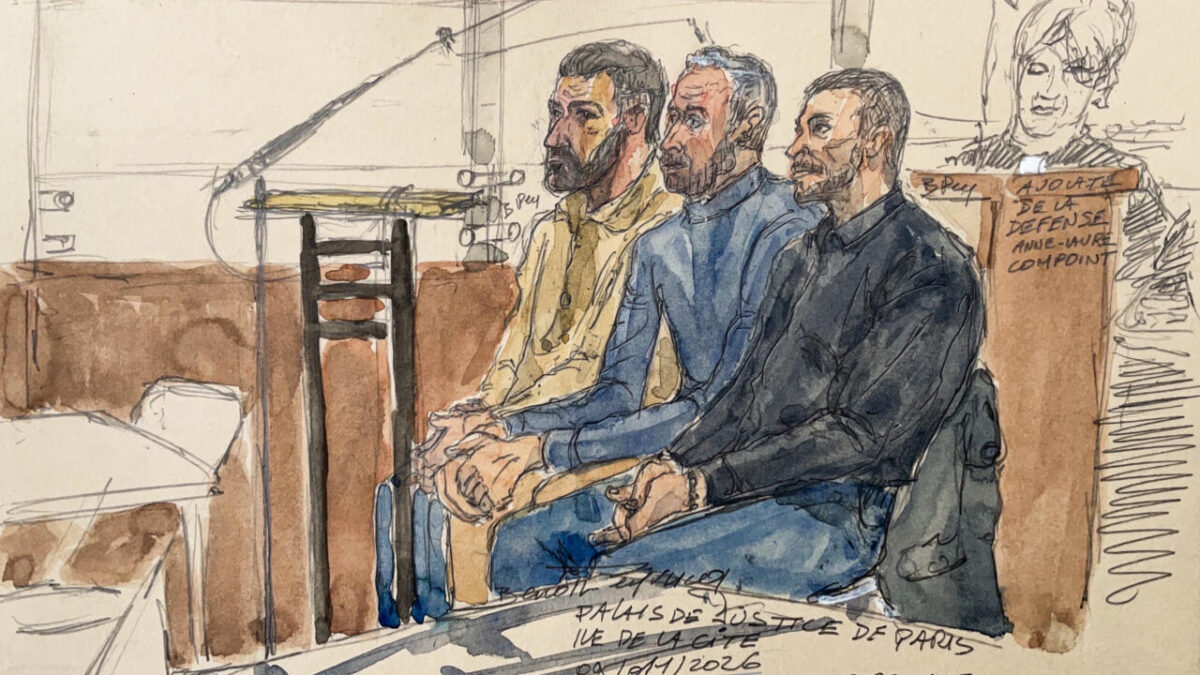
The question hung over the day-long hearing before the Paris criminal court, which focused on the personalities of the three defendants, seated side by side.
The first to take the stand was Pierre Plantier, 37, who drove the patrol car in the 17th arrondissement on November 21, 2020. With a trimmed beard and mustache and a light sweatshirt, the officer, who holds a vocational restaurant diploma, explained that he had moved into policing, a job he had “idealized.”
His personality profile appeared unremarkable: “calm,” “discreet,” “appreciated by his friends and colleagues,” the personality investigator said.
Philippe Tondeux, 50, presented a more troubled profile and, despite his calm tone, broke down in tears twice. The first time was when the investigator mentioned his sick mother; the second was when he was questioned about several weeks he spent in detention at Fleury-Mérogis.
Tall, with salt-and-pepper hair and a mouth regularly pulled by a nervous tic, Tondeux was the team leader of the patrol that beat the producer. After “20 years on the street,” he had been preparing to request a transfer to the provinces to work in an office.
The personality investigator described a man of “fragile morale,” “with a strong sense of powerlessness and insecurity,” who spoke of society as an “ordeal.”
“I had ideals like everyone when I was at university,” said Tondeux, who at one time voted left but “no longer takes an interest in politics.”
He raised his voice, however, when one of the defense lawyers returned to the question of racism.
“I know I am not racist, and I am proud of it. I know who I am, sir, I am 50 years old,” he said, adding that he had been raised with values of “tolerance” and “respect.”
Racism came up again when Aurélien Lapersonne, the youngest defendant at 29, took the stand. His family background was described as complicated, “conflictual” and even “violent.” He was the one who wrote the false report of Zecler’s arrest.
Clémentine, his partner of seven years, described a man who is “courageous and honest.” According to her, “he has expressed regret for some time about the situation.”
The deputy prosecutor then cited a text message exchange between Lapersonne and his partner before the assault. “These bastards are accepted in France and nothing is done,” he wrote in August 2020.
“I forbid you to become racist,” she replied. “It’s not racism, but all the bastards who cause trouble are all the same.” “I’m not generalizing.
If I were generalizing, I would have immediately said Black or Arab.”
“I don’t remember the context anymore, maybe a difficult intervention, but that doesn’t define me,” he explained from the stand.
“Deep down I am not racist,” he said, adding that “this case has shaken me because what was said in the media does not represent us. We are not like that.”
Nevertheless, none of the defendants offered a word to Michel Zecler, and all expressed concern about their future criminal records. Two benches behind them, the producer, still visibly marked by the assault six years later, listened without flinching.