China Ring Crane 14,000 Tons, Digi Mart USA News (Xuzhou, Jiangsu province, China): China has spent decades demonstrating how far engineering can go when it aims at extraordinary scale, from the Three Gorges Dam to the 55-kilometer link connecting Hong Kong, Zhuhai and Macao, and the Huajiang Bridge, whose deck rises 625 meters above a river. Each project posed technical challenges that required unusual solutions, and the machines needed to build them also have striking stories.
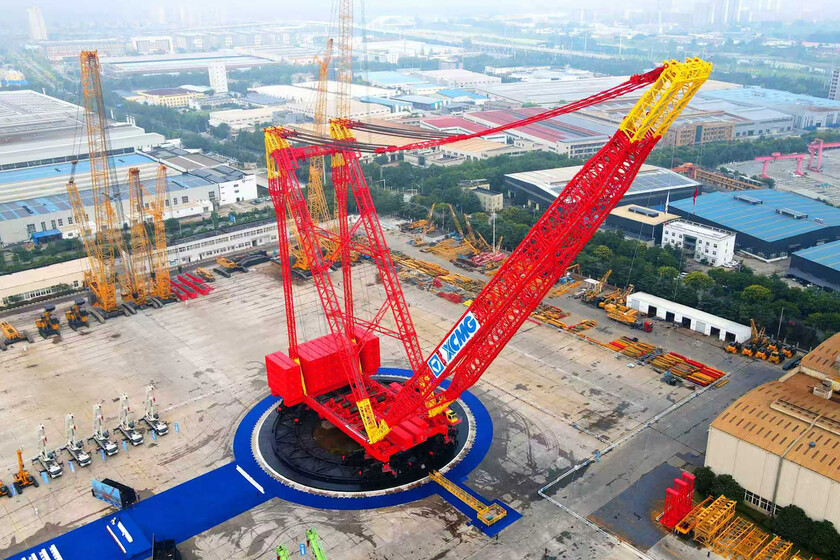
In Xuzhou, in China’s Jiangsu province, XCMG and Sinopec Heavy Lifting & Transportation are developing a ring crane designed to lift loads of up to 14,000 tons in its full configuration. On August 28, 2026, the manufacturer announced it had finished assembling the first of the two main units that will make up the system.
That is an important step, but the complete system is not yet operational.
According to Crane & Transport Briefing, each of the two units is designed to lift up to 7,000 tons separately. Both can operate independently or be combined for larger operations, allowing the equipment to be adapted to each project’s needs.
The 14,000-ton figure is the announced limit for the combined system, not a load that has already been lifted in a real operation.
Ring cranes use rolling systems that distribute enormous loads and allow the lifting structure to rotate with the help of large counterweights. Equipment such as Mammoet’s SK6000 shows that the arrangement of these systems can vary by project.
However, lifting heavy weight is not the same as placing it at a distance: the farther a load sits from the rotation axis, the greater the stress on the structure. XCMG announces a maximum lifting moment of 700,000 ton-meters, a figure that links both variables.
As the specialist publication Vertikal notes, complete public load charts are not yet available to determine how much weight the crane can lift at each radius.
Consider a nuclear power plant under construction, where components arrive partially assembled and must be placed in precise locations. The larger the modules, the more demanding the operations required to install them, especially when several nearby structures must be worked on.
XCMG proposes using its system to serve two nuclear islands, the groups of facilities associated with two reactors, from a single location and with one boom configuration. According to the manufacturer, this would avoid certain movements and equipment reconfigurations.
The crane would not lift two complete reactors, but would facilitate assembly of their installations.
Building a crane of this kind also raises challenges beyond its dimensions. The Chinese company NGC, one of the project’s suppliers, has developed reducers for the lifting and traversing mechanisms, gear assemblies that adjust rotation speed and the torque transmitted by the motors.
Xingcheng Special Steel, part of the CITIC group, has supplied high-strength steel for components subjected to heavy stress. Producing huge parts is not enough; they must also withstand the planned loads and the mechanisms must operate in a controlled manner during lifts.
For perspective, some of the large land-based ring cranes already in use illustrate the scale. Mammoet’s Dutch-built SK6000 has a maximum capacity of 6,000 tons, while Sarens’ SGC-250, known as Big Carl, reaches 5,000 tons.
XCMG’s development aims for 14,000 tons. The comparison conveys the project’s magnitude, but these figures are maximum nominal capacities, and the weight a crane can lift also depends on its configuration and the reach of each lift.
The project predates its presentation in Xuzhou. According to XCMG, joint research and development work began in 2015, project details were made public in 2024, and the contract with Sinopec was signed on October 10, 2025.
Completion of the first main unit, reported in August 2026, marks industrial progress, but how the complete system will perform when both units work together remains to be verified. Megastructures draw attention for what is seen when finished, but behind them lie engineering projects that require years of development before demonstrating what they can do.