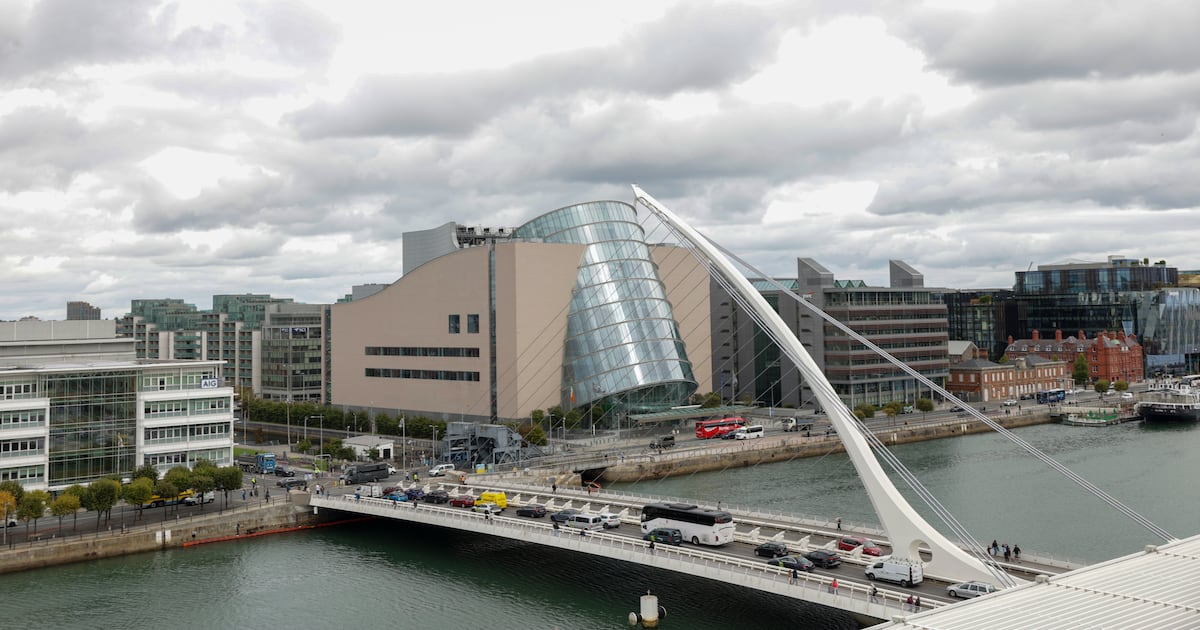
European Political Community summit in Dublin, Digi Mart USA News (Dublin, Ireland): Ireland is hosting back-to-back summits on Thursday and Friday, welcoming 45 European prime ministers and presidents to the Convention Centre in Dublin. The high-level political meetings will require a massive security operation that will bring parts of the city to a standstill.
French president Emmanuel Macron, Ukrainian president Volodymyr Zelenskiy, UK prime minister Andy Burnham and German chancellor Friedrich Merz are expected to attend, alongside leaders of the other European Union states and the wider European neighbourhood, from the Balkans and the Caucasus to Iceland. The Thursday meeting of the European Political Community (EPC), a group of almost 50 countries, is a relatively new format.
Friday will be limited to the EU’s 27 national leaders, who plan to discuss artificial intelligence.
There will not be enough room at Baldonnel airbase or Dublin Airport to park all the jets flying in visiting leaders, so some planes will need to layover in Shannon before flying out of Dublin on Friday. “It’s an absolutely gigantic event, a once-in-a-generation event that will happen and it’s important that we pull out all the stops,” said Thomas Byrne, Minister of State for European Affairs.
Macron proposed the EPC as a way to bring a wider circle of European leaders together after Russia invaded Ukraine in 2022. Vladimir Putin and Belarusian president Alexander Lukashenko are not invited.
The summit is held twice a year, and the hosting role rotates between an EU member state holding the EU council presidency and a European country outside the union.
The EPC is sometimes criticized as a talking shop, but Sébastien Maillard, an associate fellow at Chatham House think tank, said the get-together has important “symbolic value.” It emerged as a way to signal that Ukraine’s future lies within the European family. “Ukraine is with us, we’re not married yet, but we’re engaged,” Maillard said.
Because the EPC does not take decisions, there is no haggling over language in any joint communique.
Canadian prime minister Mark Carney is joining the Dublin meeting, having attended the previous EPC in Armenia in May. NATO secretary general Mark Rutte and European Commission president Ursula von der Leyen will also attend.
Turkish president Recep Tayyip Erdogan likely will not attend, and Spanish prime minister Pedro Sánchez will be occupied with a tough election at home.
Donald Trump is not named on any draft agenda, but he is expected to come up in conversations on the margins, as leaders gauge each other’s views on how the Republican midterm election defeat could play out. Much of the informal exchange is expected in the “leaders’ lounge,” an area set up for quick one-to-one meetings and smaller huddles.
The Ukraine war will feature prominently. Zelenskiy faces a €70 billion shortfall in Ukraine’s wartime budget for 2027 and has turned to European friends, the UK and Norway, and other western allies such as Canada and Japan, to help close the gap.
Specialist gardaí and Defence Forces personnel are on high alert for attempts by Russia or other malign actors to cause disruption. The week before Denmark hosted the event last year, several rogue drones mysteriously appeared over airports and military bases, and Danish prime minister Mette Frederiksen privately told fellow EU leaders she suspected Russian meddling.
An extensive security cordon will surround the Convention Centre, and access to the north quays near the venue will be closed from Tuesday morning until Friday evening. Garda motorcycle escorts will bring delegations from Dublin Airport and Casement Aerodrome in Baldonnel, resulting in rolling road closures.
The heaviest disruption is expected on Wednesday afternoon, Thursday morning and Friday evening.
Irish officials canvassed European colleagues for advice, and the feedback was to get the food right and make sure the Wi-Fi works. An official dinner will be held in the National Gallery, and the evening cultural programme includes music and a poetry reading.
The EPC also offers western Balkan states hoping to join the EU in the near future a chance to press their case. “We’ll be using the opportunity to beat the drum for enlargement,” one government source said.
Friday’s meeting will consider how Europe can become a “leading and sovereign player” in the AI race, according to preparatory papers sent to capitals this week. Negotiations over the union’s next seven-year budget are also expected to feature in discussions on the sidelines.
Several thousand delegates are expected in total, along with hundreds of journalists, and some leaders are bringing large entourages.
The Department of Foreign Affairs estimates the bill will come to at least €15 million, before substantial security costs are added. Government sources are quietly confident that a threatened public sector strike pencilled in for Thursday will be averted, though more than 400 public servants are rostered to work on the day.
Hosting a large European summit does not win many votes, but it can offer a political boost to smaller states outside the EU. The previous EPC in Yerevan, Armenia, helped that government make the case for the South Caucasus country to continue a westward pivot away from Moscow’s control.
Armenian prime minister Nikol Pashinyan and Macron performed an unlikely musical duo during a state dinner, with Pashinyan on drums and the French president singing. Taoiseach Micheál Martin joked at the time that he had “six months to practice the drums.”