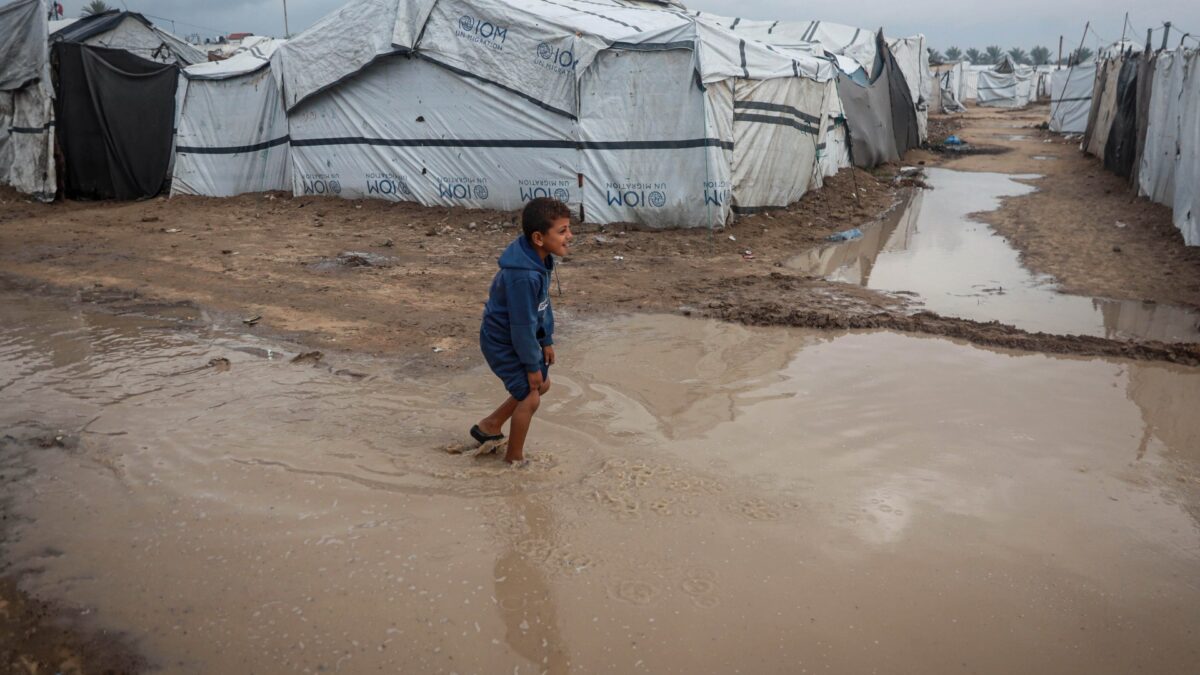
Gaza displaced Palestinians flooding tents, Digi Mart USA News (Az-Zawayda, Gaza Strip): On Saturday night, water rushed into Jaber al-Kaseeh’s tent in central Gaza’s az-Zawayda area, waking him and his family as heavy rain swept across the territory. Soon the tent’s floor was flooded, soaking mattresses, carpets and blankets and spoiling what little food the family had kept.
“Everyone woke up and stayed awake, asking their neighbours about the extent of damage and inquiring about children,” Jaber, who is in his 70s, told Al Jazeera. He described the area outside the displacement camp, where thousands of Palestinians have taken refuge, as a swimming pool.
According to Gaza’s Government Media Office, more than 70,000 tents have been flooded since heavy rains began late on Friday. Hundreds of thousands of displaced Palestinians are sheltering in locations considered “highly vulnerable” to further flooding.
More than a year after a so-called “ceasefire” deal was signed between Israel and Hamas, the source reports that Israel has continued to block the entry of goods into Gaza, including 60,000 mobile homes and 200,000 tents. Only 20,000 tents have been allowed in, while mobile homes have remained parked on the Egyptian side of the border, many of them for more than two years.
Jaber says this is the fourth winter his family has spent in a tent in the az-Zawayda area. Originally from Beit Lahiya in northern Gaza, he has been displaced several times since Israel launched its war on October 7, 2023.
More than 90 percent of Palestinians have been displaced, many of them multiple times.
Jaber said his camp was flooded three or four times last winter, forcing many families to leave. About 40 tents remain, but the latest flooding has left them in even worse condition.
“All the tents are now damaged, torn and covered in mud,” he said. “We urgently need tents, tarpaulins, plastic sheets, mattresses, blankets and carpets to protect us from the difficult days ahead.
We keep hearing about tents and tarpaulins being distributed, but we have received nothing.”
Jaber said his family had hoped the mobile homes and temporary housing units promised under the ceasefire deal would allow them to return to a life of safety. “But it was all just words in the air.
We have seen nothing,” he said.
Under the first phase of the agreement, temporary housing units, tents and heavy equipment to clear rubble were to be allowed into Gaza. The source reports that the arrival of mobile homes and heavy machinery has been delayed, with trucks reportedly waiting on the Egyptian side of the border while families remain in tent camps.
According to the United Nations Office for the Coordination of Humanitarian Affairs (OCHA), Gaza requires approximately 121,000 tents and 561,000 tarpaulins, while available stocks remain far below what is needed.
Om Hani Hamouda, a displaced woman from Beit Lahiya now sheltering in al-Zawayda, said replacing her worn-out tent with a caravan has become a dream. “We did not expect that the first rainfall would leave us in this condition,” she told Al Jazeera.
“These tents do not protect us from the cold, storms or rain. Whenever winter comes, everyone holds their breath.”
Hamouda said she had hoped the ceasefire agreement would allow her family to return to northern Gaza or receive a caravan or building materials, but there has been no sign of progress. “We are asking for a dignified life.
We want these tents to be replaced with caravans. Even a simple caravan would be better,” she said.
Hamouda’s family has been displaced around 15 times during the war. She spent more than 15 years living and working in the United Arab Emirates before returning to Gaza nearly two years before the war began.
“My children cry because they miss the life we had there,” she said. “Life here is so difficult.
There is no life in any sense.”
Ramy Abdu, chairman of the Euro-Mediterranean Human Rights Monitor, told Al Jazeera that large quantities of tents, caravans, prefabricated housing units and shelter equipment remain stranded at Gaza’s borders because of Israeli restrictions. He said more than 1.5 million displaced Palestinians face another winter in worn-out tents, and that even people in houses and apartments remain exposed because of extensive damage to homes and infrastructure.
“Today, we cannot even say that those living in houses and apartments are safe from extreme weather because, with around 85 percent of homes destroyed or damaged, every family is exposed to some degree of harsh weather conditions,” Abdu said. He added that Israel continues to reject shipments containing timber and emergency shelter kits, depriving families of the ability to repair homes.
Abdu said Israel, as the occupying power, is legally obligated under the Fourth Geneva Convention to ensure essential supplies reach civilians and to facilitate humanitarian relief.
Jihad Dawwas, 51, said he felt helpless because his children had nowhere dry to sleep during the rains. Water poured into the tents at the camp where he is sheltering, while strong winds blew away many surrounding tents.
“They slept standing up. By morning, some of my children had become ill because of the cold and the storm,” he told Al Jazeera.
Dawwas, who was displaced from northern Gaza, is sheltering with seven of his own children and three orphaned children of his brother. He said he bought the family’s tent with his own money and had received no tent from any charity or aid initiative.
“A tent cannot replace a home, not even by one percent,” he said. “We are living in what is left of our lives.”
He said he had seen no caravans or temporary housing units arrive, despite the expectations raised by the ceasefire agreement. “Our lives are a daily hell.
We are completely forgotten. There is no fair distribution of aid, and no one is really asking about us,” Dawwas said.
He questioned why even basic shelter supplies had become so difficult to obtain. “Do tents and tarpaulins really need all this pressure and effort just to become something we can ask for?” he asked.
“They should provide us with tents and tarpaulins, and give us at least a dignified life.”