
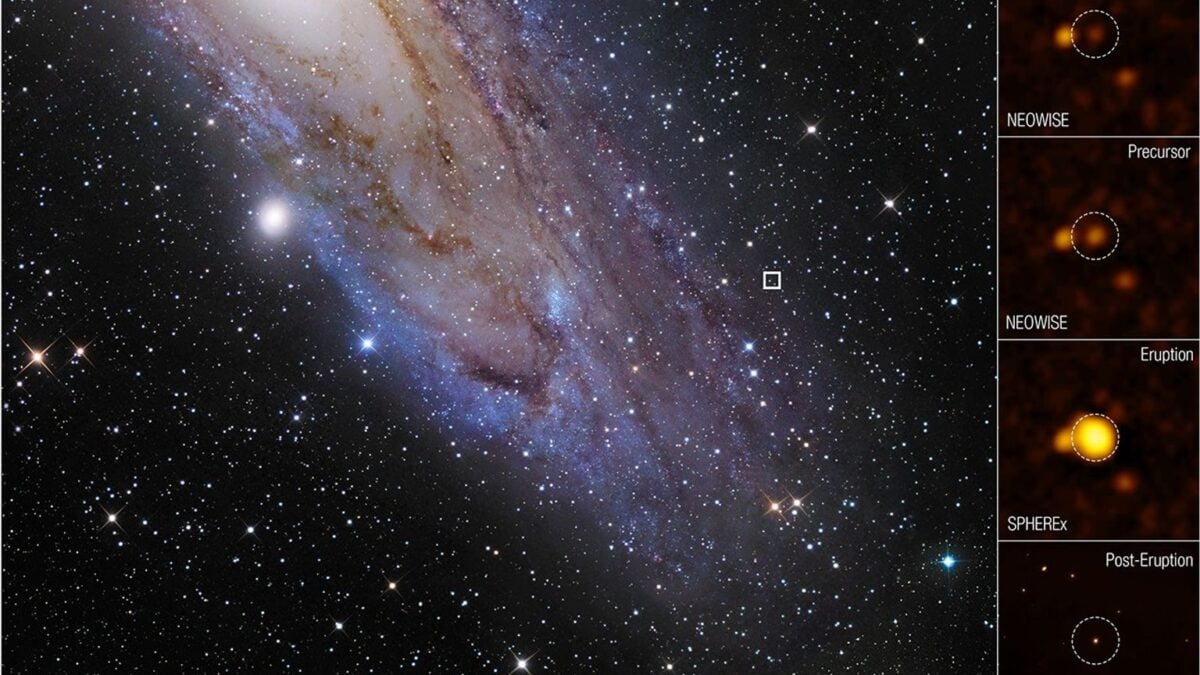
Bao stellar merger NASA Webb Andromeda, Digimart Global: Researchers have identified what they describe as a first of its kind: a star slightly less massive than the Sun spiralled into and merged with a puffy supergiant star at the outskirts of the neighbouring Andromeda galaxy. The team nicknamed the newly single, potentially rejuvenated star Bao.
The discovery was funded in part by NASA and was strengthened by quick-turn observations from the James Webb Space Telescope, cross-referenced with extensive data from telescopes in space and on the ground.
According to a new paper in Nature published on Wednesday, lead author Viraj Karambelkar, a NASA Hubble Fellow at Columbia University, said the team noticed something unusual in 2023 and kept monitoring the system. In 2025 the system erupted, and Webb observed Bao only 47 days after the eruption peaked, the earliest follow-up of such an event so far.
Stellar mergers are very difficult to observe in real time because they are hard to predict.
Before the merger, the two stars had spent millennia orbiting each other as a binary pair. After the smaller star came into contact with the giant star’s surface, the two became one after about seven orbits, roughly seven years.
Other known binary star mergers involving two smaller stars took thousands of orbits. Co-author Nadia Blagorodnova of the University of Barcelona said the team had expected an outburst from such an extended star to take years, but its brightness rose and peaked within a week.
The researchers describe the event as a common envelope evolution, in which the smaller companion star spiralled through a shared outer envelope of gas and lost orbital energy to drag until it merged with the primary’s core. The team estimates that before the eruption the primary star was about seven times as massive as the Sun, 350 times its radius and 18,000 times brighter.
The smaller companion, nicknamed Little Bao, was likely about 0.7 solar masses. Co-author Kishalay De of Columbia University described the encounter as almost like a bomb exploding inside a living star.
The team reconstructed the events using ultraviolet, visible and near-infrared observations from several telescopes, including NASA’s NEOWISE, SPHEREx, the Zwicky Transient Facility, the retired Neil Gehrels Swift Observatory and NOIRLab’s Gemini North telescope in Hawaii. Webb’s observations were taken on 24 December 2025. The researchers said it remains to be seen how the new star’s mass settles over time, and that future observations will be needed to determine what the merged star looks like.
The team said the approach allowed them to measure how efficient common envelope evolution is while the merger was happening, rather than reverse-engineering events that may have occurred long ago. Karambelkar said a large influx of similar discoveries may follow as NASA’s Nancy Grace Roman Space Telescope begins its planned surveys.