
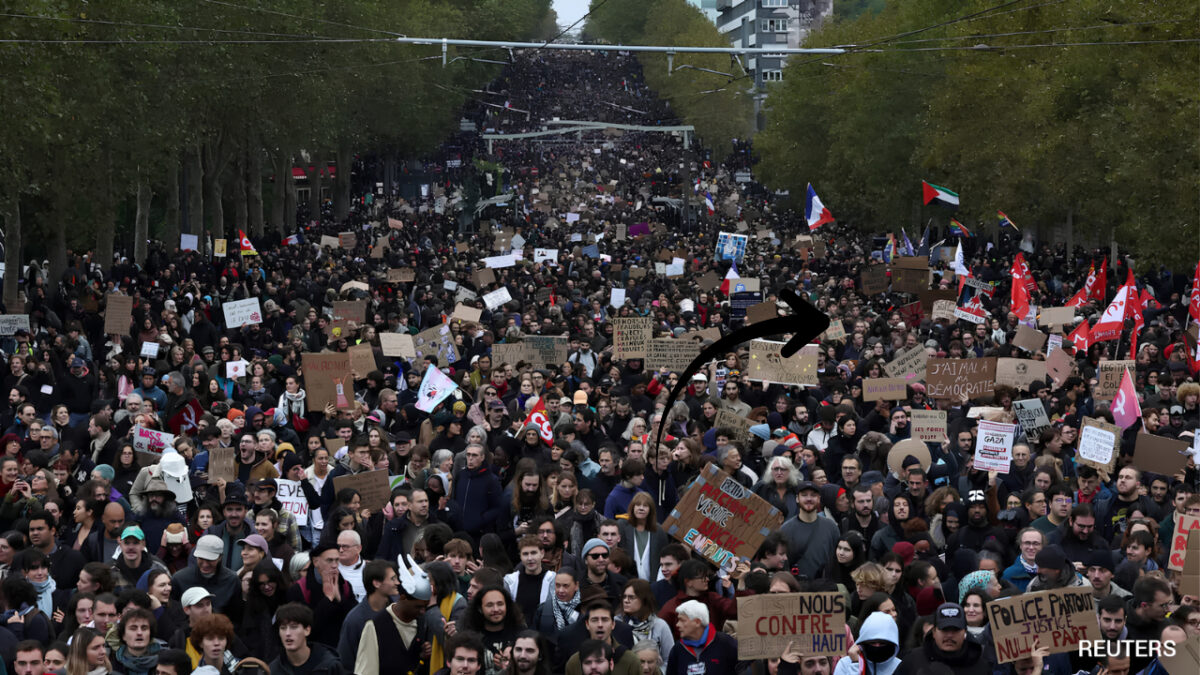
The Interior Ministry reported more than 600,000 participants nationwide, while the CGT trade union put attendance at nearly 1.6 million across over 200 demonstrations. The differing estimates left the precise turnout disputed, but both indicated the scale of a movement now reaching well beyond its origins in a single school.
School Complaints Grow Into a National Movement
The protests began in September over staff shortages at a high school southeast of Paris. Students seeking better learning conditions helped spread the campaign nationwide, before workers joined with demands for higher pay, improved pensions and relief from rising living costs.
That expansion has given the movement a broader social character. According to Associated Press reporting, education funding remained a central demand even as economic grievances drew new participants.
Thursday’s marches showed how concerns about classrooms, employment and household budgets have become intertwined, bringing different generations together without erasing their distinct priorities.
Students Demand Conditions That Support Learning
For students, the dispute concerns the everyday experience of attending school. Complaints include absent teachers who are not replaced, overcrowded classrooms and deteriorating buildings. Protesters argue that these problems interrupt lessons and make it harder to prepare for examinations and further education.
Reporting on the movement describes frustration over insufficient staff and facilities that students consider unfit for learning. T
heir demands extend beyond repairing buildings: they want reliable teaching and an education system that offers a fair chance of advancement. The widening demonstrations have carried those concerns from school entrances into the national political debate.
Higher Wages Become a Shared Demand
Workers joining Thursday’s rallies described another source of insecurity: earnings that fail to cover everyday needs. Unions called for wage increases, a higher minimum wage, tax reforms and better conditions for young people, linking workplace demands with the student campaign.
The connection was visible in Paris, where workers and retirees marched alongside students. Associated Press reported signs warning about inequality and the difficulty of spending an entire lifetime merely trying to make a living.
Such messages captured the common ground between participants whose immediate concerns differed but whose frustration increasingly focused on living standards and public services.
Healthcare Staff Highlight Pressure on Services
Healthcare workers brought complaints that echoed those heard in schools. Corinne Cucchini, a representative from the Private Healthcare Federal Union, joined the Paris demonstration to raise concerns about staffing shortages and insufficient equipment at the hospital where she works.
Her account placed wages alongside working conditions rather than treating them as separate issues. For employees delivering essential services, the dispute concerns both personal income and the resources available to do their jobs.
Their participation widened the protest’s message: demonstrators were not only asking for better household finances, but also challenging the conditions under which public needs are met.
School Closures Reveal the Disruption
About a third of France’s high schools were closed or unable to operate normally, according to reporting on Thursday’s action. Some were affected by student blockades, while others faced disruption because teachers had joined the strike.
The Education Ministry said just over 15 percent of teaching staff took part. Those figures describe different aspects of the disruption: teacher participation does not directly measure how many schools could function.
The closures also exposed the movement’s central tension. Students seeking more dependable education were using interrupted schooling to press their demands, while teachers stepped away from classrooms to support change.
Peaceful Marches Accompany Localised Confrontations
The Paris procession remained peaceful, and most major rallies proceeded without serious disorder. Elsewhere, however, authorities reported tensions and incidents in cities including Lyon, Nantes, Rennes and Toulouse. Police in Lyon used tear gas during confrontations with protesters.
Interior Minister Laurent Nuñez said 70,000 police officers were deployed nationwide, supported by armoured vehicles, drones and helicopters. The operation reflected concern after earlier demonstrations had been marred by rioting and looting.
Nevertheless, the incidents did not define every march. Distinguishing peaceful participation from confrontations remains important when assessing an event involving hundreds of thousands of people across many locations.
A Broader Test for Macron’s Government
Thursday’s mobilisation added pressure on President Emmanuel Macron’s government after weeks of unrest. The alliance between students and organised labour has made the dispute harder to contain within education policy alone: demands now encompass pay, pensions, school resources and the quality of essential services.
The CGT said the turnout marked a new stage and pledged to continue pressing the government and employers. That position suggests organisers view the demonstrations as leverage rather than an endpoint.
Large crowds establish visibility, but the movement’s practical impact will depend on whether its different demands produce negotiations and concrete responses.
Different Grievances, One Public Message
The day’s significance lay in that convergence. Students demanding teachers and functioning classrooms marched beside employees seeking better wages and retirees concerned about pensions. Their circumstances were different, yet their demands brought them into a shared mobilisation.
Associated Press described a movement that grew from school staffing complaints into wider economic protest. Thursday’s demonstrations showed that transformation on a national scale. What began at a school entrance had become a challenge reaching across workplaces, public services and households throughout France.










