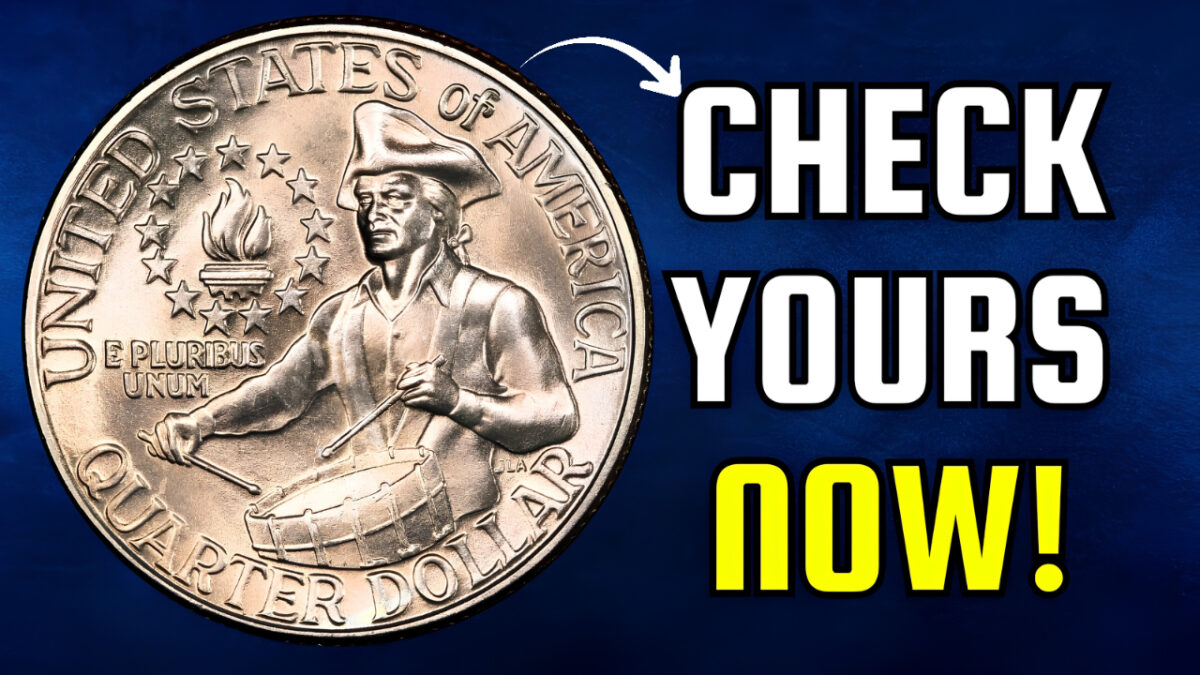
Now, dramatic online headlines have renewed interest in these familiar pieces, often suggesting that ordinary pocket change could represent an extraordinary discovery. The more useful story is about identifying what collectors actually seek, rather than accepting an eye-catching claim without supporting evidence.
Claims that five Bicentennial quarters carry an enormous combined valuation should not be mistaken for documented auction news. Published collecting references distinguish ordinary examples from exceptional specimens, while professional records identify particular coins by condition and variety.
That distinction matters: a familiar design alone does not establish rarity. The five categories below explain why certain Bicentennial quarters deserve closer attention, without suggesting that every coin bearing the anniversary dates is a major find.
Why the Bicentennial Quarter Looks Different
The United States Mint introduced the special quarter as part of the nation’s two hundredth anniversary celebration. Its reverse features a colonial drummer designed by Jack Ahr, whose submission emerged from a national design competition. Washington remained on the front, accompanied by the dual date 1776–1976.
The special designs appeared on quarters, half dollars, and dollars produced during 1975 and 1976, giving Americans circulating reminders of the anniversary rather than collectibles available only through specialist dealers.
The program also included collector versions with different finishes and metal compositions. Alongside copper-nickel issues, the Mint produced forty percent silver coins in proof and uncirculated formats.
These distinctions explain why two quarters with the same drummer design may belong to different collecting categories. Understanding how a coin was made is the first step toward understanding its appeal; the anniversary inscription, by itself, does not tell the whole story.
1. Exceptionally Preserved Silver Uncirculated Quarters
San Francisco’s silver uncirculated Bicentennial quarter is one important category. These coins contain forty percent silver, but their composition does not automatically make them scarce.
PCGS lists a substantial original mintage, demonstrating why collectors separate the availability of an issue from the rarity of its finest surviving examples. An ordinary specimen and an exceptionally preserved specimen may share a date, mint mark, and composition while attracting very different levels of attention.
The standout examples owe their importance to preservation. PCGS documents a silver uncirculated quarter graded Mint State 69, placing it near the top of the grading scale.
Its auction history illustrates a central collecting principle: remarkable condition can distinguish an individual coin within a broadly available issue.
Readers should therefore avoid treating an exceptional auction result as a representative outcome for every silver Bicentennial quarter found in an inherited collection.
2. Silver Proof Bicentennial Quarters
Silver proof quarters form a separate category from silver uncirculated pieces. The Mint offered both formats, giving collectors different ways to obtain the anniversary designs.
Although they share the same historical theme, proof and uncirculated coins should not be described interchangeably. Their production formats are part of their identities, and correctly identifying the format helps prevent misleading comparisons between coins that merely look similar in a photograph.
For a family sorting an older collection, original packaging can provide useful context about which collector product was purchased. However, the presence of a silver proof does not establish an extraordinary rarity.
These were deliberately offered to collectors as part of the Bicentennial program. Their significance begins with their official format and composition, not with an unsupported claim that every reflective drummer quarter represents a once-in-a-generation discovery.
3. Denver FS-101 Doubled-Die Quarters
The Denver FS-101 doubled-die obverse is a documented variety rather than an invented internet label. PCGS maintains a dedicated listing for it within the Washington quarter series.
The designation identifies a specific variety associated with the front of the coin. This makes it more meaningful than a seller’s vague description of “double lettering,” which does not, on its own, establish that a coin belongs to the recognized category.
Professional attribution is especially relevant when a discovery depends on small design details. A Denver mint mark establishes where the quarter was produced, but it does not establish the FS-101 variety. PCGS records connect the designation with specifically identified specimens and grades.
That documented framework is what allows collectors to compare like with like, rather than assuming that every unusual-looking Denver quarter shares the same collecting significance.
4. Denver FS-102 Doubled-Die Quarters
FS-102 is another recognized Denver doubled-die obverse variety. It has its own PCGS listing, separate from FS-101, despite sharing the same basic Bicentennial design.
That separate classification matters because variety names are not interchangeable. A credible description should identify which recognized variety is present instead of combining several designations into a dramatic sales headline or treating every apparent doubling effect as the same discovery.
5. Authenticated Major Mint Errors
Major mint errors provide another collecting avenue. Documented discussions of Bicentennial quarters include off-center strikes, multiple strikes, and coins struck on an unintended blank.
These are production abnormalities, not simply unusual dates or ordinary wear. Their interest depends on what actually happened during manufacture and whether that explanation can be authenticated. The existence of genuine errors should not become a reason to label every scratched, bent, or oddly colored quarter a Mint mistake.
The Real Story Behind the Excitement Bicentennial Quarter Coins
Bicentennial quarters remain appealing because they connect everyday American money with a national celebration. Exceptional preservation, recognized varieties, collector formats, and genuine production errors offer distinct reasons to study them.
None supports assigning a sensational combined valuation to five unidentified coins. For American readers, the meaningful discovery is not a promised fortune but an accurately identified piece whose history and characteristics can be checked against established records.