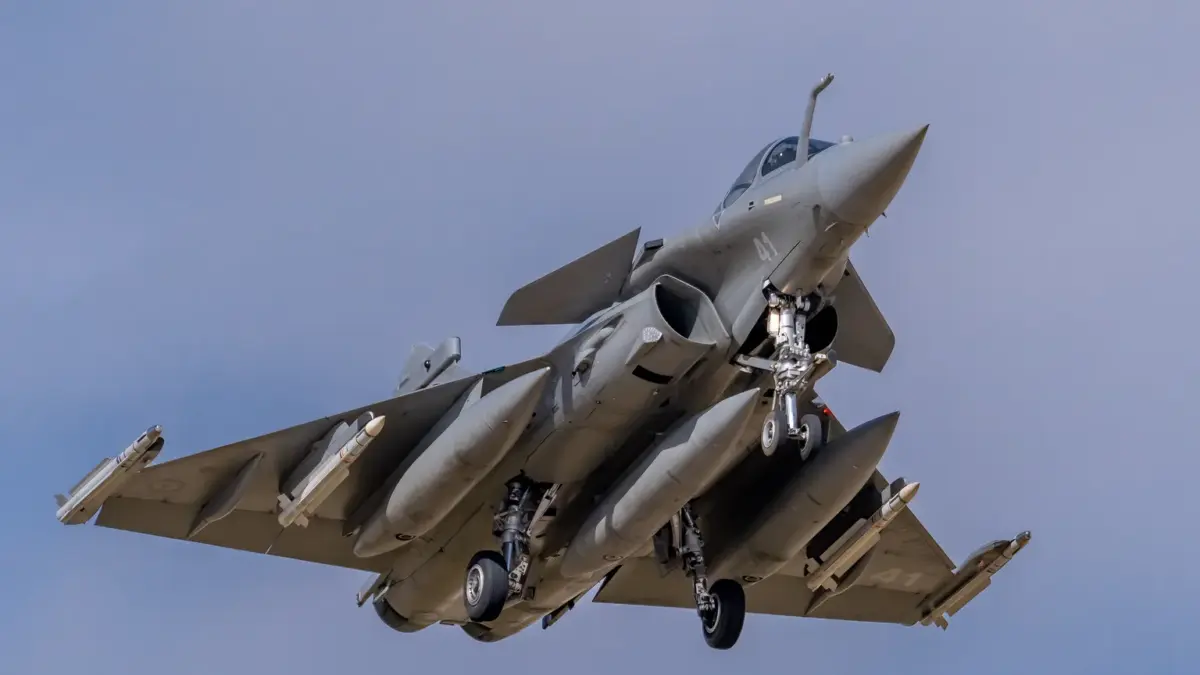
Rafale F5 UAE funding French fighter development, Digi Mart USA News (France): Forty years after the Super Mirage 4000 failed for lack of Saudi financing, France has signed an agreement with the United Arab Emirates for development of the Rafale F5. Abu Dhabi is financing specific components under a modular approach that is meant to preserve French sovereignty.
The partnership reveals France’s growing dependence on Gulf capital for its defense programs.
The Franco-Emirati Rafale F5 agreement was signed on October 30, 2026. Between the failed Super Mirage 4000 effort and this deal, the constant has been Paris seeking in the Middle East the resources its budget can no longer provide on its own.
The agreement with the Emirates marks a break, however, because it is no longer a one-off request but a structured partnership that redefines diplomatic balances between France and the Gulf.
In the early 1980s, Dassault Aviation developed the Super Mirage 4000, a heavy fighter competing with the American F-15. The program relied on a bet: securing financing from Riyadh.
Saudi Arabia, a longtime French arms customer, never followed through. The project collapsed, leaving France alone with its industrial ambitions.
As Aerobuzz noted in its analysis of November 3, 2026, “France no longer has a dirham, so it is going to the Middle East to finance its national defense. The approach is not new.”
Since the 2000s, Abu Dhabi has changed status. The Emirates no longer simply buy Western military equipment; they finance its design.
The GlobalEye airborne early-warning system, developed by Saab with Emirati money, illustrates this shift. Presented as the successor to European AWACS, the aircraft shows that the UAE can now influence the continent’s technology choices.
Paris is watching, and it understands that its preferred partner is no longer in Riyadh but in Abu Dhabi.
The intergovernmental agreement signed in October 2026 formalizes a rapprochement that is already long-standing. The Emirates are financing specific Rafale F5 components, such as sensors and engines, under a modular approach.
Why the Emirates rather than Riyadh? Three reasons are cited.
First, Abu Dhabi has a clear strategic vision: to become a regional technology hub beyond oil. Second, the UAE conducts a discreet diplomacy considered less unpredictable than that of Saudi Arabia, which has been marked by tensions with Washington after the Khashoggi affair.
Third, Emirati investors are heavily engaged in European military innovation, creating a mutual interdependence favorable to both sides.
The F5 standard, expected by 2033, will integrate artificial intelligence and collaborative combat. According to La Tribune, “everything will change except the shape of the aircraft.” This technological shift requires massive investment, well beyond France’s current budgetary capacity.
Paris insists that the modular approach preserves French control over critical technologies. Dassault Aviation and the French Air Force reaffirm their industrial and operational leadership.
The Emiratis finance but do not decide. Yet the line between financing and influence remains porous.
Whoever pays inevitably shapes development priorities. Sensors and engines financed by Abu Dhabi will also serve Emirati operational needs, not only French ones.
The partnership creates a convergence of interests and, with it, a form of mutual dependence.
The question of sovereignty is becoming less binary. The issue is no longer whether France remains master of its own house, but how far it can share without losing control.
The Rafale F5 agreement tests that limit. If Paris retains technological mastery, Abu Dhabi gains a strategic oversight role.
It is a fragile balance, negotiated in chancelleries but with lasting industrial consequences.
The Franco-Emirati partnership reveals a budgetary reality: France can no longer finance its power ambitions alone. Next-generation defense programs, including SCAF, MGCS and third-generation nuclear submarines, require financial envelopes beyond the reach of any single European country.
Recourse to Gulf financing is becoming structural rather than occasional.
Several scenarios are emerging. In the first, Paris multiplies modular partnerships with different Gulf states, preserving a form of independence through diversification.
In the second, Abu Dhabi becomes the privileged partner of French defense, creating an asymmetric dependence. In a third option, the European Union pools financing, reducing the need for outside capital.
Nothing today indicates which path will prevail.
The Rafale F5 agreement illustrates a profound geopolitical transformation. Defense alliances no longer rest only on strategic convergence but also on financial necessity.
France, a nuclear power and permanent member of the UN Security Council, implicitly acknowledges that it can no longer do everything alone.
An open question remains: how far will this logic go? If Abu Dhabi finances the Rafale today, which French programs will depend tomorrow on Gulf capital?
And at what point does partnership become subordination? The answer is already taking shape in the offices of Dassault Aviation, where French engineers now work with Emirati financing.
It is a quiet revolution, but a decisive one for the future of European defense.