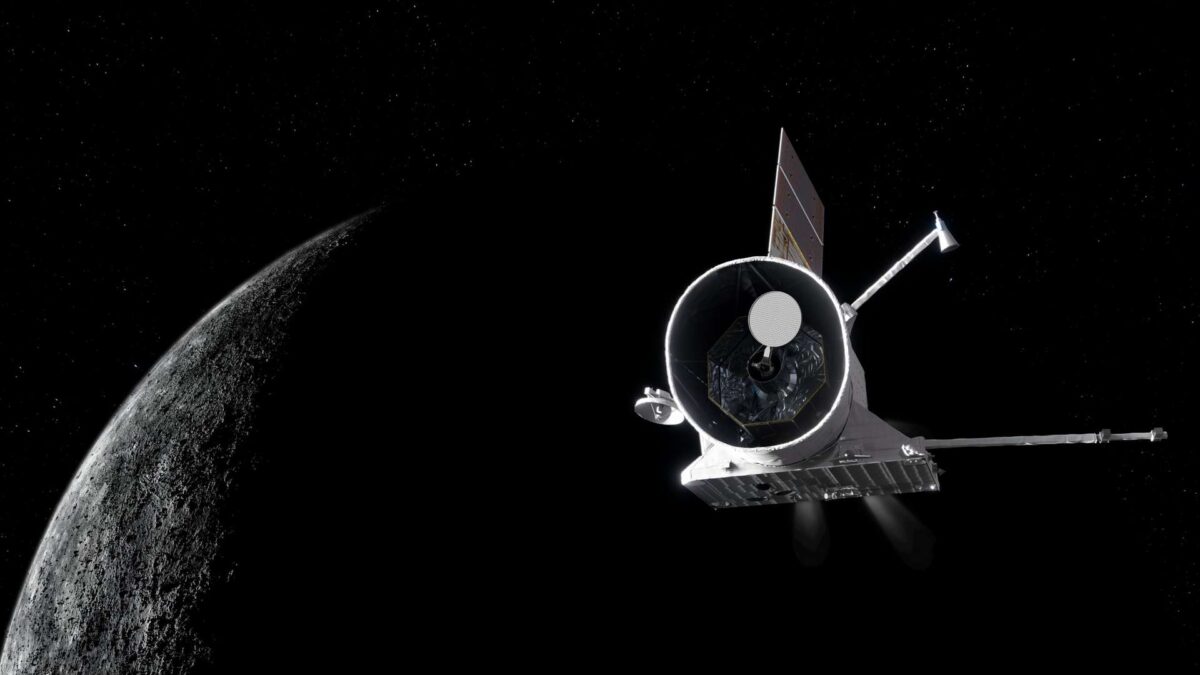
BepiColombo Mercury mission, Digimart Global: The BepiColombo spacecraft, a European Space Agency mission with Japanese participation, has been captured by Mercury’s gravity and is now in a very elliptical orbit, according to a report from the French publication Futura Sciences. The journey took roughly eight years and about 10 billion kilometres.
The spacecraft is currently in an orbit measuring 674 by 178,000 kilometres in altitude. The mission’s scientific programme is not due to start until April 2027, because a series of manoeuvres must be completed first.
Key manoeuvres before science begins
On 9 and 10 December 2026, the MPO planetary orbiter is scheduled to separate from the Mio magnetospheric orbiter, releasing it into an orbit of 590 by 11,640 kilometres. On 16 December 2026, MPO is due to eject its solar shield before heading to its final orbit, which it is expected to reach on 10 March 2027, at an altitude between 480 and 1,500 kilometres.
BepiColombo is the third mission to Mercury and the first European one. It is the first to place two spacecraft in orbit around the planet at the same time, which the report says should help answer questions left open by NASA’s Messenger mission.
Why Mercury matters to scientists
Mercury is the closest planet to the Sun and the smallest in the Solar System, and it is also the least explored. According to ESA science programme director Alvaro Gimenez, this is due to the difficulty of reaching it rather than a lack of scientific interest.
The mission aims to trace the history of Mercury’s magnetic field, better understand its volcanism and study water-ice deposits found in many craters. Researchers quoted in the report describe the planet as a key witness to the part of the protoplanetary disc closest to the Sun.
Two orbiters, one set of comparisons
The mission’s modular design includes three European modules and one Japanese element. Japan supplies the Mio orbiter, which will study Mercury’s magnetic field using five instruments.
With two spacecraft operating together, the mission can separate spatial variations from temporal ones, which the report says is useful for studying how the magnetic field interacts with solar particles and the planet’s magnetosphere.