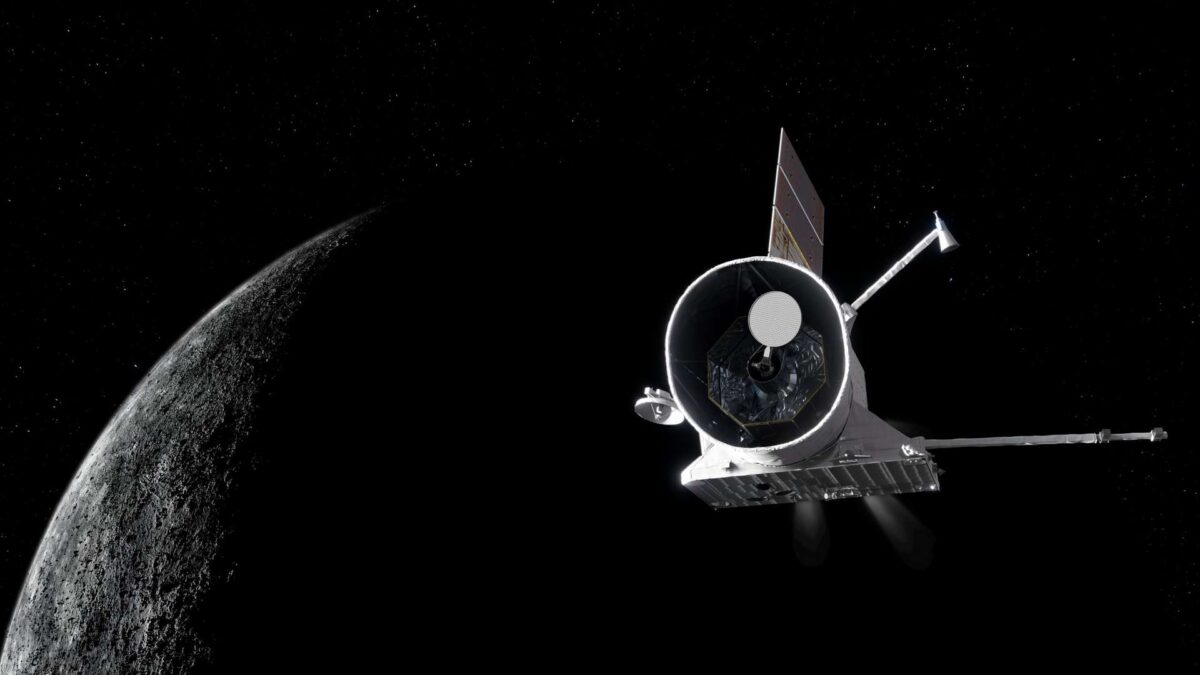
BepiColombo Mercury mission, Digimart Global: The BepiColombo spacecraft, a joint mission of the European Space Agency (ESA) with Japanese participation, has been captured by Mercury’s gravity after a journey of about eight years and roughly 10 billion kilometres. According to the publisher’s report, it now travels on a highly elliptical orbit of 674 by 178,000 kilometres altitude.
The mission’s science programme will not begin until April 2027. Before then, several manoeuvres are planned. On 9 and 10 December 2026, the MPO planetary orbiter is due to separate from the Mio magnetospheric orbiter, releasing it into an orbit of 590 by 11,640 kilometres.
On 16 December 2026, MPO is scheduled to eject its solar shield before reaching its final orbit on 10 March 2027, between 480 and 1,500 kilomètres altitude.
Why Mercury Matters to Scientists
Mercury is the smallest planet in the Solar System and the closest to the Sun, yet it is also the least explored. Alvaro Gimenez, ESA’s science programme director, attributed this to the difficulty of reaching the planet rather than a lack of scientific interest.
Only two earlier NASA missions have visited it: Mariner 10 in the mid-1970s and MESSENGER from March 2011 to March 2013.
François Leblanc, a planetary scientist at LATMOS who is scientific lead for the probe’s ultraviolet spectrometer, described Mercury as the ultimate witness to the part of the protoplanetary disc closest to the Sun. The planet’s internal characteristics remain a source of many questions, and it is considered one of the best Solar System analogues for the many exoplanets already discovered.
How the Two-Orbiter Design Helps
BepiColombo is the third mission to Mercury and the first from Europe. It is the first to place two spacecraft in orbit around the planet at the same time, a design intended to address questions left open by MESSENGER, particularly about Mercury’s magnetic field, volcanism and water-ice deposits in deep craters.
Having two probes also allows scientists to separate spatial variations from temporal ones, helping distinguish the influence of the solar wind and other external disturbances from the magnetosphere’s own variability.