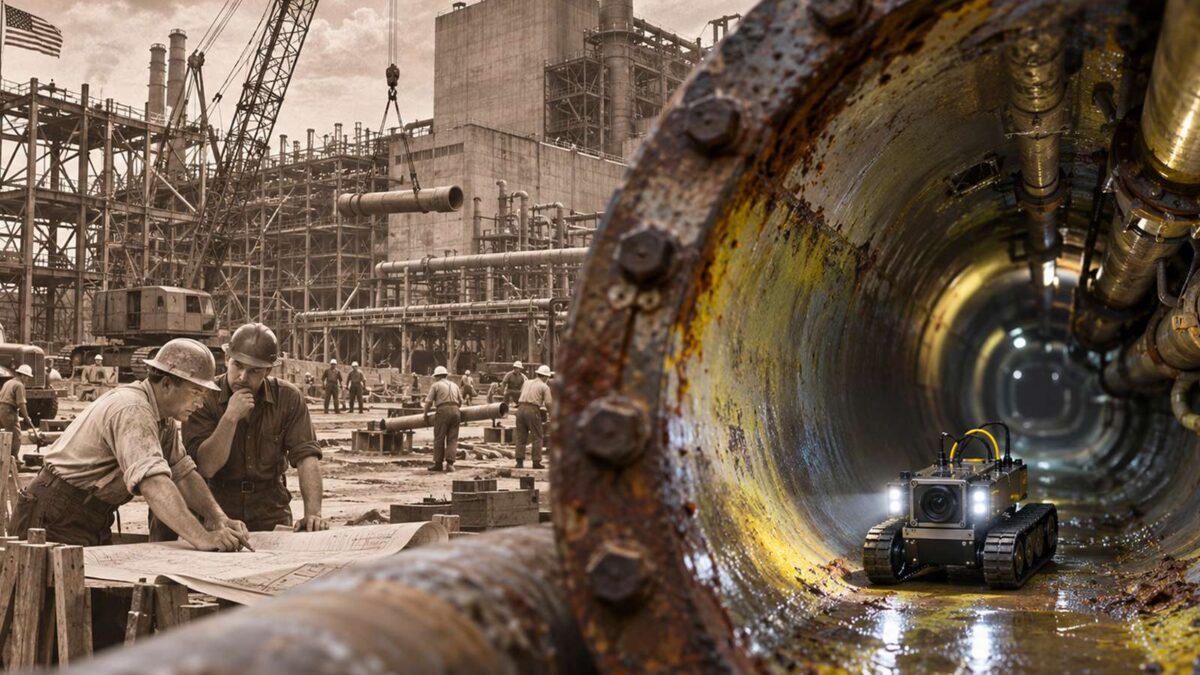
Hanford nuclear site robot, Digimart Global (Hanford, Washington State): The Hanford nuclear complex, built by the United States in 1943 as part of the Manhattan Project to produce plutonium for atomic bombs, still holds significant quantities of radioactive waste. The site, on the banks of the Columbia River, hosted the first industrial-scale plutonium reactor in the world before production ended.
Radioactive waste from decades of production is stored in underground tanks connected by a network of double-walled pipes. These aging pipes must be inspected for corrosion or cracks, but many run for hundreds of metres underground, include numerous right-angle bends, and some measure only 5.1 centimetres in diameter.
Digging them up would be costly and complex, and would not reveal internal corrosion.
A robot designed for tight spaces
Conventional inspection cameras can advance only about three metres in such pipes, and ultrasonic probes are often too bulky to pass the bends. To address this, engineers at Sandia National Laboratories developed a robot called SPIINE, presented in the scientific journal Robotics.
The robot measures 15.2 centimetres long and features a flexible chassis, six deformable wheels, a high-resolution camera and adjustable LED lighting. It is controlled with a simple video game controller and can conform to pipe walls, pass 90-degree turns and change direction at junctions.
A key challenge is the cable that supplies power and transmits data. Friction increases at each bend, making progress more difficult.
To spread the pulling force, researchers proposed linking several motorised modules along the cable.
Next steps before field use
Initial laboratory tests are described as conclusive, but SPIINE has not yet been proven under real conditions at Hanford. Engineers are working on a self-cleaning camera system, a recovery mechanism in case of failure, and miniaturised ultrasonic sensors able to measure pipe wall thickness.
If successful, the robot could help secure one of the largest nuclear cleanup projects in the United States while limiting worker exposure to radioactive waste.