microring resonator laser comb, Digimart Global: Researchers have shown that a single high-Q microring resonator can act as the nonlinear, frequency-selective mirror of a fibre laser, generating a broadband optical frequency comb without additional couplers, filters or delay lines. The work is described in a new paper published in Light: Advanced Manufacturing by a team led by Yuriy Gladush of the Skolkovo Institute of Science and Technology and Igor Bilenko of the Russian Quantum Center, according to a publisher report.
Optical frequency combs built from high-quality microring resonators are used in metrology, spectroscopy, optical communications and quantum photonics. Most applications need coherent combs that correspond to dissipative cavity solitons.
The traditional method of producing them involves slowly scanning a narrow-line pump laser through a resonance, a delicate procedure that prevents self-starting and typically converts only a few percent of pump power into the comb.
How the reflective design works
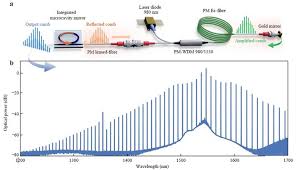
In the scheme described, the silicon nitride (Si3N4) microring, with a 1 THz free spectral range and a loaded Q-factor close to one million, is edge-coupled to a 1 m polarisation-maintaining erbium-doped fibre pumped at 980 nm and closed at its other end by a gold mirror. The optical feedback that closes the laser cavity comes from resonantly enhanced Rayleigh backscattering inside the microring itself, so the same element both generates the comb and provides the mirror function, according to the report.
The authors report self-starting coherent combs with a 1 THz repetition rate, no detectable residual pump, and a spectrum exceeding 500 nm at 1550 nm at maximum available pump power. The laser can be switched off and on and recovers the same comb state immediately.
Laser-scanning spectroscopy indicates that central and side comb lines are red-detuned relative to the microresonator resonances, which the authors say is consistent with soliton comb operation.
Simulations and a second test system
Coupled mean-field simulations of the intracavity dynamics reproduce the measured spectra and predict bell-on-a-pedestal pulses at the same 1 THz repetition rate, the report states. To check that the feedback originates from the microresonator rather than parasitic facet reflections, the authors also built the same architecture with a crystalline MgF2 toroidal microresonator coupled through a tapered fibre, where non-resonant interface reflections are reported to be suppressed below 1e-5. That system also showed self-starting comb generation and immediate recovery after perturbations.
The researchers describe the reflective single-bus topology as robust and less sensitive to alignment than multi-port coupling schemes, and say it could be combined with integrated active waveguide platforms. They forecast that the approach may lead to more practical and efficient microcomb sources for future photonic systems; this remains a projection rather than a demonstrated application.