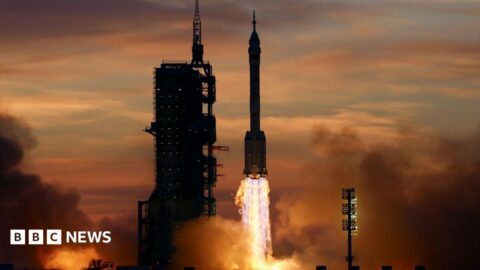
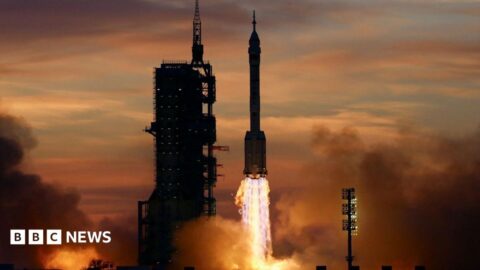
Dimorphos asteroid images, Digimart Global: Four years after NASA deliberately slammed a spacecraft into Dimorphos, a roughly 160-metre-wide asteroid, scientists are preparing to release the first closeup images of the aftermath. The pictures were captured by the European Space Agency’s (ESA) Hera spacecraft, according to The Guardian’s report.
NASA’s Double Asteroid Redirection Test (Dart) mission was designed to test a planetary defence system that could deflect an asteroid or comet threatening Earth. Neither Dimorphos nor its larger companion, Didymos, posed such a threat, but their orbits offered a practical way to assess whether the strategy could work.
On 26 September 2022, the roughly half-tonne Dart spacecraft struck Dimorphos at more than 13,000mph, sending a large cloud of rocky debris into space.
Earth-based telescopes showed the mission shortened the time Dimorphos takes to orbit Didymos by about 33 minutes. Before the collision, NASA officials had said a change of 73 seconds or more would count as a success.
However, how much of the asteroid was displaced and how it responded to the impact have remained open questions.
To investigate further, ESA launched Hera on 7 October 2024. After a two-year journey, the car-sized spacecraft reached the asteroid pair this month and has been surveying them from a distance of 15 to 18 miles (25 to 30km). The Guardian reports that computer simulations published in 2024 suggested Dart may have reshaped the entire asteroid rather than excavating a large crater.
What the images could reveal
Dr Ian Whittaker, a senior lecturer in physics at Nottingham Trent University, said the images should help show whether any Dart material remains on the surface or whether the debris mostly came from the impact. Hera’s instruments will also allow scientists to examine the height of surface features, including the smooth areas, equatorial ridge and boulder-like shapes the original Dimorphos had.
Next steps for the mission
Over the coming months, Hera will move progressively closer to the asteroids and deploy two shoebox-sized satellites, one of which will use radar to look inside Dimorphos. The wider aim is to turn asteroid deflection from a single successful experiment into a reliable method of planetary defence.
Whittaker noted that the effect of an impact also depends on how the asteroid responds, including how much material is blasted into space.