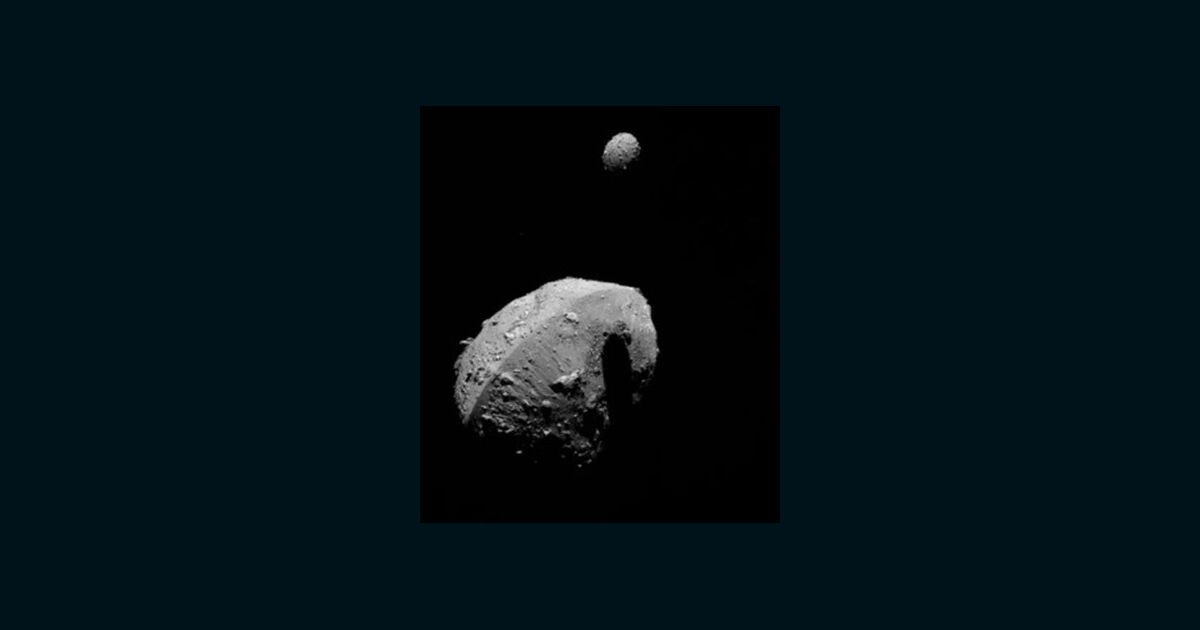
Hera Didymos asteroid eclipse, Digimart Global: An early view from the European Space Agency’s Hera mission shows a solar eclipse in deep space, with the smaller moon Dimorphos blocking the Sun across part of the rocky surface of its parent body, Didymos.
According to the ESA, the image was acquired by Hera’s monochrome Asteroid Framing Camera, which is used for both navigation and science imaging. Patrick Michel, Hera Principal Investigator and Director of Research at CNRS / Observatoire de la Côte d’Azur, said that eclipses similar to Earth’s total solar eclipse also occur on asteroids that have a small moon.
How the eclipse works
Michel noted that Didymos and Dimorphos follow the same celestial mechanics as Earth and the Moon, but at a much smaller scale and lower gravity. He said that a person standing on Didymos could in principle experience a similar eclipse, though in practice this would be very difficult because the asteroid’s gravity is so low and it spins very quickly.
The moonlet orbits roughly one kilometre from Didymos, which explains why its shadow falls so clearly across the parent body. The ESA said Dimorphos is 151 metres across, about the same size as the Great Pyramid of Giza, while Didymos has a diameter of 730 metres, slightly smaller than Dubai’s Burj Khalifa.
Because of their small masses, the ESA said Dimorphos has gravity around 40,000 times weaker than Earth’s, while Didymos has gravity about 200,000 times weaker.
Background to the mission
In 2022, NASA’s DART spacecraft struck Dimorphos to change its orbit around Didymos. The ESA’s Hera mission has now arrived to conduct a close-up investigation of the binary system, with the aim of gathering data to help turn that test into a well-understood and potentially repeatable planetary defence technique.
Livestream of first close-up images
The ESA said the Hera team will share the first close-up images of the asteroid system during a livestream starting from 19:45 CET on Wednesday 25 November. The broadcast can be followed on ESA WebTV or the ESA YouTube channel.