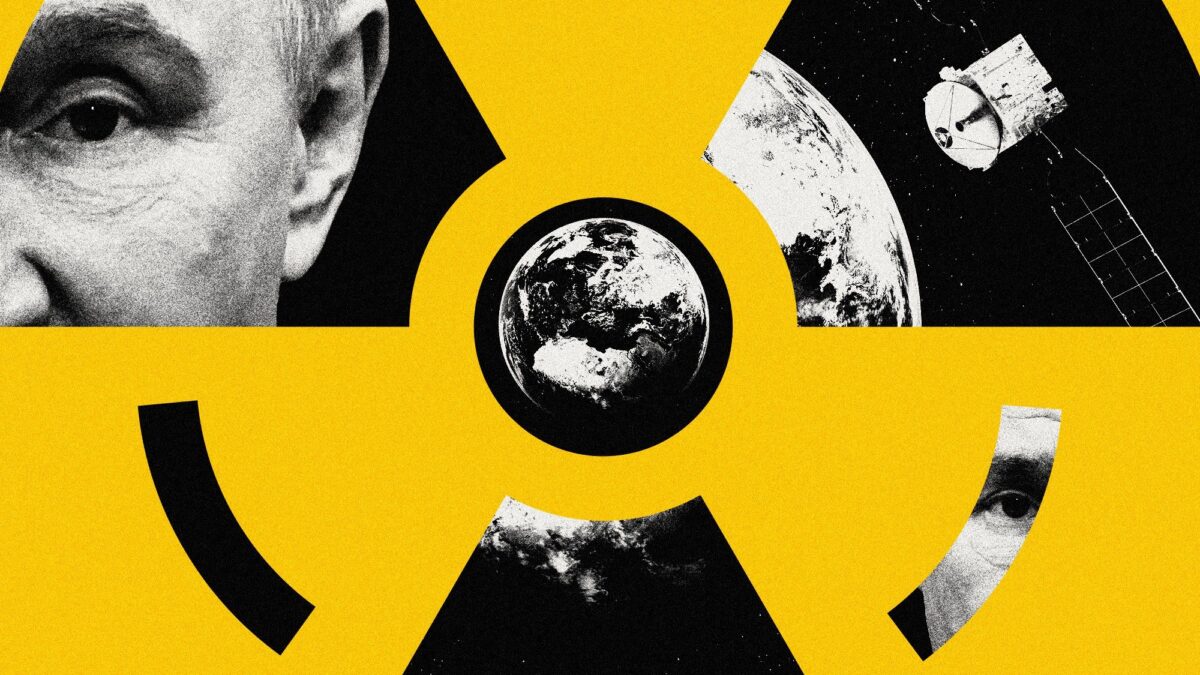
Russia nuclear space weapon, Digimart Global: Reports that Russia may be preparing to place a nuclear weapon in orbit have prompted discussion in Nato circles this week. According to The Telegraph, BND, Germany’s spy agency, has reportedly established that Russia has assembled a nuclear-armed satellite, Sputnik-S, and is nearly ready for launch.
A joint investigation by several German media outlets, which reported the BND’s warning, said the satellite could be launched within 60 days. Nuclear experts are sceptical about the claims, but Western leaders are taking them seriously, underlining how space could become a new frontier in the wider Cold War.
Why a nuclear blast in space is so damaging
Nuclear detonations, whether launched from Earth or set off on satellites, can severely damage critical infrastructure. In the early 1960s, the United States observed this during the Starfish Prime test south-west of Hawaii, the largest high-altitude test of its kind.
The detonation at around 400km crippled a third of the world’s satellites and knocked out 300 street lights on Hawaii.
A recent study by the universities of Wisconsin-Madison and Princeton found that a nuclear blast in space could cripple most of the 16,000 satellites in low Earth orbit. The scenario modelled a bomb detonated 500km above Earth, releasing energetic electrons that become trapped in the planet’s magnetic field.
The initial blast would disable around 3 per cent of low-orbit satellites, while repeated exposure could disable nearly all, 98 per cent, within a week.
Expert scepticism about the plan
Dr Bleddyn Bowen, an associate professor of astropolitics at Durham University and a nuclear weapons specialist, told The Telegraph that there is little detail about what Russia plans. He noted that stationing a nuclear weapon in orbit would make it as vulnerable as the satellites it targets, and that a warhead kept on Earth could achieve the same effect with an existing missile.
Dr Bowen also said that an EMP from a space detonation would not spare Russia or China, and that such an attack would risk a wider nuclear response. He added that the plan would appear to breach the 1967 Outer Space Treaty and the 1963 Partial Nuclear Test Ban Treaty, both of which forbid nuclear weapons in space.
He suggested Moscow may be engaging in typical sabre-rattling.