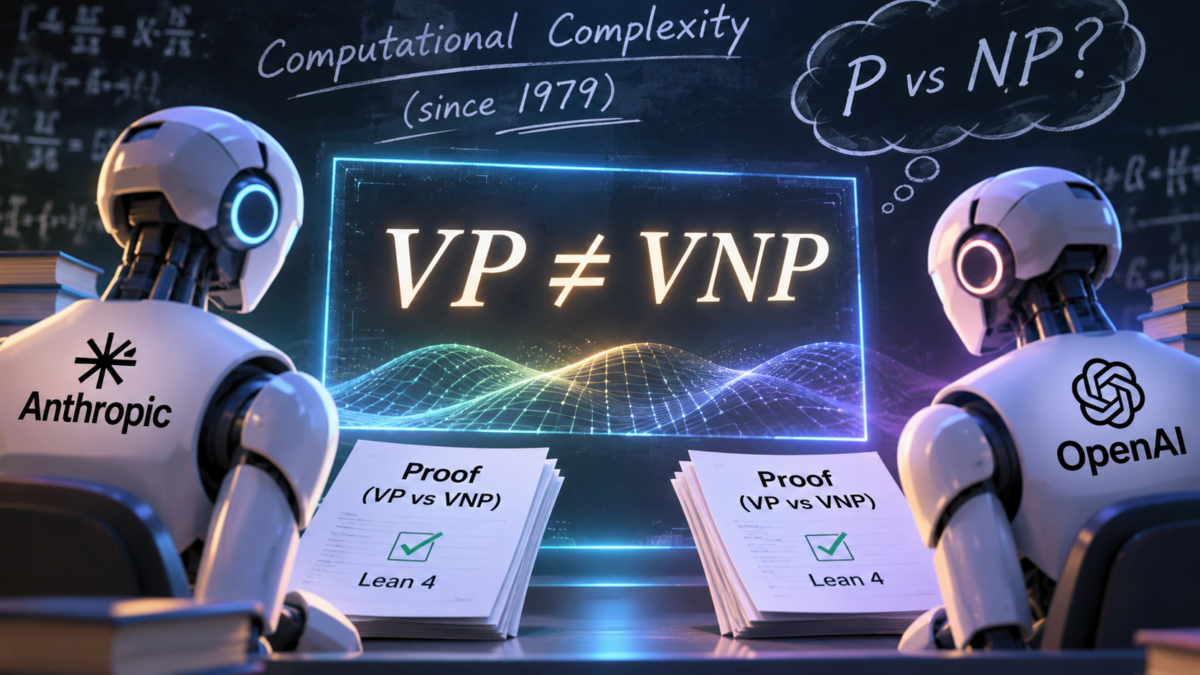
VP versus VNP problem, Digimart Global: Anthropic and OpenAI have independently released mathematical proofs addressing the same long-standing problem in computational complexity theory, a development that could mark a notable milestone for AI-assisted research. The problem was introduced by mathematician Leslie Valiant in 1979.
Anthropic published its findings on GitHub, reporting a proof that VNP is not contained within VP. The work was produced by an internal research version of its Claude AI model, which also wrote the accompanying paper and a formal verification of the proof.
The proof was formalized in Lean 4, a programming language designed for mathematical verification. Anthropic acknowledged that no human mathematician had yet reviewed the proof.
How the two submissions compare
OpenAI published its own paper on the same problem on GitHub later the same day, also including a Lean 4 formalization. The two proofs differ in several important respects, according to the publisher’s account.
Upload timestamps show Anthropic’s submission appeared about six hours before OpenAI’s.
Both papers argue that VP is not equal to the broader class VNP. They approach the problem differently, but both claim to establish that certain mathematical computations cannot be performed efficiently using relatively small arithmetic circuits.
The formal proofs allow the logical steps to be checked, although the mathematical claims still require independent scrutiny.
Why the problem matters
The goal of this line of research is to show that some computational problems are intrinsically harder than others and cannot be solved efficiently, regardless of how clever an algorithm might be. Proving a problem is intrinsically hard is considerably more difficult than showing it can be solved quickly, because it requires demonstrating that no sufficiently efficient algorithm exists.
VP versus VNP is an algebraic counterpart to the better-known P versus NP problem. Both concern the difficulty of solving computational problems, but VP and VNP describe complexity classes involving computations over polynomials rather than conventional binary logic.
P versus NP asks whether every problem whose solution can be checked efficiently can also be solved efficiently, and a proof either way would have far-reaching implications for computing, optimisation and cryptography. VP versus VNP is a more structured related problem that could help mathematicians develop new techniques.
Expert reaction
Tom Gur of the University of Cambridge described the progress as unprecedented, saying that decades of mathematical work appeared to have advanced within days. He also stressed that the mathematical community needs more time to study the proofs and determine how broadly their techniques can be applied.
Varun Kanade of the University of Oxford believes the results could bring researchers closer to solving P versus NP, but says new techniques will probably still be necessary. Ben Livshits of Imperial College London noted that the rapid progress raises broader questions about the future of theoretical computer science and the role of AI in mathematical research.
The announcements follow other recent claims of major AI-linked mathematical breakthroughs, including a reported proof of the Riemann hypothesis. Independent verification will be essential before these results can be considered established.